Two candidates read the same People scenario and pick different answers, and both can explain their choice. Often the split is a vocabulary problem: they filed the situation under different tasks.
Why do People domain terms get mixed up?
People carries 33% of the 2026 PMP exam and holds 8 tasks. Four of those tasks are about stakeholders, and their names overlap: engage, align, manage expectations, and plan and manage communication. In a real project office nobody labels the work that carefully. A project manager who calls a one-hour talk with the sponsor “stakeholder management” is not wrong on a Tuesday afternoon.
The exam is stricter. PMI’s July 2026 outline gives each task its own list of work, and a scenario is written to sit under one of them. If you can tell which list the stem describes, two of the four options usually drop away.
 PMP Risk Management Explained: Register, Responses, Reserves and Risk vs Issue (2026 Exam) Watch on YouTube · CertCrafter
The same habit of precise terms helps in other domains. The channel’s video on risk versus issue covers a pair that trips people in the same way.
Align or manage: what is the difference between Tasks 5 and 6?
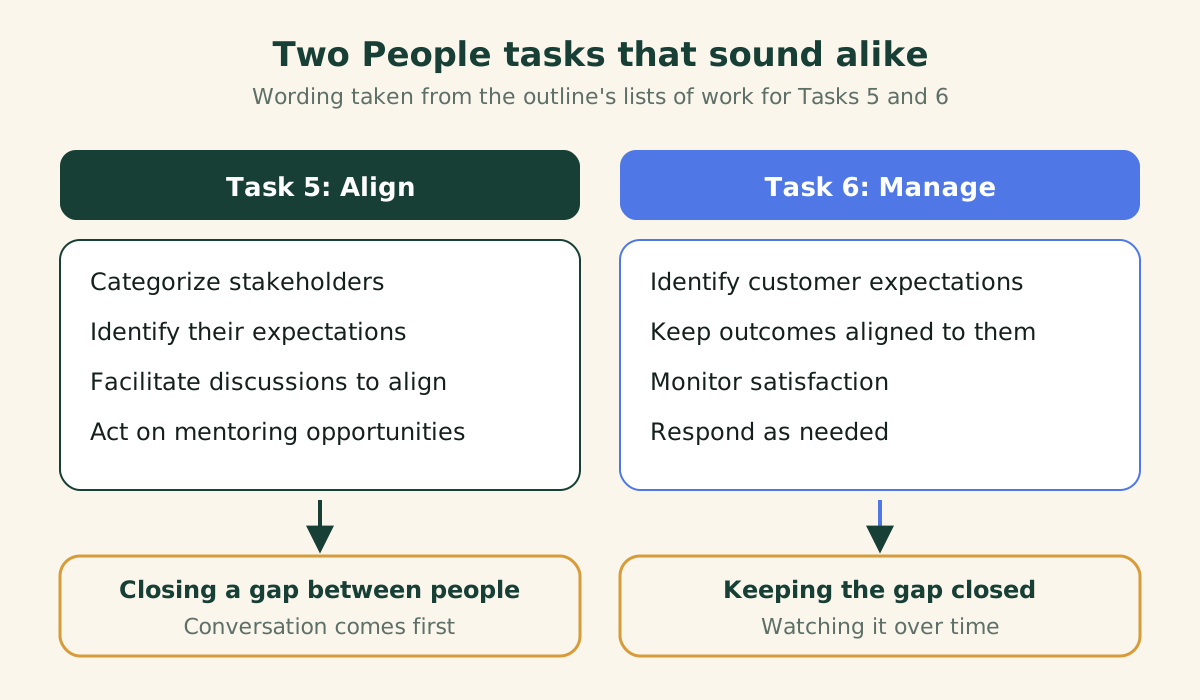
This is the pair candidates mix up most. Both mention expectations, and both are about stakeholders and customers.
Task 5, align stakeholder expectations, lists four pieces of work: categorize stakeholders, identify their expectations, facilitate discussions to align those expectations, and act on mentoring opportunities. The verb is about getting people to agree. Two groups want different things, so someone has to get them into one room.
Task 6, manage stakeholder expectations, lists three: identify internal and external customer expectations, align and maintain outcomes to those expectations, and monitor satisfaction and respond as needed. The verb is about keeping a position that already exists.
On site, the difference is timing. Align is the kickoff conversation where operations says the system must run overnight and finance says the budget only covers daytime batches. Manage is month nine, when the overnight requirement is agreed but a vendor change puts it at risk and somebody has to notice before the customer does.
Which other pairs get confused?
Five pairs cause most of the damage. The outline’s own wording is the tie-breaker.
| Pair | What separates them in the outline |
|---|---|
| Engage stakeholders vs communicate | Engage includes analyzing stakeholders and building trust. Communication is a strategy, a feedback loop and reports. |
| Vision vs ground rules | Vision is a shared picture of the project, kept current. Ground rules are team behavior, with violations managed. |
| Identify vs analyze stakeholders | Both sit under Task 4. Identifying finds them. Analyzing works out where they stand. |
| Lead vs empower the team | Both sit under Task 3. Leading includes setting expectations and choosing a style. Empowering is one piece of it. |
| Knowledge transfer vs communication | Transfer is identifying, gathering and fostering. Communication is about reporting and feedback. |
Look at the third row. Identify and analyze are separate steps for a reason. A register full of names is identification. It says nothing about who will fight the plan.
How do engagement and communication differ on a real project?
Engage stakeholders lists six pieces of work, and communication appears inside it only as tailoring: analyze and tailor communication to stakeholder needs. Task 8 lists six more, and the first is defining a communication strategy.
In practice, engagement is the relationship and communication is the channel. A weekly status email to forty people is communication, and it can run for a year while the head of operations stops attending design sessions. The email never failed. The engagement did.
This is why the order matters in scenarios. If the stem says a stakeholder has gone quiet, a better report does not fix it. Analyzing where that person stands, and what they need to hear, comes first.
Worked example: which task is the question really about?
Say a stem tells you the project sponsor expects a live dashboard, the operations team expects a monthly summary, and the project manager has been sending both a weekly email. The sponsor has complained that she can’t see risk.
- Strip out the symptom. The complaint is about visibility, but the cause is that two groups expect different things.
- Ask which task lists that cause. Identifying and discussing differing expectations is Task 5, align.
- Check that no option jumps ahead. Redesigning the weekly report belongs to communication (Task 8), and it only works once the expectations are agreed.
- Pick the option that gets both groups into one conversation about what each needs.
Step 2 is the whole skill. The report is the visible problem, but the first move sits one task earlier.
The PMP Complete Exam Kit works more of these under timed conditions, with every answer explained.
What do the figures say about where the terms pile up?
Four of the eight tasks carry six or seven pieces of listed work each, which is where most scenarios find their detail.
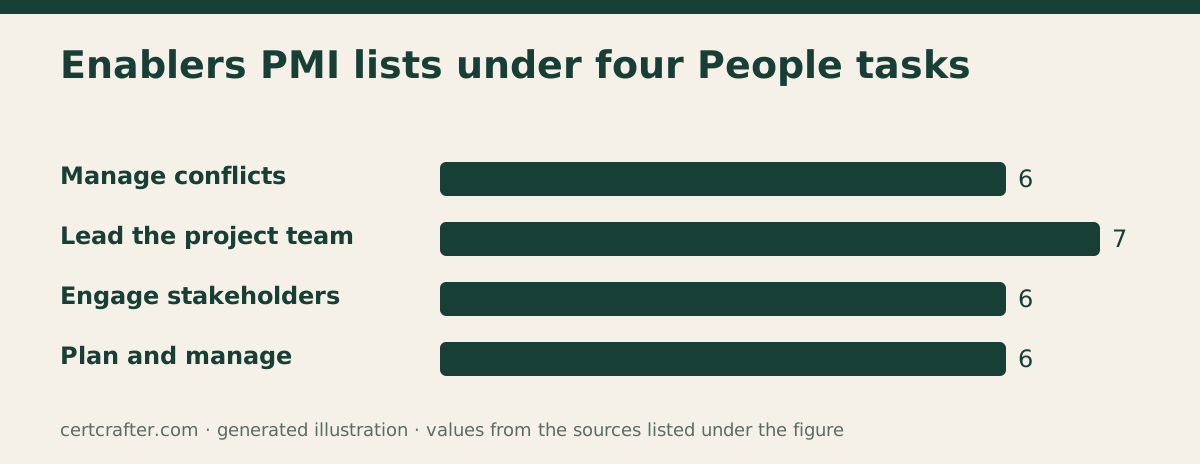
Long lists give question writers plenty of ground to build a plausible wrong option from a neighboring task. Short ones, like managing expectations at three items, are easier to separate because the work is narrow.
What do candidates get wrong on these terms in the exam?
They answer from the nearest familiar word. “Communication” sounds safe, so a candidate picks the option that sends a report, even when the stem describes a stakeholder nobody has analyzed.
They also treat the two expectation tasks as one. If the gap between two groups is still open, the answer is about facilitating a discussion. If the gap closed months ago and has reopened, the answer is about monitoring and responding.
Last, they read “conflict” as a People problem whenever people are involved. A clash over a missed rule is a ground rule violation to manage. A clash over what the project is for is a vision problem. Same room, different task.
Before you choose, name the task, then name its verb. That takes ten seconds and removes most of the doubt.
What should you do next?
Take the free sample quiz and, for each wrong People answer, write down which task you thought it was and which it was. Then read the full tour of the domain in what the People domain tests and the field mistakes in PMP common mistakes. The PMP 2026 certification page, the practice test bundle and the PMP guides hub have the rest.
Comments
Comments are read by a person before they appear. How we moderate.