Plenty of PMP candidates know the content and still lose time on the day, because they never planned how 240 minutes meet 180 questions and two locked breaks.
What does the PMP 2026 exam look like?
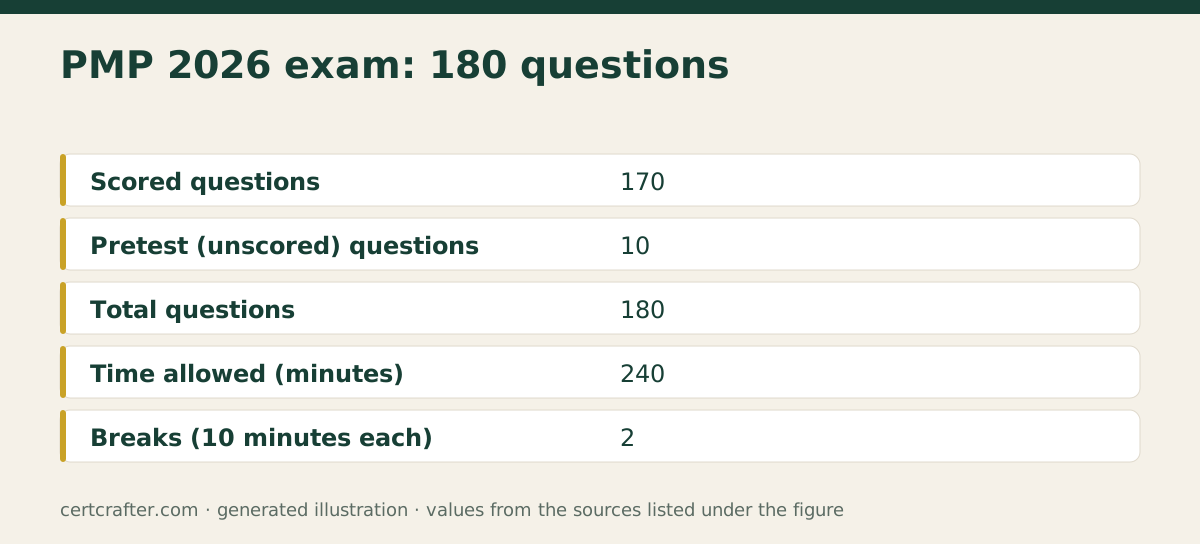
PMI’s July 2026 outline states it plainly. The exam has 180 questions. Of those, 170 are scored and 10 are pretest. You get 240 minutes. The tutorial before the exam and the survey after it are optional, and neither eats into the 240.
That is under a minute and a half a question if you spread the time evenly. You won’t, because a case with several questions behind it takes longer than a single-answer item. Still, the average is a useful number to carry. If one item runs far past it, you are paying for that somewhere else.
Which question types will you meet?
The outline names the types, and it adds that the exam is not limited to them. Multiple choice with one answer. Multiple response, where more than one option is right. Case or scenario questions, marked new, where you read a detailed situation, sometimes with charts, and then answer a series of questions on it. Graphic-based questions, also marked new, where you must read a chart, graph or diagram first.
The center-based exam adds four more: enhanced matching, plain matching, point and click, and the pull-down list. The outline marks several of these as available only in a testing center, so check which delivery you chose.
Why does this matter beyond the exam? On a real project you rarely get a clean multiple-choice question. You get a status chart, an email thread and a sponsor’s remark, and you decide. The case and graphic formats copy that. Read the exhibit first, then the question.
 PMP 2026 — PMP or CAPM first? Watch on YouTube · CertCrafter
If you are still deciding between PMP and CAPM, the channel has a short, PMP 2026: PMP or CAPM first?, and the PMP vs CAPM guide goes through it in more detail.
How are the breaks and sections ordered?
PMI describes two 10-minute breaks. The first comes after the case-study section. The second comes approximately midway through the independent question portion. Once you review your responses and start a break, you cannot return to the earlier section.
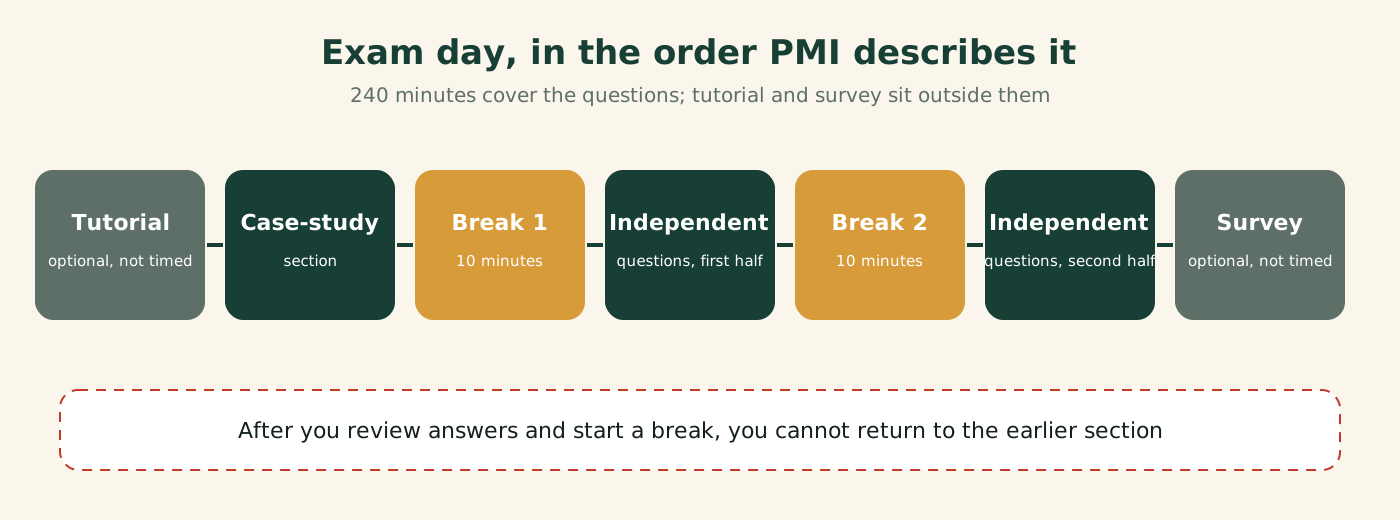
This is a gate, the same idea as a stage gate on a capital project. Work that goes through the gate is closed. So flag nothing for later across a break, and finish your review of a section before you press the button.
Online proctored candidates should read PMI’s online-testing section, which treats breaks separately. The outline also says you may be asked to show identification to the proctor after a break.
How is the PMP exam scored?
Here the outline gives you less than people hope. It says pretest questions do not affect the score and are used to test the validity of future questions. It says all questions are placed randomly. It does not publish a passing mark, so this post doesn’t quote one. Treat any pass-mark figure you see on a forum as unverified.
Pretest items change how you should behave. You can’t spot them, so you can’t skip them. Answer every question as if it counts. It is also why a strange, badly worded item is no reason to panic: it may be one of the ten.
Worked example: a pacing plan for 240 minutes
Use PMI’s numbers and your own habits.
- Divide the time: 240 minutes over 180 questions, with the breaks held outside the 240. Work out your own per-question average.
- Set a checkpoint at each break. When you reach the first break, note how far through the clock you are and compare it with how far through the questions you are.
- Decide your cap in advance: if an item runs well past your average, choose your best answer, flag it and move on, but only within the current section.
The cap is a habit you build in practice, not a rule from PMI. Try it on timed sets before the real day.

What about dates, eligibility and retakes?
The outline is dated July 2026, and the weights it carries are People 33%, Process 41% and Business Environment 26%. The what changed post covers how they moved. This post does not list exam dates because PMI schedules through its testing partner and the outline gives no fixed calendar. Book through PMI and the testing provider named in the outline.
Before you book you must apply and be accepted. The outline lists education and experience paths, and all project management experience must fall within the last 10 years. You also need at least 35 hours of commercial training aligned with the outline. Applications can be audited, so keep your documents.
On retakes, PMI allows up to three attempts within the one-year eligibility period. After three, you wait one year from the last exam. If the year passes without a pass, you must reapply, even if you sat fewer than three times. Read the PMI Certification Handbook before you pay, because those rules are PMI’s to change.
How do you use all this in practice?
Match your preparation to the format. The common mistakes guide shows where candidates drop marks on scenario items. Practice with mixed formats, not only single-answer questions. The PMP Complete Exam Kit works through timed sets with every answer explained, though its own practice questions use four options with one answer, so you must prepare for matching and graphics from the outline’s descriptions.
Try the free sample quiz to time yourself on a few questions, and the practice test bundle when you want the full set. The PMP guides hub lists the rest. Your next step: run one timed block of mixed questions and compare your pace with the average you worked out.
Comments
Comments are read by a person before they appear. How we moderate.