Most people who get stuck on the PMP application are not short of experience. They count it wrong, or they try to use a book as training hours.
Who is eligible for the PMP in 2026?
You have to apply before you can sit the exam. PMI’s July 2026 outline says candidates must meet one of the education and experience paths it lists. The experience must have been gained in the last 10 years, in a professional setting, before you submit.
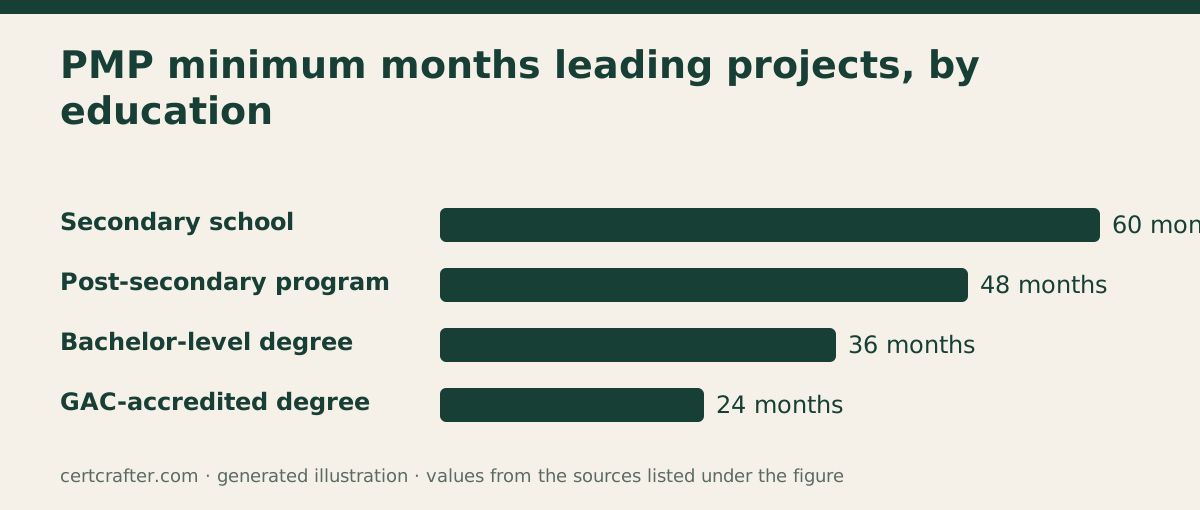
The outline sets four tiers. The less formal education you hold, the more months you need.
| Education | Minimum months leading projects |
|---|---|
| Upper-secondary school (EQF Level 4) | 60 months (5 years) |
| Post-secondary program (EQF Level 5) | 48 months (4 years) |
| Bachelor-level qualification (EQF Level 6) | 36 months (3 years) |
| Degree from a GAC-accredited program | 24 months (2 years) |
The months must be non-overlapping. PMI also notes that GAC accreditation is a program quality designation and does not, by itself, change the degree level required.
What counts as project experience?
The outline wants experience leading and directing projects. It does not have to be paid work, but it has to be in a professional setting. School projects, academic research for a degree, planning personal events and home improvement do not qualify. Routine, operational or administrative tasks should stay out of your entries.
On a real site this is where people trip. An engineer who spent four years doing maintenance work on a plant did real work, but if the job was running a routine, it is not a project. The shutdown she planned and led, with a start, an end and a goal, is.
The outline defines a project as a temporary initiative in a unique context, undertaken to create value. Write each entry so that reading it, a reviewer can see the beginning, the end and your lead role.
 PMP 2026 — PMP or CAPM first? Watch on YouTube · CertCrafter
If you are weighing the entry-level route instead, the channel has a short video, PMP 2026: PMP or CAPM first?, and the written version is PMP vs CAPM.
How do you count months of experience?
Tenure is tracked in months, not in the number of projects. Six months of experience is six months whether you led one project or three in that time.
Worked example: two overlapping projects
PMI gives this case in the outline.
- Project I runs from 1 January to 31 March. That is three months.
- Project II runs from 1 February to 31 May. Only the months after Project I ends add something new, which PMI counts as two months.
- The time you led both at once cannot be counted twice. Together they equal five months, 1 January to 31 May.
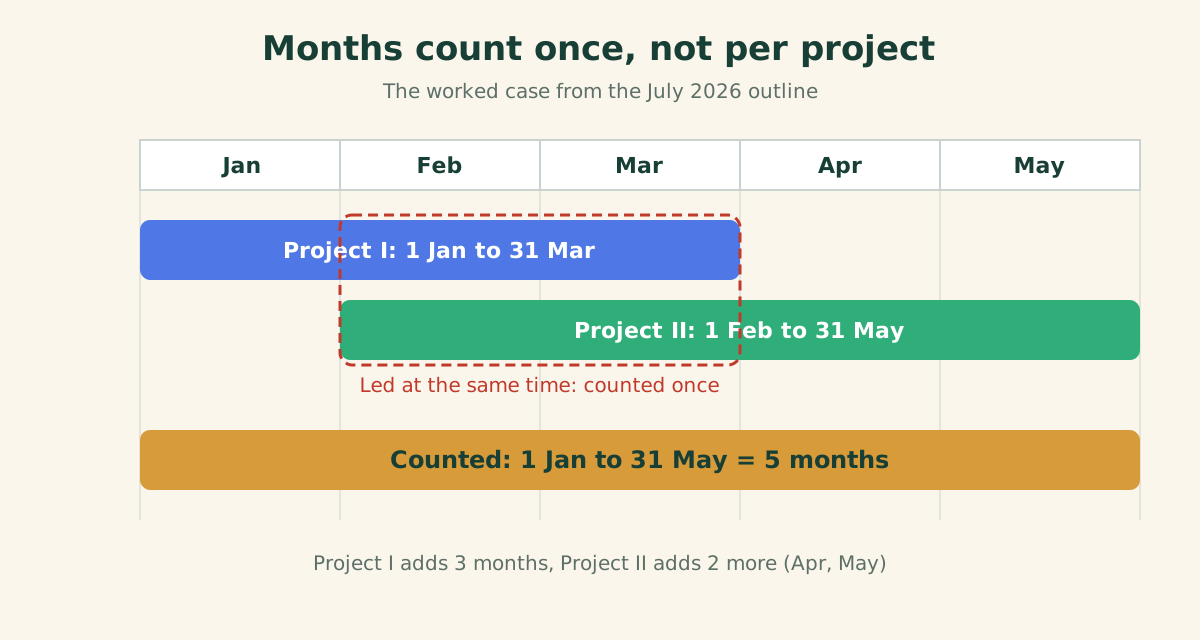
The mistake is adding 3 and 4 and claiming seven. On a portfolio of parallel projects the count is the calendar span you were leading something, not the sum of the project lengths.
What are the 35 hours of training?
On top of the months, you need at least 35 hours of commercial training in project management, aligned with topics in the exam content outline. The outline lists the providers that can supply it, including PMI Authorized Training Partners, courses from accredited higher education institutions, employer-sponsored programs, training companies and self-paced on-demand courses that include an end-of-course assessment.
Training is not tied to one format or provider. But all of it is subject to audit, and PMI may disqualify training it finds to be of poor quality. Books and practice exams alone are not accepted.
One classroom hour equals one training hour. A university course that met 3 hours a week for 15 weeks would be 45 hours. If only part of a course dealt with project management, only those hours count.
The PMP Complete Exam Kit is practice material. It is useful for drilling, but PMI is explicit that practice exams alone are not training hours, so book a course for the 35.
Can a CAPM replace the training hours?
Yes, in part. If you hold an active CAPM and have met the education and experience requirements, you do not need to document the 35 hours. PMI waives the requirement and counts the CAPM as a 35-hour credit. A graduate of a GAC-accredited degree program can also count the GAC coursework toward the 35 hours.
What happens if your application is audited?
If your application is selected for an audit, you must provide documents that verify your education level and its authenticity. A credential that does not state a framework level needs one of three things: a link or extract from a national qualifications register, a statement from the awarding body or ministry confirming the level, or a formal evaluation by a recognized national body.
In practice, keep your diploma, the course certificates and a contact for each project manager or sponsor before you start filling in the form. Chasing a certificate from a school abroad after an audit notice is slow.
How does eligibility show up in the exam?
It doesn’t, directly. No question asks you how many months you need. What the application does test is whether you think like someone who has led projects, and the exam is scenario-based for the same reason. The outline says candidates apply project management concepts and their own experience to on-the-job situations.
So the entries you write are good rehearsal. For each project, write down the goal, who the stakeholders were, one risk that turned into an issue and what you did. Those are the situations the questions describe.
Once you are accepted, the outline says you may take the exam up to three times within your 1-year eligibility period. After three attempts you wait 1 year from the date of the last exam before you reapply. Read the PMI Certification Handbook before you pay, because PMI can change these rules.
What to do next
Count your months on a calendar first, tier by tier, before you touch the application. Then check your 35 hours against the provider list. Start from the PMP 2026 certification page, try the free sample quiz, and see the PMP guides hub for the exam format and domain posts. The practice test bundle is there when you are ready to drill.
Comments
Comments are read by a person before they appear. How we moderate.