Candidates call Orientation the easy 5% of the exam and read the number as an angle. Then a perpendicularity frame shows up with a linear value, and the mark goes.
What is an orientation tolerance, in plain terms?
An orientation tolerance limits how far a feature may tilt from a datum. It does not say where the feature sits, and it does not say how wavy it is, although it ends up limiting waviness as a side effect.
Take a mounting block with a large base and a machined end face. The designer wants that end face square to the base, so a bracket bolts on without rocking. The frame says the end face must stay within a set distance of perfect squareness to the base. That is orientation.
ASME describes the work as applying form controls, orientation controls and location controls, and the Technologist level tests reading and interpreting drawings. You are handed a callout and asked what it requires, not asked to invent one.
How much of the exam is orientation, and why can it still fail you?
ASME publishes section weights. Orientation is 5% of the 150 questions, the same as Form and Runout.
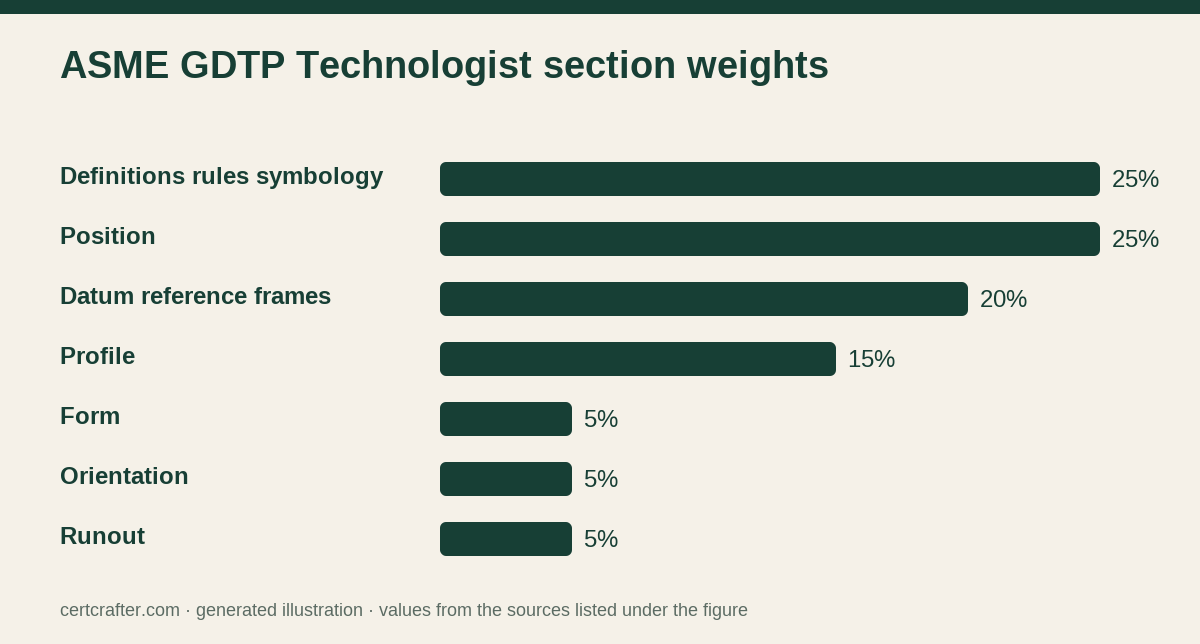
The pass rule is 74% overall and at least 50% in each section. Orientation is a few questions, so missing a handful puts you under 50% and a strong score elsewhere does not rescue you. Treat the small sections as a floor.
Our short video on the Technologist exam in sixty seconds covers the pass rule in one pass.
 ASME GDTP — The ASME GDTP Technologist exam in sixty seconds. Watch on YouTube · CertCrafter
What does the zone look like, and why is it not an angle?
The zone is the whole point. For a plane surface, an orientation control creates two parallel planes, a tolerance value apart, held at the stated angle to the datum. Every point of the toleranced face must lie between them.
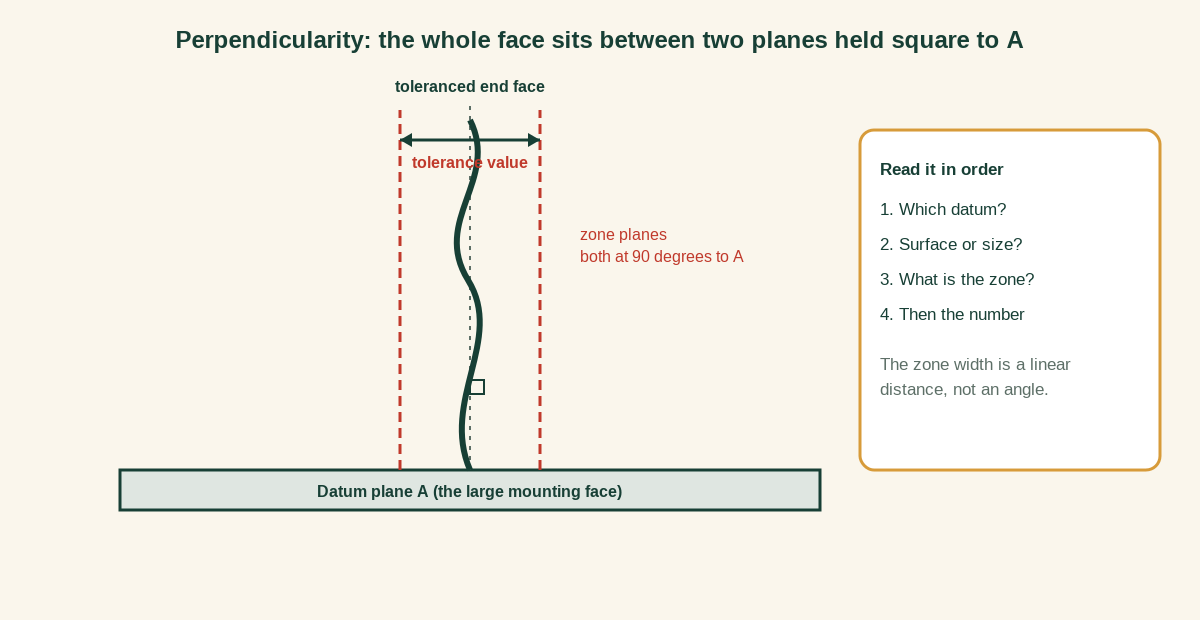
Because the width is a distance, the angle it allows depends on the length of the face. A long face allows a smaller angle than a short one for the same value. Option writers know this, and one wrong answer on nearly every orientation question reads the number as degrees.
Worked example: reading one perpendicularity frame
Here is the case from our free sample set, worked once. An end face on a hydraulic manifold carries a small perpendicularity value to datum A, the large mounting face. Step by step: find datum A, see that the frame sits on the surface, then read the zone. The correct reading is that every point of the end face lies between two parallel planes, the stated value apart, both exactly square to A. The wrong readings are the tempting ones: that only the high points count, that the value is an angle, or that the zone sits on a median plane. That last one is right only when the frame is attached to a size dimension, not to a surface.
The ASME GDTP Complete Exam Kit works more of these under timed conditions, with every answer explained.
How do orientation controls show up on a real job?
On a shop floor, orientation matters wherever a part has to seat against another. A bearing housing bore that must be square to its mounting face. A valve body flange. A locating slot that has to run parallel to a reference edge.
Inspection is where people slip. The operator sets the part on the datum feature, then checks the toleranced face against the zone. Two field errors come up. One is quoting the largest single deviation and calling the face good, when the whole face has to sit between the planes. The other is forgetting that the datum has to be set properly first, because a rocking datum gives a different answer every time the part is picked up.
There is also a side effect worth knowing, and it explains why a tight orientation value often drives the machining method, not just the inspection. Because the whole face must fit in the gap, an orientation tolerance also limits the form of that face. A face that wanders more than the tolerance cannot be squeezed into the gap however it is tilted.
Where does the exam trip people on orientation?
The trap is the placement of the frame, as it is in form. Attached to a surface, the zone is two parallel planes holding the surface. Attached to a size dimension, the same frame controls the derived median plane or axis of the feature of size, not its surface.
The exam likes this because all four options sound plausible. One puts the zone on a median plane when the frame sits on a surface. One reads the value as degrees. One lets low points sag, as if only high points were checked. Read where the frame is attached, then what the datum is, then the number.
Check which exam you booked too. The 78% pass mark found in many places belongs to the Y14.5-2009 exam, and the 2018 Technologist exam is passed at 74% overall.
How should you study Section 9 in a week?
Keep it short and specific. The aim is a fixed routine, not a pile of notes. Take the habit of reading the frame in the same order each time: datum, surface or size, zone, then the number. Say the zone out loud for a plane surface and for a feature of size until it stops feeling like a trick.
Then spend your real time on the large sections, since Orientation is only 5%, and return to it only to protect the 50% floor. A last pass through the free ASME GDTP quiz shows whether the habit holds under a clock. The GDTP guides hub has the sibling posts on datums and form tolerances.
Comments
Comments are read by a person before they appear. How we moderate.