Most candidates plan for the 74% and forget the other half of the scoring rule. They also miss that ASME runs several clocks, and one of them can cost you the fee.
What is the format of the ASME GDTP Technologist exam?
ASME describes the Y14.5-2018 Technologist exam as 150 scored multiple choice questions, a maximum of 4 hours, closed book. You sit it at a Prometric Testing Center. The standard itself is not allowed in the room, so everything comes from working knowledge.
That is a little over a minute and a half per question, which sounds comfortable. It stops being comfortable on a datum or position question where you have to sketch the frame in your head before you can read the options.
The level tests reading and interpreting drawings made to Y14.5-2018. ASME sets no experience requirement for it. Selecting controls and datum features is the Senior skill, and the Senior level asks for three years (36 months) of documented GD&T experience.
Our sixty second video on the Technologist exam covers the same format in short form.
 ASME GDTP — The ASME GDTP Technologist exam in sixty seconds. Watch on YouTube · CertCrafter
How is the exam scored, and what is the second rule?
Two conditions must both be met. The overall score must be at least 74%, and the score in each section must be at least 50%.
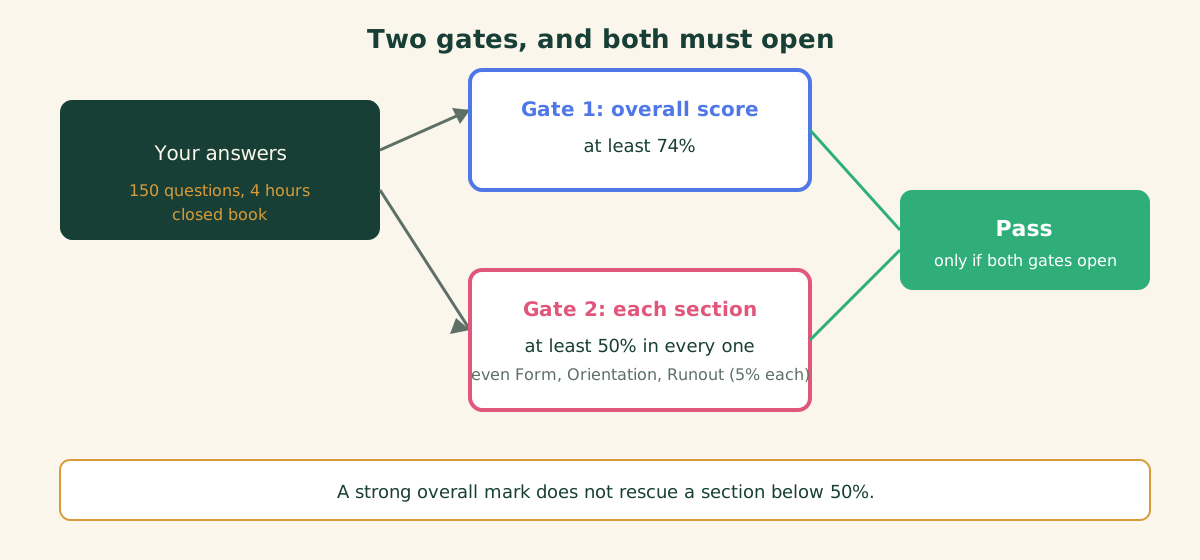
The second gate is the one that surprises people. Three sections carry only 5% each, Form, Orientation and Runout. They are small, and it is tempting to write them off. If you do, a weak mark in one of them fails you even when your total clears 74%.
Worked example: checking a score against both rules
A candidate finishes with an overall score of 78%, and in one small section scores 25%.
- Overall: 78% is above 74%, so gate one opens.
- Section check: the small section is at 25%, below the 50% floor, so gate two stays shut.
- Result: not a pass, despite the strong total.
- Fix: the next attempt needs that section lifted to 50% or more, which costs only a few correct answers, rather than a general push on everything.
The ASME GDTP Complete Exam Kit reports your score by section, so you can see a weak area before the real exam does.
How is the exam split across sections?
ASME publishes the approximate distribution, which is unusual and useful. Use it to decide where your hours go.
| Section | Share of the exam |
|---|---|
| Sections 3 to 6: definitions, rules, tolerancing, symbology | 25% |
| Section 7: datum reference frames | 20% |
| Section 8: form | 5% |
| Section 9: orientation | 5% |
| Section 10: position | 25% |
| Section 11: profile | 15% |
| Section 12: runout | 5% |
Position and datums are the two biggest single sections after the grouped rules block, and position tolerance zones are located from datums, so the two travel together. Study them as one block of work, and keep a slice of every week for the small sections too. Our posts on datums and on the ten most common mistakes go deeper on those areas.
Where do candidates go wrong on format and scoring?
Three habits show up again and again. Some candidates read the 74% as the whole rule and never check their section marks in practice. Others study from material written for the 2009 edition, which ASME treats as a separate exam. And a few treat the 4 hours as a reason to slow down, then run short on the long drawing questions at the end.
Practice under the real limit. Time yourself on a full set, then look at the section split before you look at the total.
What do the clocks and dates look like from purchase to certificate?
ASME does not publish fixed exam dates for this exam. You book a slot at Prometric once you are accepted, so the dates that matter are the deadlines ASME sets around you.
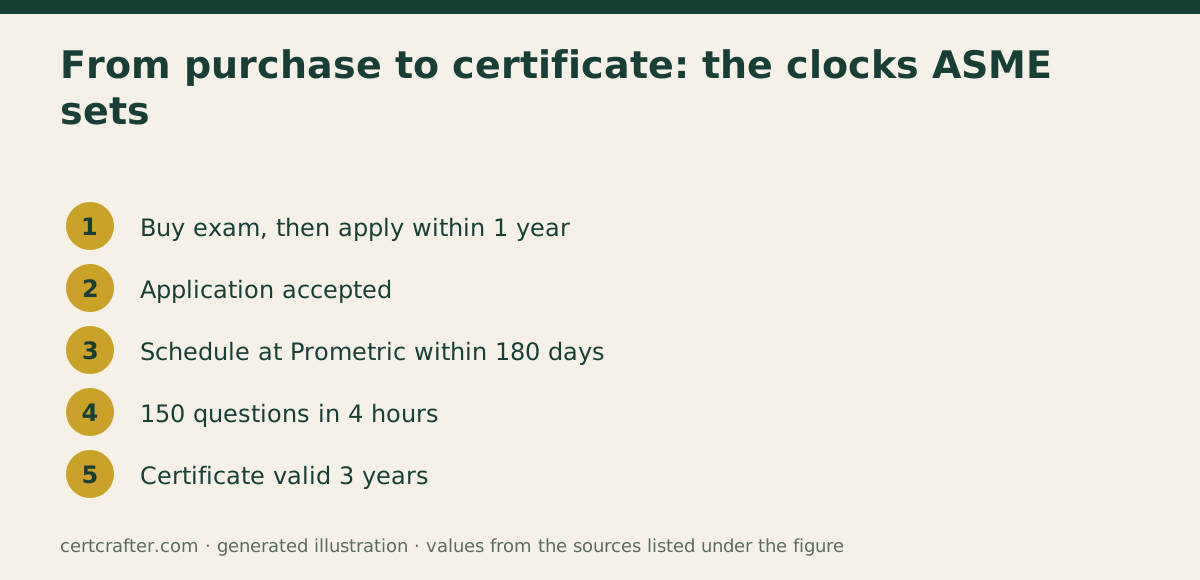
You pay for the exam first, then submit an application through ASME’s PC-Connect system. ASME wants that application within one year of purchase. Once it is accepted you get 180 days to schedule. Miss the window, or break the rescheduling rules, and you pay a reinstatement fee for a fresh 180 days.
Pass and the certificate runs for three years. ASME states a zero tolerance policy on expired certificates, so diarize the renewal early. ASME sends a reminder from six months out.
In industry, training managers often book the exam only after the team has finished a drawing review cycle, so the study time comes from real drawings. A drafter, a CMM programmer and a supplier quality engineer all read the same frame, and the exam checks that you read it the way the standard does. A 180 day clock is generous if you plan it and expensive if you leave an accepted application sitting in a drawer.
What does the exam cost?
ASME lists the 2018 Technologist exam at $395. The Senior exam for 2018 is listed at $495. Fees can change, so confirm the current price on the official page before you buy.
Which edition should you sit?
ASME offers certification on the 2009 or the 2018 revision of Y14.5. Confirm which exam you are registering for, because they are separate exams with separate content, and a certificate names the revision it is based on. Study material for the wrong edition is the quietest way to lose marks.
What should you do next?
For a free first look at the question style, try the sample quiz. The practice test bundle has six full tests with 900 questions, the certification page lists the sections and the guides hub has the rest.
Your next step: write the seven section weights on one card, and mark the three 5% sections in red. Those are the ones to check first on every practice test.
Comments
Comments are read by a person before they appear. How we moderate.