Candidates who know every datum symbol still lose marks here, because a datum question is rarely about the symbol. It asks what the frame does to the part.
What is a datum reference frame, in plain terms?
A part floating in space can move three ways and turn three ways. That is six degrees of freedom. A datum reference frame is the drawing’s instruction for stopping them, so every inspector, machinist and CMM programmer starts measuring from the same place.
The frame is built from datum features on the part itself. A face, a bore or a slot is touched by the real equipment, and the datum is the perfect plane or axis simulated from it. Think of a surface plate under the part, or a gauge pin in a hole.
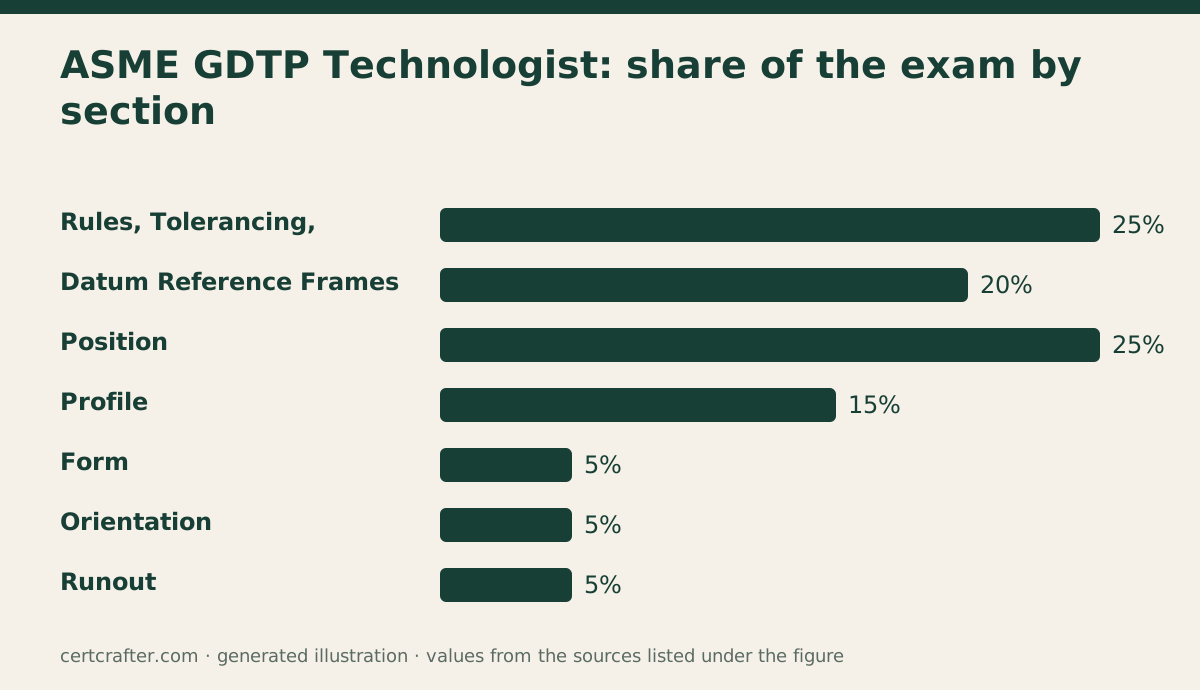
ASME’s Technologist exam gives this section 20%. Position carries 25% and its tolerance zones are located from these datums, so a weak grip on frames drags down two sections at once.
Why does the order of the datums matter?
The feature control frame lists datums left to right as primary, secondary and tertiary. The first one does the most work. Each later datum only controls what the earlier ones left free.
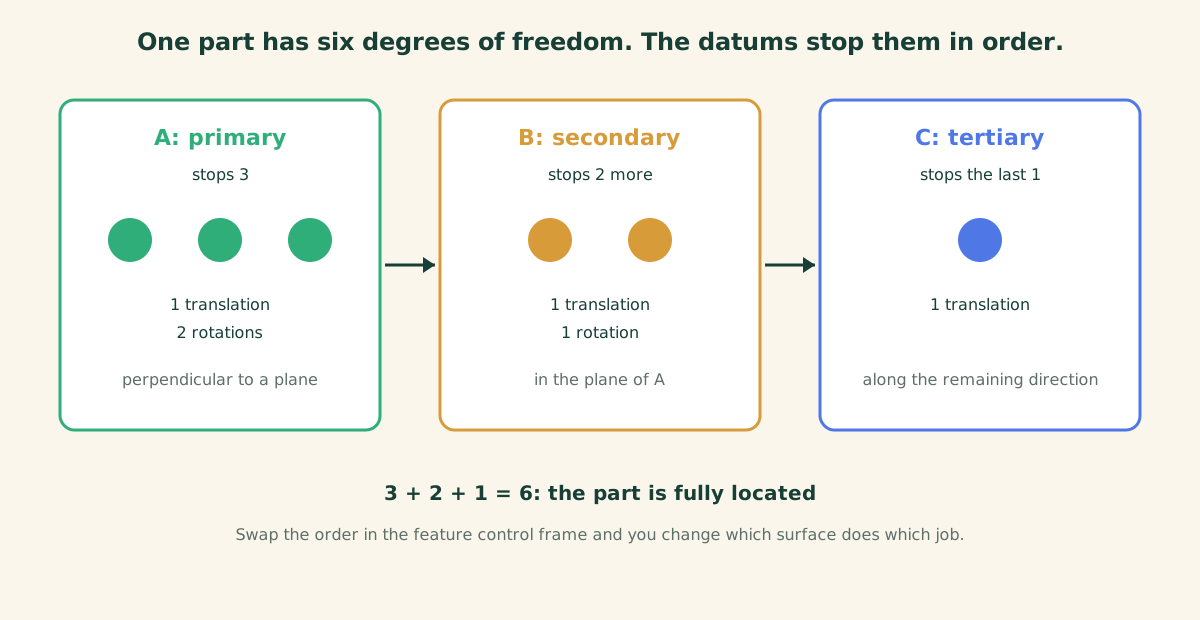
The 3, 2, 1 split is the idea to own. A plane primary datum stops one translation and two rotations. A secondary plane square to it stops one more translation and one more rotation. A tertiary stops the last translation. Six in all, and none is counted twice.
Our video on datum features, reference frames and targets shows the same set-up on a physical part.
 GD&T Datums Explained: Datum Features, Reference Frames and Targets (ASME GDTP Y14.5-2018) Watch on YouTube · CertCrafter
Worked example: counting what is left free
A block carries position | Ø0.5 | A | B on a hole pattern, with A a flat face and B a second face square to A. No tertiary datum is named.
- Datum A is the primary plane. It stops one translation and two rotations: three degrees of freedom.
- Datum B is the secondary plane. It stops one more translation and one more rotation: two degrees of freedom.
- Add them: five of the six are stopped.
- One translation is left free, along the direction that runs parallel to both A and B.
- The pattern may therefore slide along that edge without breaking the callout. If the pattern must also be held in that direction, the drawing needs a third datum.
The ASME GDTP Complete Exam Kit works more frames like this under timed conditions, with every answer explained.
How is a datum frame used on a real job?
In a shop the frame becomes a fixture. The primary datum sits on a locator pad, the secondary pushes against two pins and the tertiary against one. A good fixture mirrors the drawing, so the operator who loads the part is in effect reading the feature control frame with their hands.
Inspection runs the same logic. A CMM programmer builds the frame in the software in the stated order. Build it in a different order and the numbers come out differently, even on a good part. This is the most common reason a supplier and a customer disagree about the same part, and it is the reason drawings name the order so carefully.
ASME’s own experience guidance for senior applicants lists datum simulation strategy and datum reference structure among the activities that count. That tells you what employers expect from people who hold the credential.
What happens when a datum has a size or a modifier?
When the datum feature is a feature of size, such as a bore, the frame can name a material boundary after the datum letter. ASME lists maximum material boundary (MMB) and regardless of material boundary (RMB) as concepts the work touches, in relation to datum reference frames.
The difference shows up in the fixture. With RMB the simulator fits the feature as it is, and the part is located by its actual size. With MMB the simulator is a fixed size, and a produced feature that is smaller than that boundary can shift inside it. That shift is what the exam calls datum shift.
If you can explain in one sentence why the part is allowed to move, you have this topic. If you only know the term, a question about it will feel like a trick.
Where do candidates lose marks on datums?
Four habits account for most of it.
- Reading the datums as a set, so the order in the frame is ignored.
- Counting a degree of freedom twice, because two datums both look like they stop the same motion.
- Assuming a tertiary datum exists when only two are named.
- Treating MMB and RMB as the same thing when the datum is a bore.
Sort these out and questions on location get easier too, because position callouts lean on the frame.
How are datum questions framed on the exam?
Three shapes come up. One shows a drawing and asks what a single datum symbol establishes. Another gives a frame and asks which motions are still free. A third asks which of two callouts with the same letters in a different order locates the part more tightly. The wrong options are usually the right idea applied to the wrong datum.
Read the order first. Then count. Then check the options against your count.
What does the exam cost and how long do you have?
ASME lists the exam as closed book, 150 questions in 4 hours, passed at 74% with at least 50% in every section. You have 180 days to schedule it once your application is accepted, and the certificate runs for three years. The Technologist level has no experience requirement.
For a free first look, try the sample quiz. The practice test bundle has six full tests, the certification page lists the sections and the guides hub has the rest. Two earlier posts help here: the term pairs candidates confuse and the ten most common mistakes.
Your next step: take one drawing from your own work and write down, for its main frame, which of the six motions each datum stops.
Comments
Comments are read by a person before they appear. How we moderate.