
Most people who fail the ASME GDTP Technologist exam know the symbols. They fail on a habit: one wrong assumption they’ve carried from a shop, a course or an older edition. Here are the ten that show up most, with what each one costs you on a drawing and in the exam room.
The exam is 150 questions in 4 hours, closed book. You can’t bring the standard in. So every habit below has to be fixed in your head before you sit down.
Which mistakes come from the wrong edition?
Three of the ten come from studying the wrong year.
Mistake 1: quoting the 78% pass mark. The figure circulates widely, including in ASME’s legacy Applicant Information Handbook. It belongs to the Y14.5-2009 exam. The Y14.5-2018 Technologist exam is passed at 74%, and you need at least 50% in every section as well. Plan for 74, not 78, and plan for the floor.
Mistake 2: treating concentricity and symmetry as live controls. Y14.5-2018 removed both as tolerance types. In the exam they appear as wrong options, or in questions about what replaced them. A 2009 course will still teach them as working tools. On a modern drawing, a call for concentricity is a sign the drawing was copied from an old one, and an inspector will ask the designer what was meant.
Mistake 3: registering for the wrong exam. ASME states that the certification rests on either the 2009 or the 2018 revision, and tells applicants to confirm the exam designation during registration. Y14.5-2018 was reaffirmed in 2024 as Y14.5-2018 (R2024). That is a reaffirmation, not a new edition, so nothing is coming that you need to wait for.
 GD&T Datums Explained: Datum Features, Reference Frames and Targets (ASME GDTP Y14.5-2018) Watch on YouTube · CertCrafter
Which datum mistakes cost the most?
Datums carry 20% of the exam, and they feed into Location, which carries another 25%. Our video on datum features, reference frames and targets walks through the set-up. Two slips come up again and again.
Mistake 4: reading every datum symbol as an axis, or every one as a plane. The placement decides it. A symbol on the outline of a surface, on an extension line clear of the size dimension, or on a leader pointing at the surface makes the surface the datum feature, and the datum is a plane. A symbol aligned with the size dimension of a bore or a width makes the centre feature the datum: an axis for a bore, a centre plane for a width. Two symbols that look nearly the same, and two different set-ups on the machine.
In a shop this is where fixtures go wrong. A fixture builder who locates a bore by its surface high points instead of its axis builds a tool that rejects good parts or passes bad ones.
Mistake 5: thinking only cylinders and widths can be datums. An irregular feature of size, such as a moulded contour defined wholly by basic dimensions and controlled by profile, can be a datum feature under the 2018 edition. The true profile boundary acts as its simulator. This is the sort of item the exam likes, so work through it here.
How do you read runout without halving or doubling it?
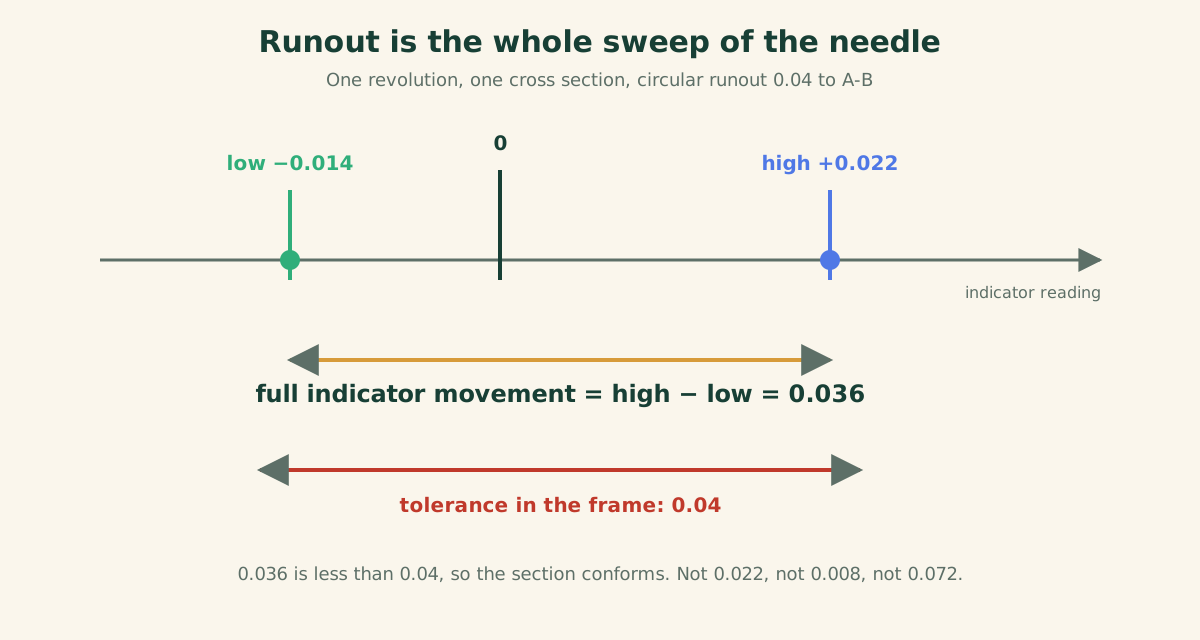
Mistake 6: converting a runout reading. Runout is full indicator movement, the total travel of the needle in one revolution of the part. High reading minus low reading. That is the number you compare with the frame.
Candidates go wrong in three ways. They halve the travel because a diameter was measured. They double it for the opposite reason. Or they report only the biggest single reading and ignore the low side, which always understates the result.
Worked example: circular runout on a shaft
A shaft turns on journals A and B. An indicator rests on one cross section of the body, which carries a circular runout callout to A-B. Through one revolution the needle rises above zero to a high reading and falls below zero to a low reading.
- Take the high reading, a positive number.
- Take the low reading, a negative number.
- Subtract low from high. Subtracting a negative adds its size, so the sweep is the two magnitudes added together.
- Compare that sweep with the tolerance in the frame. If it is smaller, this cross section conforms.
The drawn example in the illustration above shows the shape. Zeroing the indicator at the high point changes nothing, because only the total sweep counts. And the common datum A-B means both journals are simulated together to give one axis. The wrong answers in this kind of item are the largest single reading, the difference of the two magnitudes as if both sat on the same side of zero, and double the travel.
The first free question below puts a shaft in front of you. Work it before you read the options.
Circular runout reads one cross section at a time, and total runout covers the whole surface at once. That difference is a small part of the exam, 5% for the whole Runout section, but the section floor makes it count.
What goes wrong with virtual condition and bonus tolerance?
Mistake 7: using the external formula on an internal feature. First find maximum material condition. For an internal feature such as a bore or a slot, MMC is the smallest size. For an external feature such as a pin, it is the largest. Virtual condition is MMC size plus the geometric tolerance for an external feature, and MMC size minus the tolerance for an internal one.
Written plainly: pin, add the tolerance to the largest size. Hole or slot, subtract the tolerance from the smallest size.
Worked example: a pin with position at MMC
A pin has a size limit pair and a position tolerance at MMC on its axis.
- MMC for a pin is the largest permitted size.
- Virtual condition is that size plus the stated position tolerance.
- Bonus is the departure from MMC: the largest size minus the size you produced.
- Total position tolerance is the stated tolerance plus the bonus.
Bonus is earned by the actual size, never granted in advance. Take the whole size tolerance as bonus regardless of what was produced, and you will pass a part that a gauge would reject. A gauge built to the virtual condition tells you the truth every time.
Mistake 8: forgetting the default behind SEP REQT. Where two patterns share the same datum references in the same order with the same modifiers, they count as one simultaneous requirement by default. Writing SEP REQT under the frames breaks that default, so each pattern is verified in its own reference frame. Candidates mix up which one needs to be written down. Simultaneous is the default. Separate is the exception.

Where does the scoring catch people out?
Mistake 9: ignoring the small sections. ASME publishes the section weights, which is rare. Definitions, Rules, Tolerancing and Symbology carries 25%, Location 25%, Datums 20%, Profile 15%, and Form, Orientation and Runout 5% each. Five percent of 150 questions is roughly seven or eight questions. Skip them, score under 50% in one, and a total well above 74% will not save you. Use the rules and symbology guide for the largest block, then give every small section a few focused sessions.
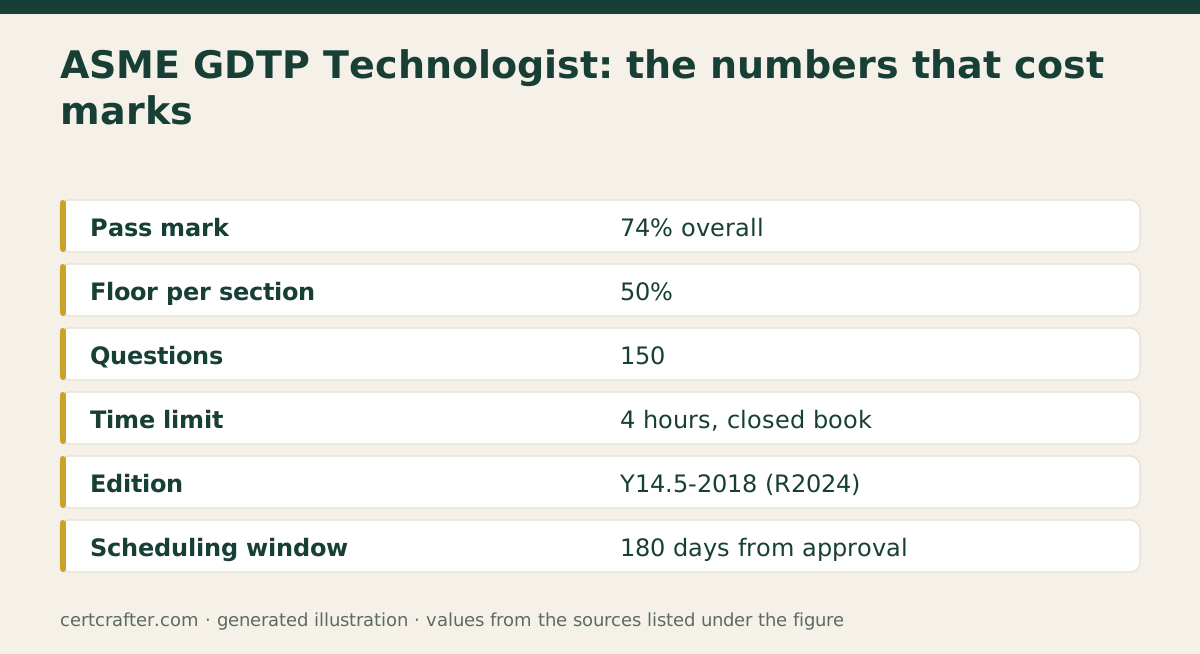
Mistake 10: studying for Senior when you sit Technologist. ASME describes the Technologist exam as reading and interpreting: the rules, definitions and meanings of symbols and modifiers, the functions and relationships of part features, and calculations derived from the drawing. The Senior exam is about selecting and applying controls, and it needs three years (36 months) of documented GD&T experience; our GDTP Senior page sets out how it differs. The price on ASME’s page for the 2018 Technologist is $395, with no experience requirement and 180 days from approval to schedule. Check the live page before you pay.
If a question gives you the callout, your job is to read it. You are not asked to redesign it.
How do you fix these before exam day?
Pick the two mistakes that sound most like you. Write one callout for each on a sheet of paper and work it through to the end, the way the two examples above do. Then try the free question on a moulded contour, which tests mistake 5.
After that, take the free set on our quiz page. If you want six full tests, the practice test bundle has them, the certification guide lists the sections, and the hub of guides has the rest.
Your next step: write the virtual condition and bonus of one pin and one slot from a drawing at your own desk, and check each against the four steps above.
Comments
Comments are read by a person before they appear. How we moderate.