My 4 engineering books go FREE on Kindle Fri 6 – Tue 10 Nov (PT). See the books → FREE on Kindle now: all 4 engineering books, until Tue 10 Nov 11:59 pm PT. Ends in . Grab yours → My 4 books: FREE on Kindle Fri 6 – Tue 10 Nov (PT). See → FREE on Kindle now: 4 books, left Grab yours →

ASME GDTP Practice Questions, Set 2 (Free)

By Sandeep Bandyopadhyay, Senior aerospace engineer · PMP, MBA, Six Sigma

TL;DR

This second free set has three ASME GDTP Technologist questions with full explanations: where a datum feature symbol sits, how a runout reading is taken, and how virtual condition and bonus tolerance work on a slot. The exam is 150 questions in 4 hours, closed book. It is passed at 74% with at least 50% in every section, so one weak section can fail a strong total. Datums carry 20%.

Original questions, not exam dumps. Every CertCrafter question is written from the published body of knowledge and the referenced codes. None is copied from a live exam, and CertCrafter is independent: not affiliated with or endorsed by any awarding body.

A large engineering drawing of a telescope mirror unit with views, sections and dimensions
Photo: Engineering drawing of E-ELT M4 unit (ann15045h) by ESO (Wikimedia Commons), CC BY 4.0, via Wikimedia Commons.

Candidates can name the symbols but still miss which datum a letter creates and what a needle reading measures. These three questions test exactly that.
Video: GD&T Datums Explained: Datum Features, Reference Frames and Targets (ASME GDTP Y14.5-2018) GD&T Datums Explained: Datum Features, Reference Frames and Targets (ASME GDTP Y14.5-2018) Watch on YouTube · CertCrafter
Image: video thumbnail, source: CertCrafter on YouTube (@certcrafters).

What do these free ASME GDTP questions cover?

Three original questions for Y14.5-2018 sit further down this page, each with an explanation you can open after you commit to an answer. They come from the free sample behind the scored ASME GDTP quiz.

One is about datums, one about runout, one about virtual condition and bonus tolerance. Each asks you to read a callout and say what it demands of the part. ASME describes the Technologist level as knowledge of the symbols, modifiers and relationships of GD&T as applied to drawings, with no experience requirement, so reading is the job.

What does a datum feature symbol actually establish?

The same letter can mean two different things, and the placement tells you which. A symbol on the outline of a flat face, or on an extension line clear of the size dimension, makes that surface the datum feature. The datum derived from it is a plane.

A symbol aligned with the size dimension of a bore or a width makes the datum the center feature of that size: an axis for a bore, a center plane for a slot. The first question puts both placements on one drawing and asks what each gives.

On the shop floor, this decides how a part is held and measured. A face datum sits on a surface plate or a fixture pad. A bore datum is picked up by an expanding mandrel or a gauge pin, or constructed by the inspection software. Pick the wrong one and the whole location scheme measures from the wrong place.
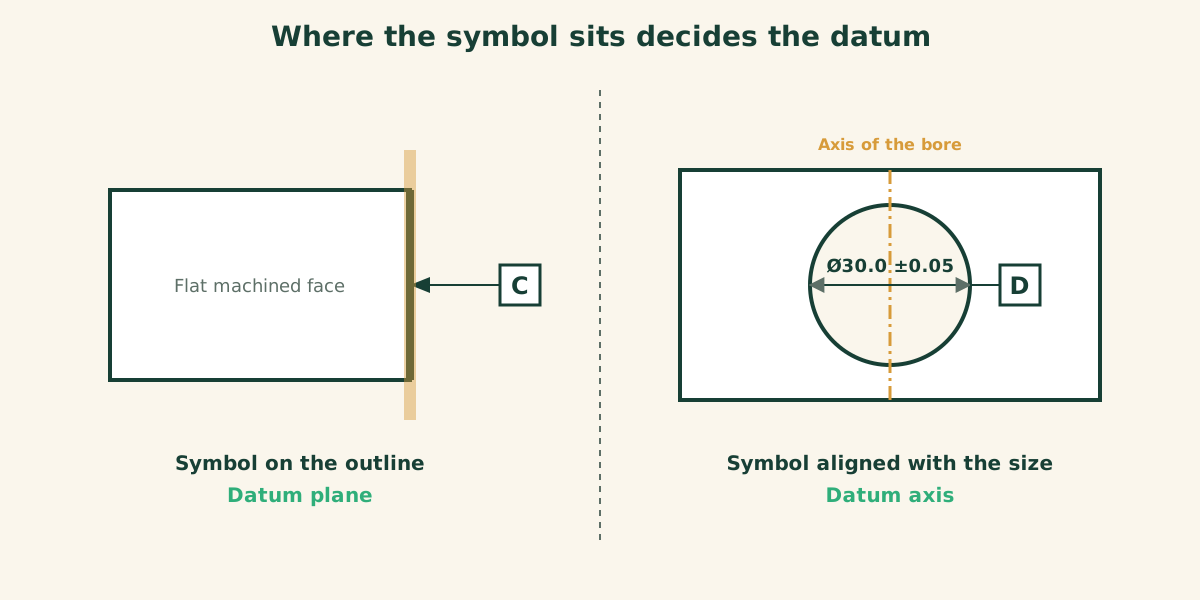
Two views: a flat face with datum feature symbol C on its outline giving a datum plane, and a bore of diameter 30.0 plus or minus 0.05 with symbol D aligned with the size dimension giving a datum axis
Illustration: CertCrafter, from the ASME certification page. Illustration: CertCrafter, from GD & T Professional Certification, GDTP Y14.5 - ASME.

How do exam questions frame datum placement?

Mostly as a trap about assumptions. One wrong option says every symbol makes an axis. Another reverses the two placements. A third invents a plane through the high points of a bore. Read the position of the symbol first, then pick the datum type, and only then look at the options.

Symbol placed on Feature serving as datum Datum it gives
Outline of a flat surface The surface itself Plane
Extension line clear of the size dimension The surface itself Plane
Aligned with the size dimension of a bore Center of the bore Axis
Aligned with the size dimension of a width Center of the width Center plane

The ASME GDTP Complete Exam Kit works more datum cases under timed conditions, with every answer explained.

What is full indicator movement, and why do people halve it?

Runout is compared with full indicator movement: the total travel of the needle during one revolution of the part. High reading minus low reading. Where you zero the indicator changes nothing, because only the sweep counts.

The second question gives a needle that falls below zero after being zeroed at the high point. The answer is the whole sweep. The wrong options halve it, because a diameter was measured, or double it for the opposite reason. Neither conversion exists.

In practice the inspector rolls the part on its datum features, usually on V-blocks or between centers, watches one dial and reports a single number. The number is the sweep. Nobody converts it.
A mid-century technical drawing of a marble headstone with its dimensions
Photo: Technical Drawing of Government Marble Confederate Headstone by Veterans Administration (Wikimedia Commons), Public Domain, via Wikimedia Commons.

Why do bonus tolerance and virtual condition fail so many candidates?

Because the rule flips between holes and pins. The third question uses a slot, which is an internal feature of size. For an internal feature, maximum material condition is the smallest permitted size, and virtual condition is that size minus the geometric tolerance. For an external feature you add instead.

Bonus tolerance is earned by the departure from maximum material condition, no more and no less. It is not granted in advance, and it is not halved because the control sits on a width. Do the arithmetic slowly: find the material condition first, then the boundary, then the departure.

On a real part, this is why a fixed functional gauge can accept a slot that a simple width check would reject. The gauge pin or bar represents the virtual condition boundary, and the slot only has to clear it. Drawings that use the modifier are giving the shop room, and candidates who understand why remember the formula without effort.

How is the ASME GDTP Technologist exam built?

It is 150 questions in 4 hours, closed book. The standard is not admissible, so every rule has to be in your head. The Technologist exam focuses on reading and interpreting drawings. The Senior exam is about selecting and applying controls and needs three years of documented experience.

The pass mark is 74% in total with at least 50% in every section. ASME publishes section weights: Definitions, Rules, Tolerancing and Symbology 25%, Location 25%, Datums 20%, Profile 15%, and Form, Orientation and Runout 5% each. Runout is small, but a poor result there still counts against the 50% floor.
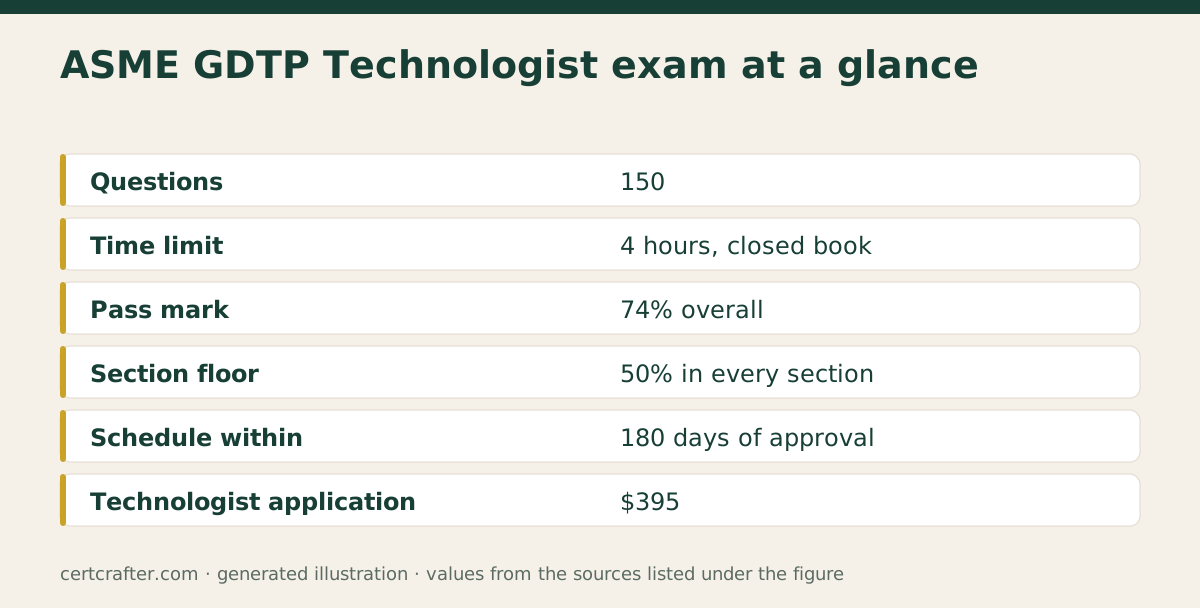
Table of exam numbers: 150 questions, 4 hours closed book, 74% pass mark in total, 50% floor in every section, 180 days to schedule, Technologist application $395
Illustration: CertCrafter, from the ASME certification page. Illustration: CertCrafter, from GD & T Professional Certification, GDTP Y14.5 - ASME.

What does the exam cost and how do you register?

ASME lists the GDTP 2018 Technologist application at $395. You pay before applying, then submit the application in ASME’s PC-Connect system. Once ASME accepts the application you have 180 days to schedule the exam at a Prometric center. A certificate lasts three years from issue. The details are on ASME’s certification page.

How should you use these three questions?

As a check on three habits, not as a readiness test. Answer before you open the explanation. When you miss one, write down which habit failed: placement, conversion or material condition.

Then go further. GDTP: The 10 Most Common Mistakes covers wrong-edition traps, and GDTP Worked Examples walks calculations step by step. Our video on datum features, reference frames and targets shows the set-up. The ASME GDTP guide has the full fact sheet, and the hub of GDTP guides lists the rest.

Take the first free set if you have not yet. The practice test bundle gives full-length timed runs. The ASME GDTP Complete Exam Kit goes deeper on all seven sections, with every answer explained.

Try these free questions

  1. On one view the datum feature symbol C sits on the outline of a flat machined face, while on another view the symbol D is aligned with the size dimension of a Ø30.0 ±0.05 bore. What does each placement establish?

    1. Both establish an axis, since a datum feature symbol always derives a centre feature from whichever surface it happens to touch.
    2. C establishes an axis and D a plane, because a symbol on an outline refers to the part as a whole.
    3. Both establish a plane, the bore plane being taken through the high points of the bore surface.
    4. C establishes a datum plane from the flat face, while D establishes a datum axis because it aligns with the size dimension.
    Show the answer and explanation

    Answer: D. Where the datum feature symbol is placed on the outline of a surface, on an extension line clear of the size dimension, or on a leader pointing at the surface, the datum feature is that surface and the datum derived from it is a plane. Where the symbol is aligned with the size dimension of a feature of size, or attached to the feature control frame of that feature, the datum is the centre feature, an axis for a bore and a centre plane for a width. So C gives a plane and D gives the axis of the Ø30.0 bore. Option one assumes every symbol produces a centre feature, which would leave no way to call out a flat face at all. Option two reverses the two placements. Option three makes both into planes and invents a high point plane for a bore, which is neither a recognised simulation nor something a bore can establish.

  2. During a runout check the indicator is zeroed against the high point of the surface, and the needle then travels down to minus 0.06 as the part completes one revolution. How is the runout value taken from that check?

    1. Half of the needle travel, giving 0.03, because a reading taken on a diameter has to be halved.
    2. The full sweep of the needle, giving 0.06, which is the full indicator movement to compare with the frame.
    3. The reading is discarded, because the indicator should have been zeroed against the low point instead.
    4. Twice the needle travel, giving 0.12, because a radial reading has to be doubled to reach a diametral value.
    Show the answer and explanation

    Answer: B. A runout tolerance is compared against full indicator movement, the total travel of the needle during one full revolution of the part. Zeroing on the high point merely sets the reference; the needle then falls to minus 0.06 at the low point, so the sweep is 0.06, and that is the number to set against the tolerance in the frame. Option one halves the reading on the belief that a diametral measurement must be converted to a radial one, but an indicator bearing on the surface reads the actual variation of that surface. Option three throws away a valid check, and where the indicator was zeroed makes no difference at all because only the total travel counts. Option four doubles the reading through the same mistaken conversion in the other direction and would reject parts that are well within tolerance. Full indicator movement is always the high reading minus the low reading.

  3. A rectangular slot is a regular feature of size, dimensioned 16.00 +0.15/-0.00, and its centre plane carries position | 0.30 (M) | A | B | C. What is the virtual condition of the slot, and how much bonus tolerance is available on a part where the slot measures 16.10 wide?

    1. Virtual condition 15.70, with 0.10 of bonus tolerance available
    2. Virtual condition 16.30, with 0.10 of bonus tolerance available
    3. Virtual condition 15.70, with 0.05 of bonus tolerance available
    4. Virtual condition 15.85, with 0.15 of bonus tolerance available
    Show the answer and explanation

    Answer: A. A slot is an internal feature of size, so its maximum material condition is the smallest permitted width, 16.00. Virtual condition for an internal feature is MMC size minus the geometric tolerance: 16.00 minus 0.30 gives 15.70, and that is the constant boundary the slot must clear. Bonus tolerance is the departure from MMC, so at a produced width of 16.10 it is 16.10 minus 16.00, which is 0.10, raising the total position tolerance to 0.40. The second option adds where it should subtract, applying the external feature formula to an internal one. The third option halves the departure, a slip that comes from thinking in radial terms on a width control, where the tolerance is already a total width and no halving belongs. The fourth option takes the full size tolerance of 0.15 as bonus regardless of the produced size, ignoring that bonus is earned by the actual departure, not granted in advance.

Take the full free 10-question sample with scoring →

Frequently asked questions

Is this set different from the first free ASME GDTP set?

Yes. The first set covers orientation, profile and position. This one covers datum placement, runout and virtual condition, so the two together touch six of the seven sections without repeating a question.

What pass mark does the ASME GDTP Technologist exam use?

74% in total and at least 50% in every section, on the Y14.5-2018 exam. The 78% figure seen in older material belongs to the Y14.5-2009 exam.

How long do you have to schedule the exam after approval?

ASME says you have 180 days to schedule the exam once your application is accepted. The exam is taken at a Prometric testing center.

Official sources

  1. GD & T Professional Certification, GDTP Y14.5 - ASME — accessed 3 November 2026

Exam rules change. Check the awarding body's official page before you apply. CertCrafter is independent and is not affiliated with or endorsed by any awarding body.

Was this helpful?

Comments

    Comments are read by a person before they appear. How we moderate.