Candidates treat Form as the easy 5% and skim it. Then a flatness result comes out as one number instead of two, and the mark goes.
What is a form tolerance, in plain terms?
A form tolerance limits how far a feature may stray from its own ideal shape. It says nothing about where the feature sits or how it is tilted. A face can be in the right place and still be wavy, and form is the control that catches the waviness.
That is why a flatness frame has no datum reference. The surface is compared with itself, so there is nothing to locate it from. Orientation, location, profile and runout all bring datums in. Form is the one family that does not, and exam questions lean on that difference.
ASME calls the work “applying form controls” next to orientation and location controls, and the Technologist level tests reading and interpreting drawings. So you will be handed a callout and asked what it means, not asked to design one.
How much of the exam is form, and why can it still fail you?
ASME publishes section weights, which most bodies don’t. Form is 5% of the 150 questions, the same as Orientation and Runout.
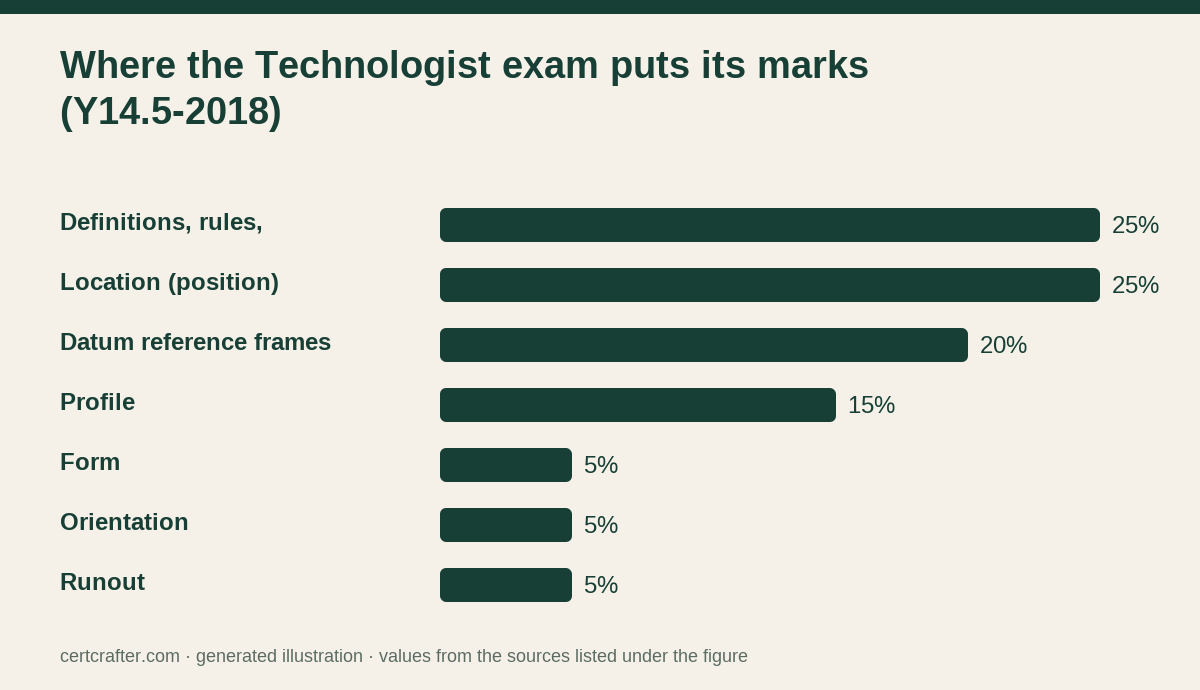
| Technologist section | Weight |
|---|---|
| Definitions, rules, tolerancing, symbology | 25% |
| Position | 25% |
| Datum reference frames | 20% |
| Profile | 15% |
| Form, Orientation, Runout (each) | 5% |
The trap is the pass rule. You need 74% overall and a minimum of 50% in each section. Form is a handful of questions, so missing a few drops you under 50% fast, and a strong score elsewhere does not rescue it. Treat the small sections as a floor you must clear, not as spare marks.
Our short video on the Technologist exam in sixty seconds covers the pass rule in one pass.
 ASME GDTP — The ASME GDTP Technologist exam in sixty seconds. Watch on YouTube · CertCrafter
How is flatness read on a result sheet?
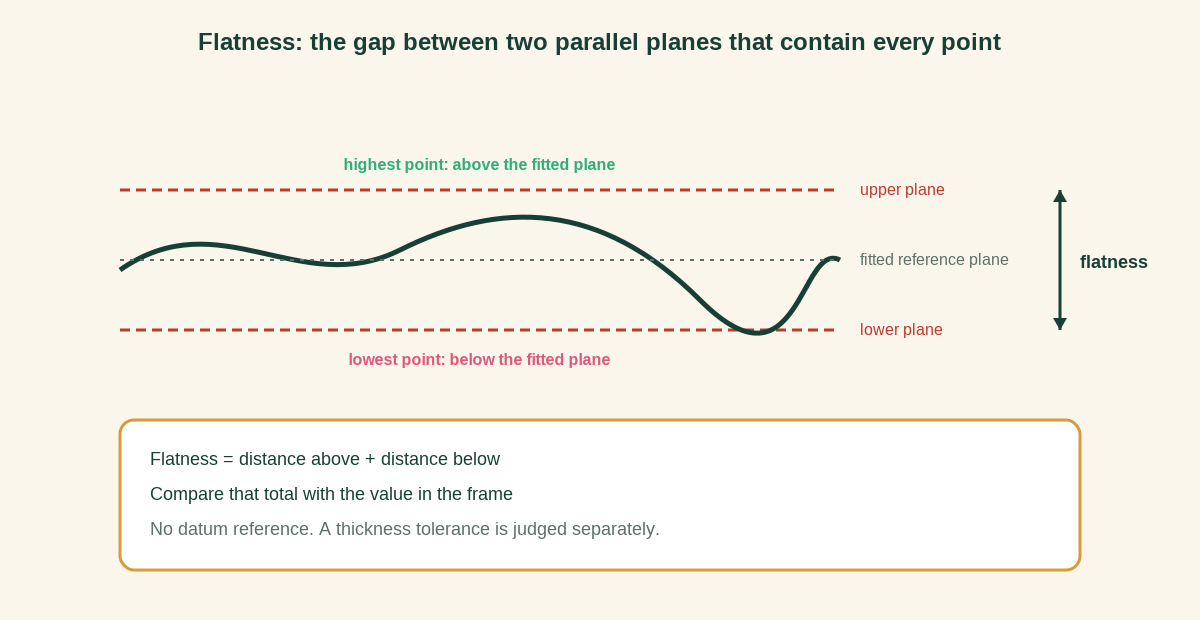
Flatness is the separation of two parallel planes that just contain the whole surface. It is a total spread. It is never the largest single deviation from some fitted plane.
Here is the reading, step by step. A measuring machine fits a reference plane and reports how far the highest point sits above it and how far the lowest sits below it. Add the two. That sum is the flatness, and that sum goes against the number in the frame. Quoting only the larger side reports roughly half the real error, which is how a marginal face gets signed off as comfortable.
The ASME GDTP Complete Exam Kit works more of these under timed conditions, with every answer explained.
What do form controls look like on a real job?
On a shop floor, form is about parts that mate or seal. A gasket face, a bearing seat, a slide way. If it is wavy, it leaks or rocks, whatever its position says.
Inspection is where people slip. A CMM returns a cloud of points, and the person reading it has to turn that into one spread. The common field error is quoting one side of the fit and calling the face good. The other is mixing form with size: a flatness limit is judged on its own, and a thickness tolerance on the same part is a separate check.
Some drawings add a second line, a tighter limit over a small area, written as a pair of values under one symbol. The whole face has to meet the large value, and every area of the stated size has to meet the smaller one. The small value can only tighten the face, never loosen it.
Where does the exam trip people on straightness?
Straightness is the one form control that can mean three things, depending on where the frame sits.
Placed on a surface, it controls the line elements of that surface, checked one at a time. Placed beneath a size dimension, it applies to the feature of size. On a width, such as a rib, it then controls the derived median plane, held between two parallel planes. On a cylinder, the zone is cylindrical and applies to the derived median line.
The exam likes the second case because the options all sound plausible. One wraps the whole surface in the zone, which is what flatness would do. One uses a cylinder for a width, which cannot work. Read where the frame is attached before you read the number.
Placing straightness this way also overrides the perfect form requirement at maximum material condition for that feature, and that is often why a designer writes it.
What else about form is out of date in older study material?
Concentricity and symmetry were removed as tolerance types in Y14.5-2018. A 2009-era drawing that used symmetry is re-expressed with position in the newer edition. Notes carried over from the old syllabus still teaching them as live controls are out of date, and a question may offer them only as wrong options.
Check which exam you booked. The 78% pass mark found in many places belongs to the Y14.5-2009 exam. The 2018 Technologist exam is passed at 74% overall.
How should you study Section 8 in a week?
Keep it short and specific. Take the habit of reading the frame position first, then the zone, then the number. Do it on flatness and on straightness until you can say the zone out loud without hesitating.
Then spend your real time on the big sections, since Form is only 5%, and return to Form only to protect the 50% floor. A last check on the free ASME GDTP quiz shows whether the habit holds under a clock.
Comments
Comments are read by a person before they appear. How we moderate.