Most candidates can draw a fault tree. They lose marks by putting the wrong gate on it, because the stem described redundancy and they read it as a chain.
What does Risk Management cover on the ASQ CRE?
It is the second of five areas in the 2025 Body of Knowledge: Reliability Fundamentals, Risk Management, Probability and Statistics for Reliability, Reliability Planning, Testing and Modeling, and Lifecycle Reliability. ASQ’s page links the Body of Knowledge as a download. It does not print weights, so this post gives none.
In practice the area is about asking what can go wrong, how likely it is, and what it costs, then deciding where to spend effort. The tools you meet most are the fault tree, which works from one bad outcome down to its causes, and the failure modes and effects analysis, which works from each part up to its effects.
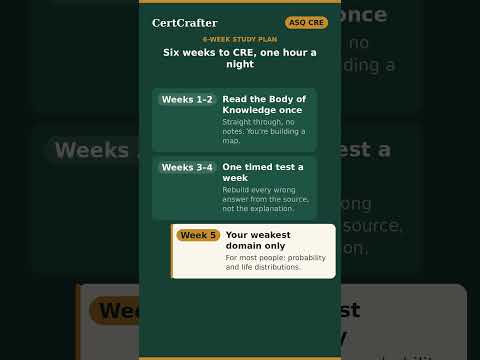 ASQ CRE — Six weeks to CRE, one hour a night. Watch on YouTube · CertCrafter
Our six-week study plan short on the channel shows where this area sits in a one-hour-a-night routine. The certification guide lists the other four areas.
How does a fault tree actually work?
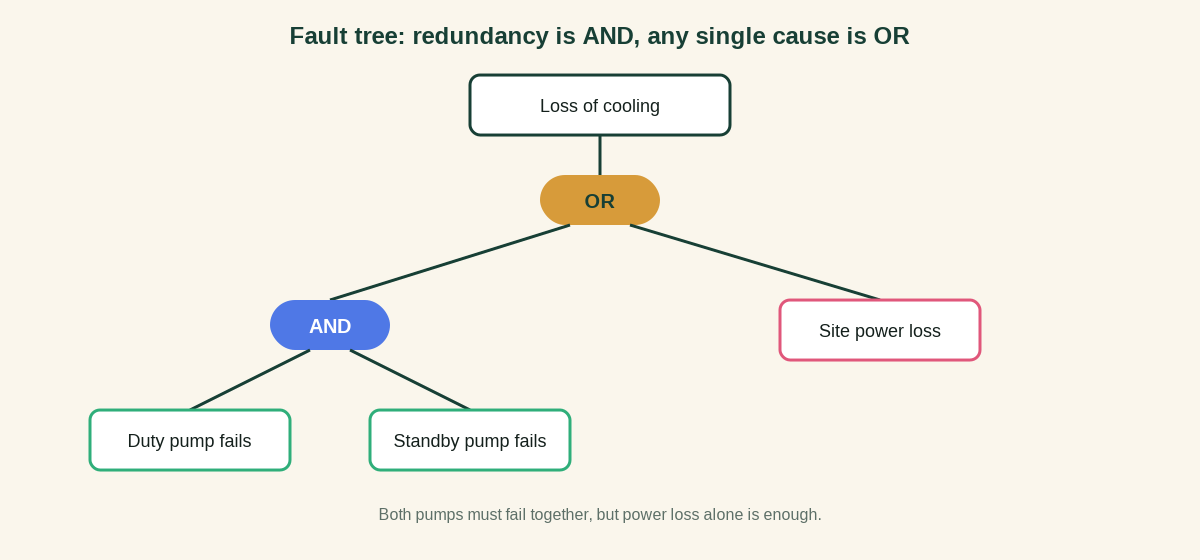
You start with the top event, the thing nobody wants. Under it you place the causes joined by gates. An OR gate says any one input is enough. An AND gate says every input must happen together.
For independent events the arithmetic is short. An AND gate multiplies the input probabilities. An OR gate is one minus the product of the complements, and for rare events adding the inputs gives nearly the same answer, which is a handy check when you are short of time.
Redundancy is the trap. A duty pump with a standby is an AND of two failures, because the function is lost only when both are gone. Candidates who think “two pumps, two chances to fail” put an OR there and overstate the risk many times over.
The free question on the chiller tree below is built on exactly that. Work the gates from the bottom up before you look at the options.
What do reliability teams do with a fault tree?
On a real project the tree is rarely about the number. It is a way to make a team argue about causes in the same room. A design review that draws the tree on a whiteboard usually finds a single event sitting under an OR gate at the top, a lone weakness that no amount of redundancy elsewhere will fix.
That finding is the value. Teams then ask whether the single point can be duplicated, monitored or removed. Probabilities come later, and they are only as good as the failure data behind them. A tree with invented inputs is a drawing, and good practitioners say so.

How are voting systems drawn?
A two out of three arrangement, such as three flame detectors where any two calling for a trip shut the burner, fails to act only when at least two channels fail. In tree form that is an OR gate over three AND gates, one for each pair of channels.
Notice how the stem is framed. It does not ask you to compute. It asks for a structure, and the wrong options are the single OR (one out of three logic) and the single AND (trips on any one channel). Read the voting rule first, then translate it into gates.
How does FMEA ranking go wrong?
A failure modes and effects analysis scores each failure on severity, occurrence and detection, and the product of the three is the risk priority number. Higher means look first.
The weakness is that the product hides what is inside it.
Worked example: two failure modes, one ranking
Take two failure modes on a pump seal, scored on a ten-point scale.
- Mode A: severity 9, occurrence 2, detection 3. Its product is the lower of the two.
- Mode B: severity 5, occurrence 6, detection 4. Its product is the higher.
- Multiply each set of three scores and sort: Mode B goes first, Mode A second.
- Now read the scores. Mode A can hurt someone and is rare. Mode B is a nuisance that happens often.
- Decide on severity first. Mode A needs a design or safety action no matter what its product says.
Current practice, including the AIAG-VDA approach, has moved toward an action priority that looks at severity before the other two scores. So no product threshold should be quoted as a universal rule, and an exam option that says “act on anything above a fixed number” is the one to doubt.
The ASQ CRE Complete Exam Kit has six full exams that work this kind of ranking and gate logic under timed conditions, with every answer explained.
Where do candidates lose marks on this area?
Three places, again and again.
The first is the gate. Redundancy means AND, a chain means OR, and a voting rule means an OR of ANDs. The second is the ranked list: an option that treats the product as the whole story is bait. The third is the open-book habit of hunting for a formula. A tabbed binder can hold the OR-gate expression, but nothing in it tells you which gate the stem describes.
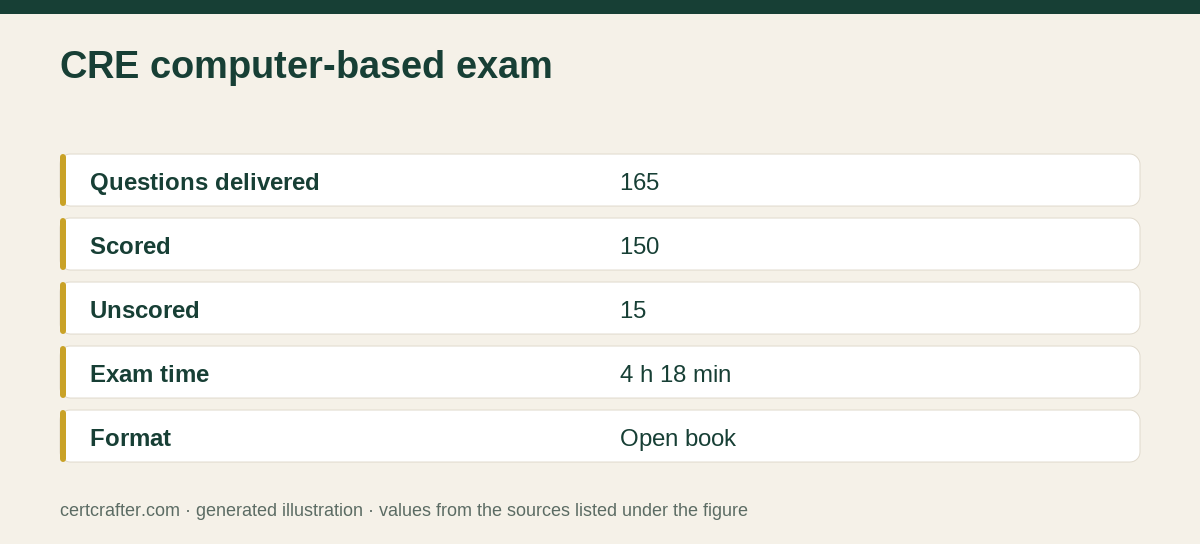
ASQ lets you bring bound reference material and gives a basic scientific calculator on screen, with a hand-held one available on request. Programmable calculators are not allowed. Tab your binder by method, not by chapter.
What do the free questions show?
Two Risk Management questions from our free sample are embedded below: the chiller tree with its AND under an OR, and the furnace voting structure. Both give you the facts and make you choose the structure. Cover the options and sketch the tree first.
How should you prepare for this area?
Draw ten small trees from plain-language descriptions, without computing anything, and check each gate against the wording. Then add the arithmetic. After that, score a handful of failure modes yourself and see where the product ranking and your judgment part ways.
The free sample quiz shows the question style, and the guides hub lists the other posts for this exam. Tonight, draw one tree from the voting example above and say each gate aloud.
Comments
Comments are read by a person before they appear. How we moderate.