Most CRE candidates don’t lose marks on arithmetic. They lose them by picking the wrong model for the situation in the first two lines of a question.
 ASQ CRE — Three reliability terms people mix up in interviews. Watch on YouTube · CertCrafter
What does Reliability Fundamentals cover on the ASQ CRE?
It is the first of five areas in the 2025 Body of Knowledge: Reliability Fundamentals, Risk Management, Probability and Statistics for Reliability, Reliability Planning, Testing and Modeling, and Lifecycle Reliability. ASQ’s page links the Body of Knowledge as a download and does not print the weights on the page, so this post gives none.
What the first area builds is vocabulary you must use correctly in every other area: failure distributions, system configurations, and the availability family. Our own study plan puts exponential and Weibull behavior first for that reason. Get those secure and the later statistics areas get easier.
You can watch the short on the channel about three reliability terms people mix up in interviews. The mix-ups it covers are the same ones the exam uses.
What does the Weibull shape parameter tell you?
How the failure rate changes with age. That’s all, and it is a lot.
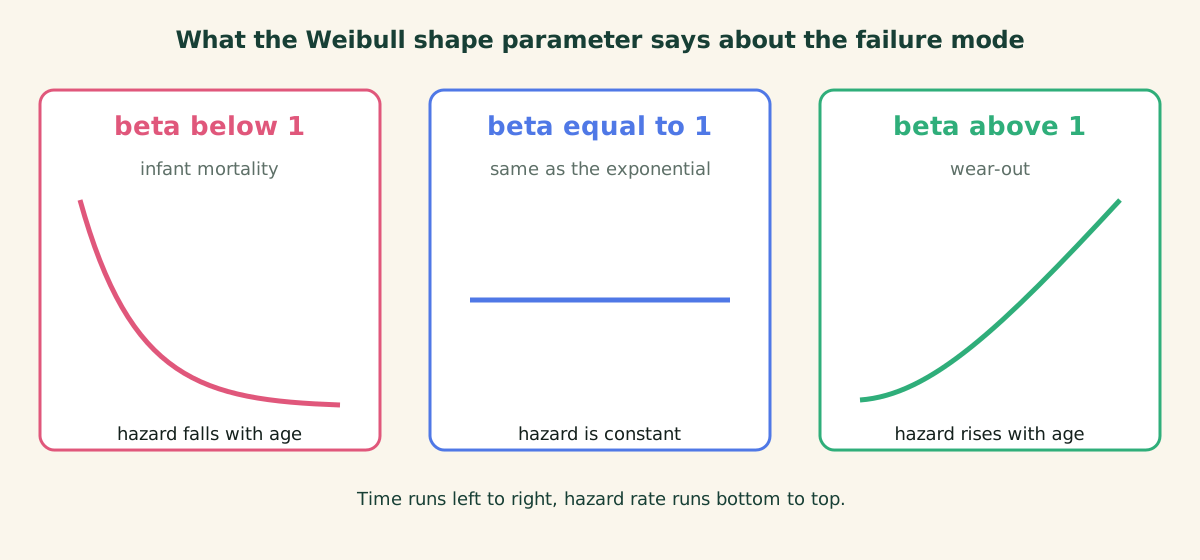
| Shape parameter | Hazard rate | Typical cause |
|---|---|---|
| beta below 1 | falls with age | infant mortality, weak parts, poor assembly |
| beta equal to 1 | constant | random events, the exponential case |
| beta above 1 | rises with age | wear-out, fatigue, corrosion |
In the field this is what separates a burn-in problem from a maintenance problem. A fleet whose fitted beta comes out below 1 does not need a replacement schedule. Replacing a part that is in its infant-mortality phase just resets the clock to the riskiest period. A beta well above 1 says the opposite: age is the enemy, and a planned replacement before the characteristic life can pay for itself.
The exam asks it as a story. A stem gives you a fitted shape and a part, and the options are four maintenance policies. You are not computing anything. You are reading beta.
Why is MTBF not the time when half the units have failed?
Because the exponential distribution is skewed. With a constant hazard rate, reliability at time t is exp(-t / MTBF). Put t equal to the MTBF and you get exp(-1), which is about 0.368.
So fewer than four units in ten are still running at the MTBF, and the rest have failed. Candidates who believe 0.5 get caught by this every sitting. It is the classic wrong-but-comfortable answer.
The related idea is the memoryless property. With a constant hazard, a unit that has already survived a long time has the same chance of surviving the next hour as a new one. That is a modeling assumption, and it only fits where beta is close to 1.
Worked example: reading a mission from an MTBF
A pump has an MTBF of some number of hours, and failures follow the exponential model. What is the chance it runs a mission exactly as long as its MTBF?
- Pick the model. Constant hazard, so use
R(t) = exp(-t / MTBF). - Put the mission time equal to the MTBF, so t divided by MTBF is exactly one.
- Evaluate
exp(-1), which is about 0.368. - State it in words: a little over a one-in-three chance of finishing without a failure, which is well under half.
Now the trap. Many candidates answer 0.5 because they read the MTBF as a median life. On a four-option question the writer places that value among the options on purpose.
The ASQ CRE practice test bundle have six full practice tests that work this kind of calculation under timed conditions, with every answer explained.
How do series and parallel systems differ in practice?
In a series system every block must work, so reliabilities multiply. Ten very good parts in series give a string that is clearly worse than any one of them, which surprises people the first time. In an active parallel system the unit works while any block works, so you multiply the failure probabilities instead.
The exam also separates active parallel from standby redundancy. In standby, the spare is not loaded until it is switched in, so it is not the same arithmetic and a question may hinge on that. A k-out-of-n arrangement, such as two of three, is a binomial sum.
On a real project the lesson is where redundancy goes. A designer who adds a spare to a block that is already very reliable has barely moved the system. The weak block in the series string is the one to fix. Reliability reviews exist to find it.
Which availability does the question want?
Inherent availability is MTBF divided by the sum of MTBF and MTTR. It leaves out logistics delay and preventive maintenance. Achieved and operational availability add more downtime terms. The exam uses the names precisely, and the first step in the question is to find which one is asked for.
The second trap sits in contracts. A single availability requirement alone does not stop a supplier from meeting it with frequent short repairs. One of the two free questions below is about exactly that: what a buyer should add so that a fast repair cannot cover a poor design.
What do the free questions show?
Two Reliability Fundamentals questions from our free sample are embedded below. One is a Weibull hazard calculation with a supplied shape and scale, the other is the availability contract case.
Look at how each stem names its inputs. Both give you the facts and make you choose the method, which is the open-book style in one sentence.
How should you prepare for this area?
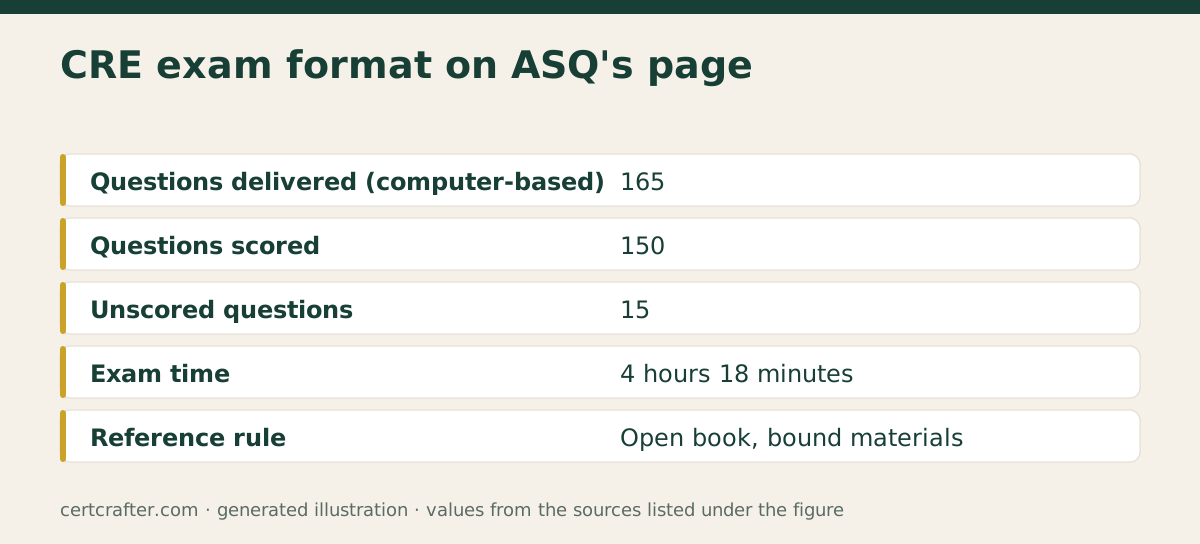
Open-book changes your preparation. ASQ allows bound reference material, a basic scientific calculator on screen and a hand-held one on request, but not a programmable one. Time spent memorizing is worth less than time spent tabbing your own binder so you find the right section fast.
Work the exponential case until exp(-1) is automatic. Then work Weibull with a supplied table or formula, because the stem will hand you values and expect you to apply them. The free sample quiz shows the style, and the guides hub lists the other posts for this exam.
Pick one worked example tonight, solve it without the binder, then check it against the binder. Whatever you got wrong is the page to tab.
Comments
Comments are read by a person before they appear. How we moderate.