Two reliability engineers can use “failure rate” for different things and both think the meeting went fine. On the CRE exam, one wrong term in a stem means the whole question is answered for a different problem.
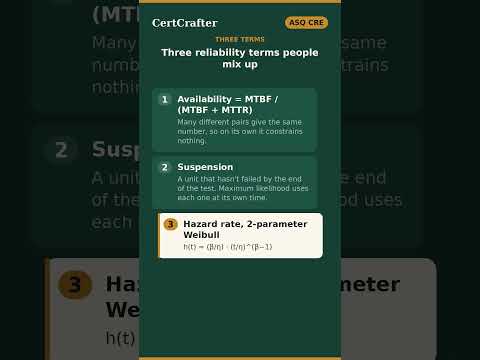 ASQ CRE — Three reliability terms people mix up in interviews. Watch on YouTube · CertCrafter
Which Reliability Fundamentals terms get confused?
Reliability Fundamentals is the first of five areas in the 2025 Body of Knowledge. It sets the vocabulary the other four areas assume. ASQ’s page links the Body of Knowledge as a download and prints no weights, so this post gives none.
The pairs that cause trouble are always the same. MTBF against MTTF. Failure rate against hazard rate. Inherent, achieved and operational availability. Reliability against availability itself. The channel has a short on three reliability terms people mix up in interviews, and the same confusions are what exam writers build wrong options from.
For the angle on distributions and system layouts, the post on what the Reliability Fundamentals area tests goes further. This one stays on words.
What is the difference between MTBF, MTTF and MTTR?
Start from what the item does after it fails.
| Term | Applies to | What it averages |
|---|---|---|
| MTTF | Items that are not repaired | Time from start to the single failure |
| MTBF | Repairable items | Running time between one failure and the next |
| MTTR | Repairable items | Time spent restoring the item to service |
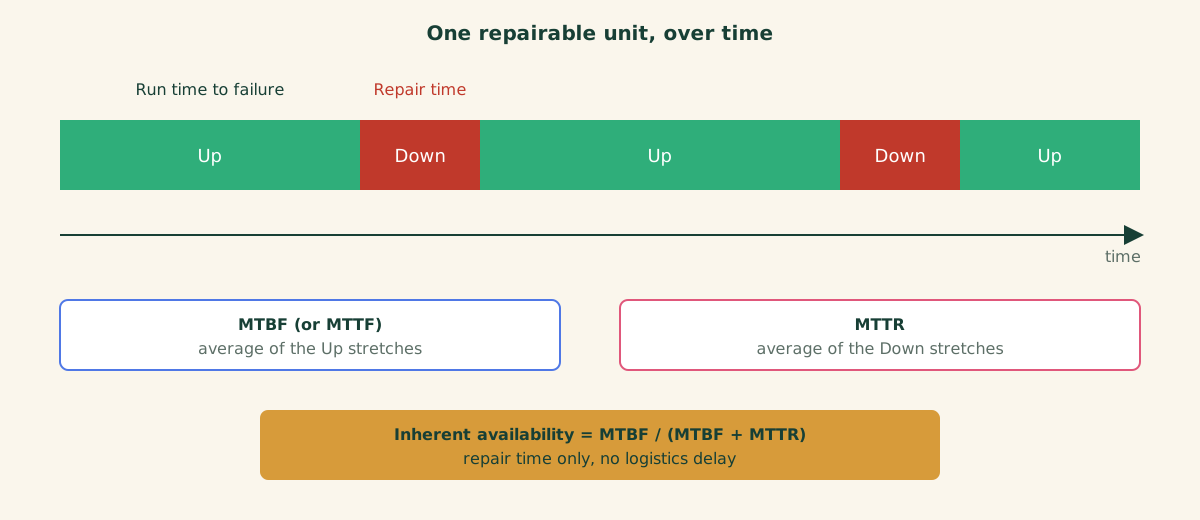
On a real plant the distinction matters because of how data is kept. A maintenance system logs work orders, and a work order is a repair. A light bulb, a seal or a fuse is replaced rather than repaired, so its record is a lifetime, and the right summary is MTTF. Teams that call everything MTBF end up averaging lifetimes of replaced parts as if they were intervals on one machine.
Neither number is a promise about any single unit. Under an exponential model, reliability at a time equal to the MTBF is about 0.368, not 0.5. Most units have failed by then.
What is the difference between failure rate and hazard rate?
Failure rate is usually quoted as a single figure, failures per unit of operating time for a population. Hazard rate is the instantaneous version: the chance of failing in the next instant, given survival to now. It can change with age.
Only when the hazard is constant do the two coincide, and that is the exponential case. Under a Weibull model with a shape parameter above one, the hazard climbs with age, so quoting one failure rate for a worn-out fleet understates what the next year looks like.
In the field this shows up in warranty reviews. A single failure-rate number from the first year, taken to the fifth, is how budgets for spares come out too low. The reading to ask for is the shape of the hazard, not the average.
Why do three availability figures exist?
Because downtime has more than one cause. Inherent availability counts only repair time: MTBF divided by the sum of MTBF and MTTR. It ignores waiting for parts, waiting for a technician and scheduled preventive work. Achieved and operational availability bring those in, and operational availability is what the operator actually experiences.
A supplier often quotes the inherent figure because it is the flattering one. A buyer reading a contract needs to ask which figure is meant. If the term is not named, the number can be met with frequent short repairs, which is a poor design that looks fine on paper.
Worked example: same machine, two availability answers
A line uses a machine that runs a long stretch between failures, and each repair is short, but spare parts arrive slowly.
- Find the term in the question. If it says inherent, only MTBF and MTTR enter.
- Compute MTBF divided by MTBF plus MTTR. The result is high, because repair time alone is short.
- If the question says operational, add the waiting for parts to the downtime before dividing.
- The result drops, and nothing about the machine changed. Only the definition did.
That is why a stem can have two defensible numbers and only one correct option. The word tells you which one.
The ASQ CRE practice test bundle has six full practice tests that work this sort of definition-driven calculation under timed conditions, with every answer explained.
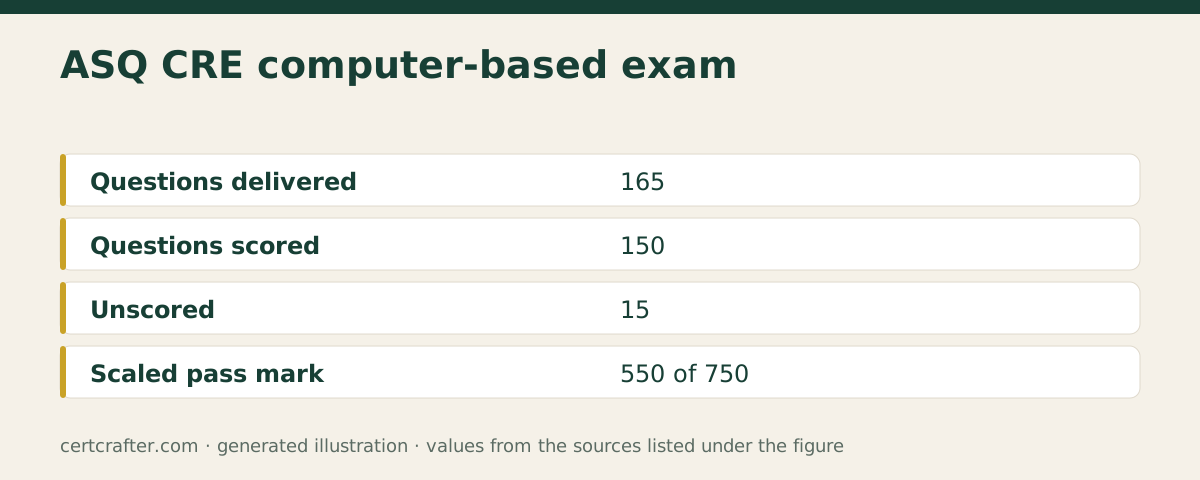
ASQ’s page shows the computer-based exam at 165 questions, 150 scored and 15 unscored, with passing a scaled 550 out of 750.
How does the CRE exam use these terms?
Mostly as camouflage. The stem gives a scenario in plain language, and the options are each right for a nearby term. A free-tier question on a satellite power unit with a single series string and no mass left for redundancy is embedded below from the free sample. Read the stem first for the word that controls the answer, then for the constraint, and only then at the options. Candidates who go straight to the options find four plausible methods and pick the familiar one.
The habit worth building is small: before any arithmetic, name the term in one or two words in the margin of your scratch paper. It takes a few seconds and it stops the most common slip, which is solving a correct calculation for the wrong quantity.
Open book helps with the arithmetic and does nothing for vocabulary. A binder cannot tell you that a stem about a replaced seal wants MTTF.
What to do next
Take ten minutes with your binder and write one line beside each pair above saying what it applies to, not how to calculate it. Then try the free sample quiz and underline the controlling term in every stem. The guides hub lists the other posts for this exam, including the ten most common CRE mistakes.
Comments
Comments are read by a person before they appear. How we moderate.