
Most CRE candidates know enough reliability theory to pass. They lose marks by preparing for the wrong exam: the wrong handbook, a loose binder, a percentage that does not exist, a model that does not fit the data.
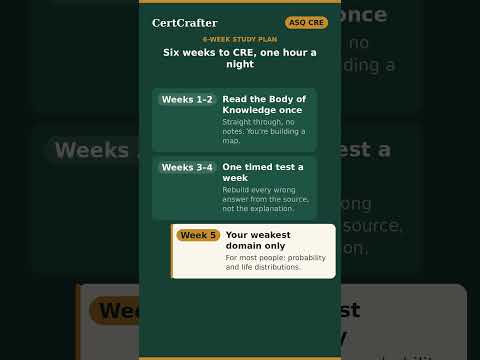 ASQ CRE — Six weeks to CRE, one hour a night. Watch on YouTube · CertCrafter
The channel has a short on six weeks to CRE, one hour a night. The mistakes below are what that plan has to avoid.
Which preparation mistakes cost the most marks?
Four of the ten happen before you read a single question. They are cheap to fix and expensive to ignore.
Mistake 1: a binder that is not bound. All ASQ exams are open book, and reference material must be bound and stay bound. ASQ’s page names ring binders, spiral binders and screw posts as acceptable, and says hand-stapled documents not securely fastened in their covers are not allowed. The Test Center Administrator inspects your references before you enter. Loose printouts in a folder are a risk you do not need.
Mistake 2: the wrong handbook and the wrong Body of Knowledge. The 2025 Body of Knowledge governs the current exam and has five areas: Reliability Fundamentals, Risk Management, Probability and Statistics for Reliability, Reliability Planning, Testing and Modeling, and Lifecycle Reliability. Much of the market still teaches an older structure. ASQ’s own question bank is written to the 2009 Body of Knowledge with seven domains, and ASQ’s reference list still points at the 3rd edition of the CRE Handbook, which was written to the 2018 outline. The 4th edition, by Hulting and McShane-Vaughn, was published in 2025. Check the edition on your desk against the outline you will be examined on.
Mistake 3: chasing a percentage. Forum posts quote a number. ASQ does not. The standard is a scaled 550 out of 750, set for each form by a modified Angoff procedure, and the raw score that equals 550 changes with the form. Study every area to a working level instead of banking on one score.
Mistake 4: the wrong calculator. Computer-based exams give you an on-screen basic scientific calculator, and the test center can hand you a basic hand-held one on request. A programmable or graphing model is out, and the TI-89 is named. Practice the whole calculation on a basic one, including the exponentials.
How should you pace a 165-question open-book exam?
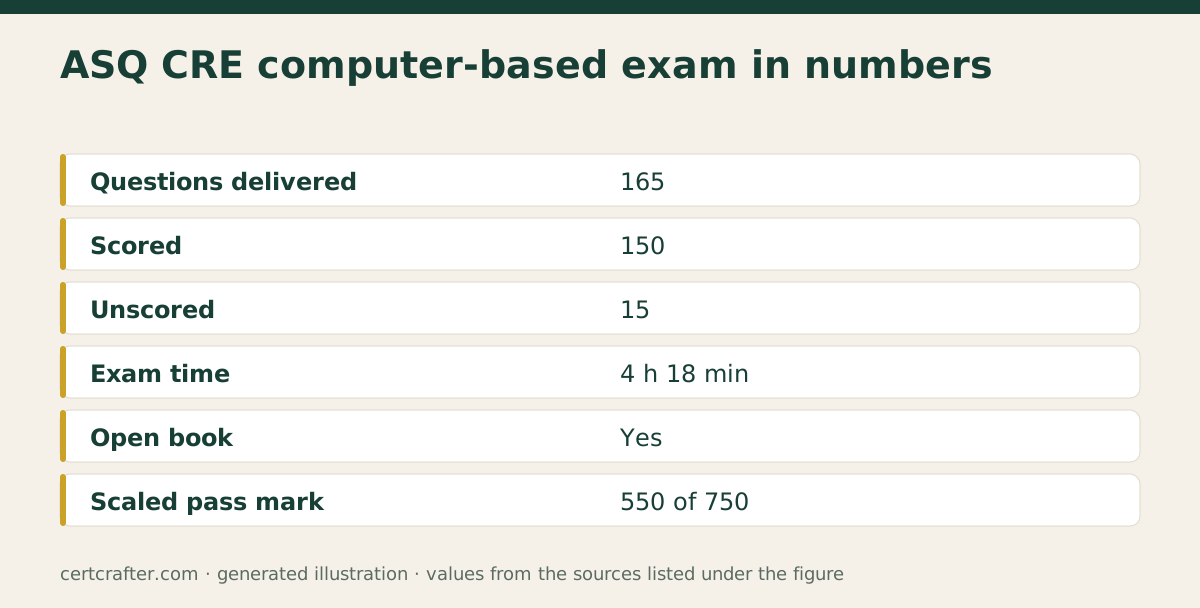
Mistake 5: treating open book as easy. The computer-based exam delivers 165 questions, of which 150 are scored and 15 are unscored and not identified. Exam time is 4 hours and 18 minutes. That is under two minutes a question. You will not look up much in that time, so tab the binder by topic and use it to confirm a method you already chose.
On a plant, this is the same habit as a good reliability review. Nobody derives a Weibull fit from scratch in the meeting. They know which tool the situation calls for and have the reference at hand for the detail.
What do candidates get wrong on the reliability maths?
Mistake 6: reading MTBF as a median life. With a constant failure rate, reliability at the MTBF is exp(-1), about 0.368, not 0.5. By the time a population reaches its MTBF, most of it has failed. A maintenance planner who reads MTBF as “half my units last this long” will promise a replacement interval the fleet cannot meet. Our reliability fundamentals post works the case through.
Mistake 7: fitting a Weibull to a repairable unit. This one catches experienced people. A plant manager asks whether one gearbox is failing more often across three years of repair records. The reflex is to fit a Weibull to the times between failures and read beta. But the Weibull describes times to first failure across a population of non-repairable items. A repair process needs a trend view, and the direct answer is a cumulative plot of failure count against cumulative operating time: a straight line means a constant rate, and a bend shows the rate changing. One of our free questions is built on exactly this, and the wrong option is the Weibull fit.
Mistake 8: ignoring the suspensions. Real test data is rarely clean. Sixty units go on test, four fail and the other fifty-six are pulled or still running at mixed times. Throwing away the survivors discards most of the information you paid for. The question you will be asked is which estimation method uses each suspension at its own time and supports confidence bounds. Our other free question covers it, and the answer is maximum likelihood. In practice, the habit to build is to ask what the data looks like before reaching for a plot.
Worked example: a series string is worse than its parts
These numbers are invented for practice, so check the method and ignore the figures.
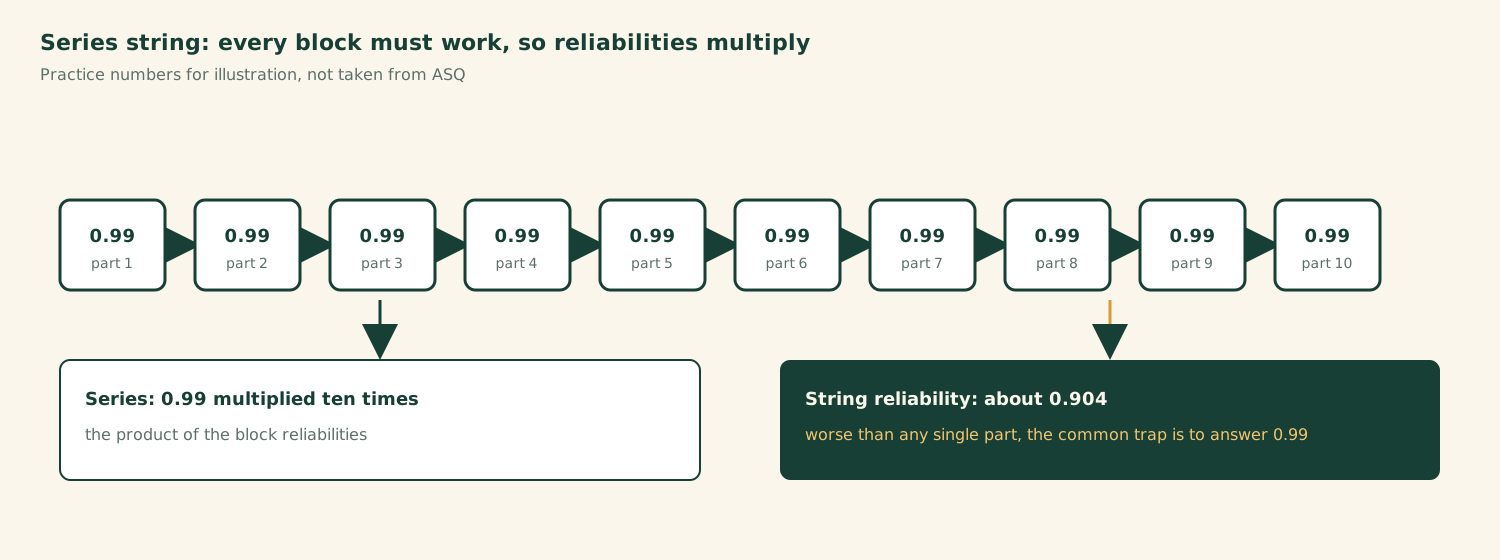
A string has ten parts in series. Each has a reliability of 0.99 over the mission. What is the reliability of the string?
- Pick the configuration. Every part must work, so reliabilities multiply.
- Multiply
0.99by itself ten times. - The product is about
0.904. - State it in words: roughly nine chances in ten, which is worse than any single part.
The trap is answering 0.99, the reliability of one part, or averaging the ten. Wrong options in a question like this are built from those two slips.
The ASQ CRE practice test bundle works more of these under timed conditions, with every answer explained.

Which availability figure is the question asking for?
Mistake 9: mixing the availability family. Inherent availability is MTBF divided by the sum of MTBF and MTTR, and it leaves out logistics delay and preventive maintenance. Achieved and operational availability count more of the downtime. A supplier quoting inherent availability for a unit your site loses to spare-part delays is quoting a number your operation will never see. In the exam, the first line of the question names the figure. Read that before you reach for any formula, because every wrong option is a correct calculation of the wrong availability.
What should you check before you apply?
Mistake 10: a thin application. ASQ asks for 8 years of on-the-job experience in one or more areas of the Body of Knowledge, and 3 of those years must be in a decision-making position, in a full-time, paid role. A degree waives part of the 8 years, and only one waiver can be claimed: a technical or trade diploma one year, an associate degree two, a bachelor’s degree four, a master’s or doctorate five. The exam fee shown on ASQ’s page is $550, a retake is $350, and members save $100 on the initial fee. Check the current page for dates and deadlines before you plan around them.
What to do next
Sort the ten by when they bite. Four are set up before you study: binder, handbook, percentage, calculator. One is pacing. Three are engineering judgment: MTBF, repairable units, censored data. One is a definitions habit and one is paperwork.
Start with the first four, since they cost nothing to fix. Then read the certification guide for the scoring and the Body of Knowledge, try the free sample quiz to see how the stems are written, and use the guides hub for the posts that go area by area.
Tonight, write down the edition of your handbook and the Body of Knowledge it was written for. If they differ, that is your first fix.
Comments
Comments are read by a person before they appear. How we moderate.