Most CRE candidates know the formulas. They lose marks choosing which one the question is asking for, and they do it with the binder open.
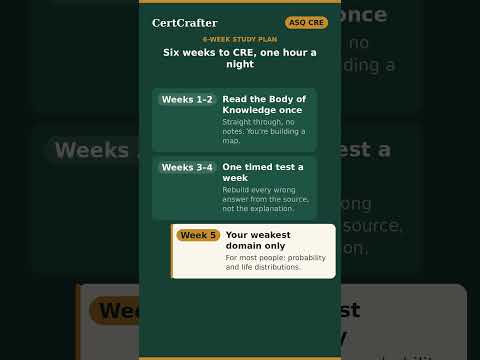 ASQ CRE — Six weeks to CRE, one hour a night. Watch on YouTube · CertCrafter
What do these free CRE questions test?
One question each from three of the five areas in the 2025 Body of Knowledge: Risk Management, Reliability Planning, Testing and Modeling, and Lifecycle Reliability. A screening decision, a fault tree and a stress against strength margin. None asks you to recite a definition. Each hands you a situation and a constraint, which is how the CRE reads.
They come from the free sample behind the CRE quiz. Commit to an answer before you open the explanation. I’d also write down which method you picked and why, in one line, because the wrong options on this exam are almost always the right method applied to the wrong situation.
How do reliability engineers decide what a screen does to good units?
A production screen is a stress test run on every shipped unit. Its job is to precipitate latent defects. Its risk is that it also uses up life in the good ones, which are nearly all of them.
On a real programme the team does not trust a profile because it looks tough. They prove it harmless first, by cycling known good units through it many more times than production will, and then they check the field returns. The first free question puts you at exactly that decision for a new power supply.
Why do fault trees trip people who know the arithmetic?
Because the gate type decides everything, and the stem rarely says AND or OR. It describes a system, and you build the tree. Two pumps where either one is enough means both must fail for the loss to happen. That is an AND gate, even though the word “or” shows up in the story.
In a plant review the tree is also an argument between people. The operations lead says a standby pump covers the duty pump, the maintenance lead says both share one power feed. Where inputs are not independent, the multiplication stops being valid. The second question gives you independent events, so practice reading the structure first and doing the sums second.
How should you read a stress against strength question?
Think of two overlapping spreads. Stress is how hard the part is loaded, strength is what it can take, and both scatter. Reliability is the chance that strength wins. A classical safety factor, a plain ratio of two means, ignores that scatter entirely, and the exam likes to offer that ratio as an answer.
In practice this is the bracket, the pressure boundary or the solder joint where two designs share the same safety factor and one of them fails in service. The third question asks you to model that margin properly.
Worked example: what does the MTBF actually tell you?
Take any item with a constant failure rate. Reliability at time t is the exponential of minus t divided by the MTBF.
- Set t equal to the MTBF. The ratio is 1.
- Reliability is the exponential of minus 1, which is about 0.368.
- A half-life reading would give 0.5, so the intuition is wrong.
Most units are still running at a time equal to the MTBF? No. Most are gone: reliability there is 0.368, not 0.5. That is the trap behind many “mean life” stems. The MTBF is an average that the long survivors pull upward. It says nothing about when the first ones go.
The ASQ CRE practice test bundle works more of these under timed conditions, with every answer explained.
How is the CRE exam structured?
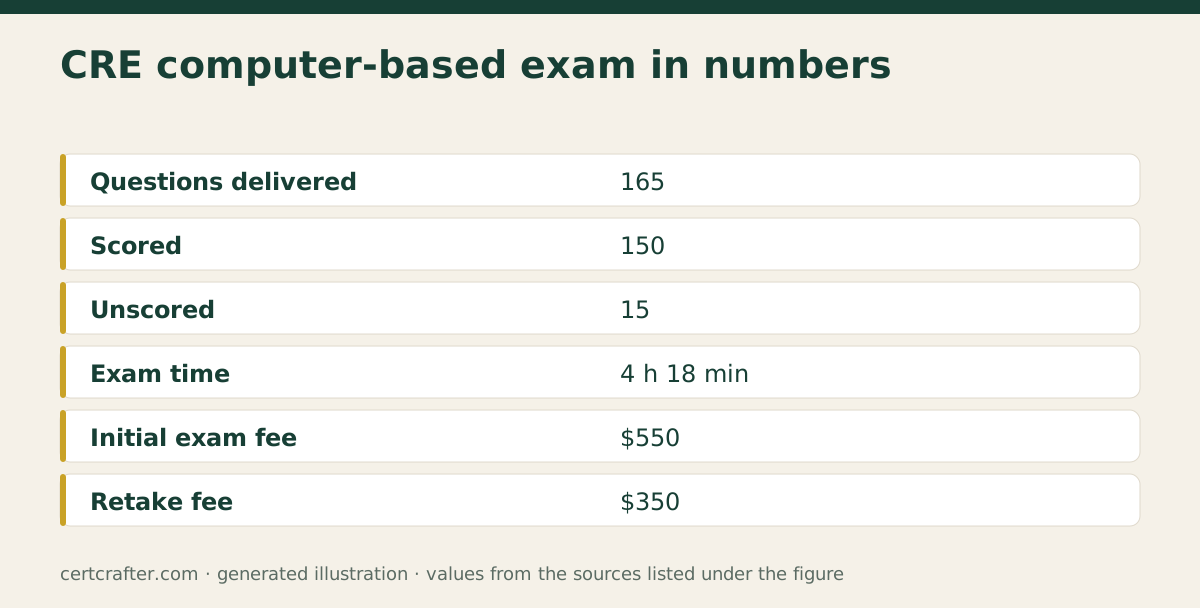
ASQ delivers the CRE by computer in one part: 165 questions, of which 150 are scored and 15 are not. Total appointment time is four and a half hours, with 4 hours 18 minutes of exam time. The paper version is 150 questions in four hours. Every question gets full effort, because you cannot tell which ones are unscored.
All ASQ exams are open book. Notes and references must stay bound, with post-its allowed as tabs only. Programmable calculators are not allowed, and a basic scientific calculator is on screen. Rehearse with your binder and a basic calculator.
What score do you need to pass the CRE?
A scaled 550 out of 750, set per form by a modified Angoff procedure. The raw number needed varies by form and is not published.
What does it cost, and when can you sit it?
The initial exam fee on ASQ’s page is $550, with a $100 saving for members, and a retake is $350. You need eight years of on-the-job experience, three of them in a decision-making position, with part of that waived for a degree.
The computer-based windows listed on ASQ’s certification page:
| Window | Application deadline |
|---|---|
| November 1 - 30, 2026 | October 12, 2026 |
| January 1 - 31, 2027 | December 7, 2026 |
| March 1 - 31, 2027 | February 8, 2027 |
The November deadline has passed, so January is the next one still open. A reschedule inside the rules costs $130, and you must make it at least five days ahead.
How should you use three free questions?
Not as a readiness test. They show whether a habit is sound. Read every explanation, including for the ones you got right, and log each miss by area and by the kind of error: wrong method, wrong gate, wrong arithmetic.
Then read ASQ CRE: The 10 Most Common Mistakes and ASQ CRE Formulas With Worked Examples. The ASQ CRE guide has the full fact sheet and the hub of CRE guides lists the rest. The next thing to do: take the three questions cold tonight, and write one line per question on what you would check first.
Comments
Comments are read by a person before they appear. How we moderate.