My 4 engineering books go FREE on Kindle Fri 6 – Tue 10 Nov (PT). See the books → FREE on Kindle now: all 4 engineering books, until Tue 10 Nov 11:59 pm PT. Ends in . Grab yours → My 4 books: FREE on Kindle Fri 6 – Tue 10 Nov (PT). See → FREE on Kindle now: 4 books, left Grab yours →

ASQ CRE Practice Questions, Set 2 (Free)

By Sandeep Bandyopadhyay, Senior aerospace engineer · PMP, MBA, Six Sigma

TL;DR

This second free set gives three more ASQ CRE questions with full explanations: a 2-out-of-3 fault tree, an availability requirement in a contract and a series string where redundancy is ruled out. The computer-based exam delivers 165 questions, 150 scored, open book. Passing is a scaled 550 out of 750 under the 2025 Body of Knowledge, and no raw percentage is published.

Original questions, not exam dumps. Every CertCrafter question is written from the published body of knowledge and the referenced codes. None is copied from a live exam, and CertCrafter is independent: not affiliated with or endorsed by any awarding body.

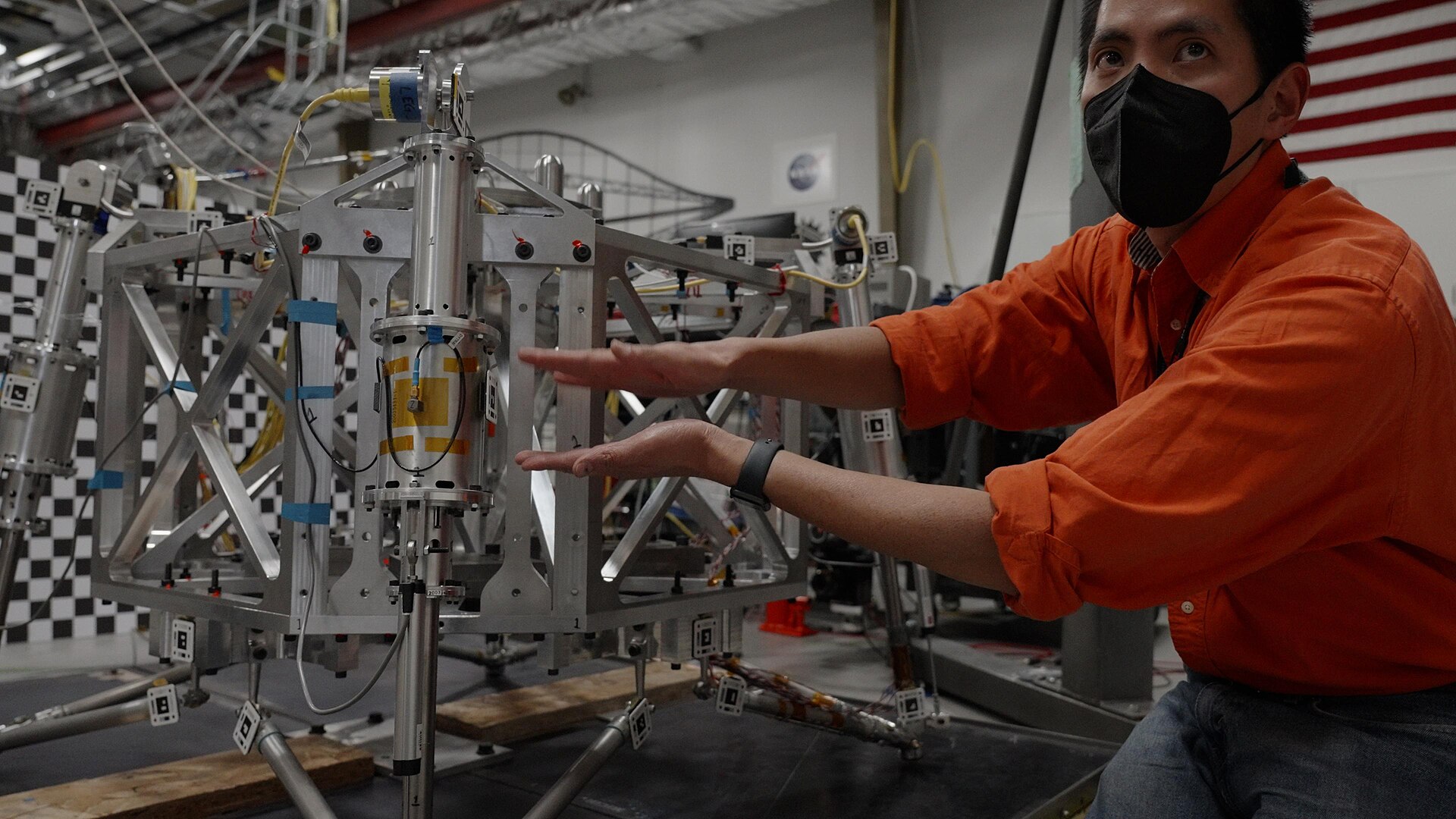
Engineers testing a prototype lander in a laboratory
Photo: Testing a Prototype Mars Lander (PIA25822) by NASA Jet Propulsion Laboratory / NASA/JPL-Caltech (Wikimedia Commons), Public Domain, via Wikimedia Commons.

Most CRE misses on system questions come from the sketch, not the arithmetic. Draw the wrong structure and every number after it is wrong too.
Video: ASQ CRE — Three reliability terms people mix up in interviews. ASQ CRE — Three reliability terms people mix up in interviews. Watch on YouTube · CertCrafter
Image: video thumbnail, source: CertCrafter on YouTube (@certcrafters).

What do these three free CRE questions test?

Each one gives you a situation and a constraint, and asks which structure or requirement fits. A voting arrangement in a furnace trip, an availability figure in a supply contract, and a satellite unit that cannot carry extra mass. They sit in Risk Management, Reliability Fundamentals and Lifecycle Reliability, three of the five areas in the 2025 Body of Knowledge.

The channel has a short on three reliability terms people mix up in interviews, which is a fair warm-up for the availability question below. The questions come from the free sample behind the CRE quiz. Choose your answer before you open the explanation.

How do you build a fault tree for 2-out-of-3 voting?

Start from what the system does, not from the word in the stem. A 2-out-of-3 trip means the burner shuts down when any two detectors call for it. So failure to shut down needs at least two channels to fail. That is three pairs, A with B, A with C and B with C, and any one pair is enough. An OR gate over three AND gates.
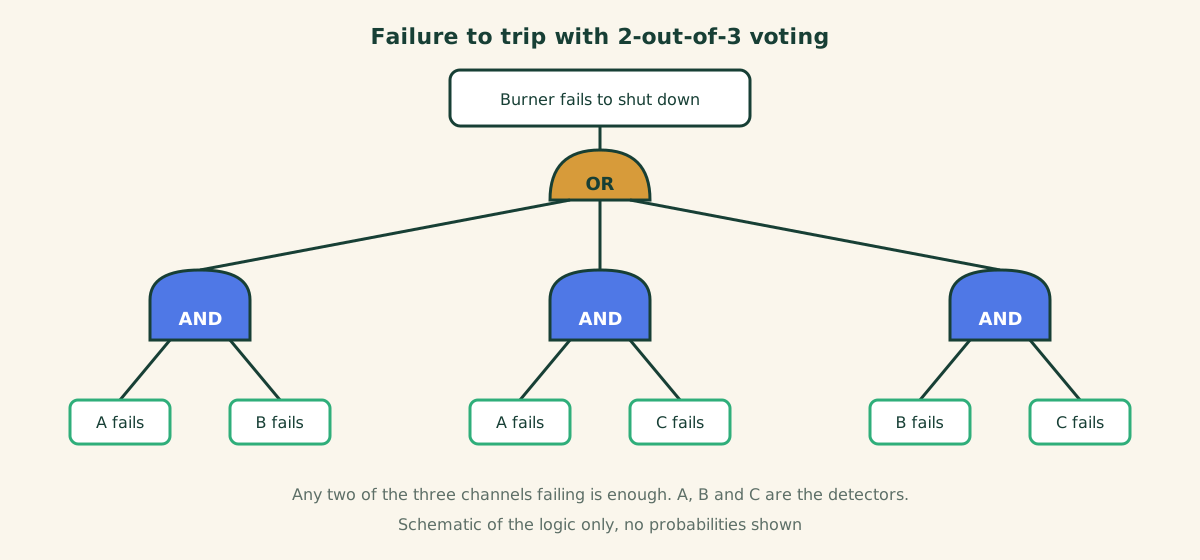
Fault tree: top event fed by an OR gate over three AND gates, each pairing two of the three detectors A, B and C
Illustration: CertCrafter, from the ASQ CRE certification page. Illustration: CertCrafter, from Certified Reliability Engineer (CRE) Certification | ASQ.

On a real plant this logic is argued out in a review with the instrument engineer, because the tree is only as honest as the independence assumption. Three detectors fed from one power supply or looking through one dirty sight glass share a cause, and the multiplication of three small probabilities stops being valid. A common cause event gets its own branch on the tree.

Candidates trip here by picking one big gate. A single OR gate says one failure loses the trip. A single AND gate says all three must fail. Neither matches the voting.

Why does an availability number alone not protect a buyer?

Because two very different machines can share it. Inherent availability is MTBF divided by MTBF plus MTTR, so a machine that fails rarely and takes long to repair can land on the same figure as one that fails often and is back up within the hour. The second interrupts operations many times more often, and the contract figure looks identical.

In practice the supplier chooses whichever is cheaper to deliver. Frequent short repairs suit a supplier with a big field crew. Rare long ones suit a supplier with a good design and a thin service network. The operator living with the first machine has a conveyor that stops every few days, and the number on the contract looks fine.

The second free question asks what the buyer should add. The fix is to pin both parameters, a floor on one and a ceiling on the other, and the options are written so that a tighter total or a penalty clause looks sensible. Notice what each option does to the trade between the two terms.

The ASQ CRE practice test bundle works more of these under timed conditions, with every answer explained.

An engineer examining a cluster of ion engines in a laboratory
Photo: Engineer Examines Cluster of Ion Engines in the Electric Propulsion Laboratory (GRC-1963-C-63281) by NASA Glenn Research Center (Wikimedia Commons), Public Domain, via Wikimedia Commons.

What do you do when redundancy is not allowed?

Go back to the series model. In a series string the system failure rate is the sum of the part failure rates, so every part you remove takes its share of the sum with it. That costs no mass. Parallel branches and voting arrangements add hardware, and voting adds a voter on top.

Design reviews on flight and plant hardware run through this sequence. First cut the part count and the interconnects, because each solder joint and connector contact is a failure rate in its own right. Redundancy comes later, and only where the budget allows it. The third question uses a 41 part string with a mass limit. The pull of the options is toward adding protection, and the constraint rules most of it out.

Burn-in is the other trap. It removes early failures from what ships, so the delivered population improves. The steady-state rate behind a mission prediction barely moves.

How is the CRE exam structured, and what does it cost?

ASQ delivers the CRE by computer in one part: 165 questions, of which 150 are scored and 15 are not. Total appointment time is four and a half hours, with 4 hours 18 minutes of exam time. The paper version is 150 questions in four hours. All ASQ exams are open book, and references must be bound and stay bound.

You need eight years of on-the-job experience, three of them in a decision-making position, with part of that waived for a degree. ASQ lists these costs and rules:
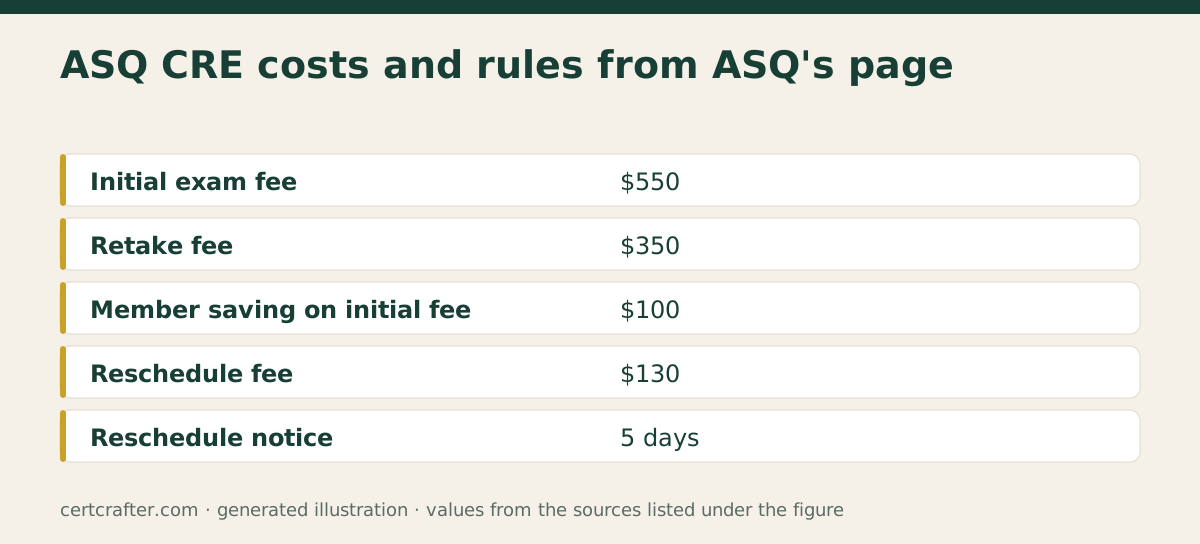
ASQ CRE costs: initial exam fee 550 dollars, retake 350 dollars, member saving 100 dollars, reschedule fee 130 dollars, reschedule notice 5 days
The CRE costs ASQ lists. Illustration: CertCrafter, from Certified Reliability Engineer (CRE) Certification | ASQ.

The computer-based windows on ASQ’s certification page:

Window Application deadline
November 1 - 30, 2026 October 12, 2026
January 1 - 31, 2027 December 7, 2026
March 1 - 31, 2027 February 8, 2027

The November deadline has passed, so January is the next window still open. Programmable calculators are not allowed, so practice on a basic one.

What score do you need to pass the CRE?

A scaled 550 out of 750 under the 2025 Body of Knowledge, set per form by a modified Angoff procedure. The raw number needed varies by form and is not published, so any percentage you see quoted is a guess.

How should you use a free set?

Read every explanation, including the ones you got right, and log each miss by area and by error type: wrong structure, wrong parameter, wrong constraint. Then read the first free CRE set and ASQ CRE: The 10 Most Common Mistakes. The ASQ CRE guide has the fact sheet and the CRE guide hub lists the rest. Tonight, sketch the 2-out-of-3 tree from memory, then check it against the picture above.

Try these free questions

  1. A furnace trip uses three independent flame detectors in two out of three voting, so the burner shuts down when any two channels call for trip. You are building a fault tree whose top event is failure to shut down on flame loss. What structure is correct?

    1. A single OR gate taking the three individual channel failures directly as its inputs
    2. A single AND gate taking the three individual channel failures directly as its inputs
    3. An OR gate whose three inputs are AND gates, each pairing a different two of the three channel failures
    4. A priority AND gate that orders the three channel failures by the time at which each one occurs
    Show the answer and explanation

    Answer: C. Two out of three voting means the trip occurs when any two channels demand it, so failure to trip requires at least two channels to fail to respond. In fault tree terms the top event is satisfied by any one of the three pairwise combinations, which is an OR gate over three AND gates, one for each pair. The case where all three channels fail is already contained within each pair, so no separate branch is needed for it. A single OR gate would make one channel failure sufficient to lose the trip, which is the logic of a one out of three arrangement rather than two out of three. A single AND gate would require all three channels to fail, which is the logic for a system that trips on any single channel demand. The priority AND gate encodes an ordering requirement in time, and nothing in the voting logic depends on which channel fails first.

  2. A contract sets a 0.98 availability requirement for a baggage handling system but says nothing separately about reliability or maintainability, so the supplier may meet it with frequent short repairs or rare long ones. What should the buyer add?

    1. Separate MTBF and MTTR floors, so fast repair cannot cover a poor design
    2. A higher availability figure of 0.99, which forces both parameters upward together
    3. A penalty clause tied to total downtime hours measured across each contract year
    4. A requirement that all spares be held on site to shorten the repair turnaround
    Show the answer and explanation

    Answer: A. Availability alone does not constrain the design, because MTBF/(MTBF + MTTR) can be satisfied by many pairs. A system with 500 hours between failures and a 10 hour repair gives 500/510 = 0.980, and one with 50 hours between failures and a 1 hour repair gives 50/51 = 0.980, yet the second fails ten times as often and interrupts operations ten times as often. Setting a floor on MTBF alongside a ceiling on MTTR pins both parameters, so the buyer gets a system that fails rarely and is also quick to restore. Raising the figure to 0.99 tightens the product but still lets the supplier trade one parameter against the other, leaving the same weakness. A downtime penalty is a commercial remedy applied after the fact, pricing poor reliability without preventing it. Mandating on-site spares dictates a solution rather than a requirement, and it touches logistics delay, which inherent availability does not even include.

  3. A satellite power conditioning unit has 41 discrete parts in one series string, and the mass budget rules out any added redundancy. The team must still raise predicted mission reliability. Which approach fits the constraint?

    1. Add an active parallel branch across the three highest failure rate parts and accept the resulting mass penalty.
    2. Apply a k-out-of-n voting arrangement across the converter stages so single part failures are tolerated.
    3. Integrate functions into fewer parts and cut interconnects, since a series string gains from a lower part count.
    4. Extend the burn-in duration so that early life failures are removed before any flight hardware ships.
    Show the answer and explanation

    Answer: C. In a series string of 41 parts the system failure rate is the sum of the part failure rates, so removing parts removes failure rate directly and costs no mass. Integrating functions, for instance replacing discrete regulation with a single controller, and cutting the count of solder joints and connector contacts attacks that sum at its source, which is why part-count reduction is the standard move when redundancy is closed off. Adding an active parallel branch across the three worst parts would help the prediction but breaks the mass constraint the question makes binding. A k-out-of-n voting arrangement is also redundancy, so it adds hardware and mass for the same reason, and it adds a voter as well. Longer burn-in removes infant mortality failures from the delivered population, which improves what ships without changing the steady-state failure rate the mission prediction uses, so the predicted number barely moves. Fewer parts and fewer interconnects is the action that fits both the physics and the budget.

Take the full free 10-question sample with scoring →

Frequently asked questions

How do these free CRE questions differ from the first set?

They cover other situations: voting logic in a fault tree, an availability clause in a supply contract, and design choices under a mass limit. The first set covered screening, a plain fault tree and stress against strength.

Is a calculator allowed in the ASQ CRE exam?

Yes, a basic one. Computer-based exams have an on-screen basic scientific calculator. Any silent, battery-operated calculator with no programmable memory is allowed, and models such as the TI-89 are not.

What score do you need to pass the CRE?

A scaled 550 out of 750, set for each form by a modified Angoff procedure. The raw number of correct answers needed varies by form and is not published.

Official sources

  1. Certified Reliability Engineer (CRE) Certification | ASQ — accessed 4 November 2026

Exam rules change. Check the awarding body's official page before you apply. CertCrafter is independent and is not affiliated with or endorsed by any awarding body.

Was this helpful?

Comments

    Comments are read by a person before they appear. How we moderate.