Most CRE candidates can recite the series formula. They lose marks by applying it to a system that is really parallel, or by feeding hours into a formula that wanted years.
Which formulas does the ASQ CRE actually use?
ASQ’s page says the computer-based exam has 165 questions, of which 150 are scored, and that every ASQ exam is open book. It also says the CRE Handbook can be used during the exam. So the real test is not “do you know the formula”. It is “do you know which one the situation needs, and what it assumes”.
Four carry a surprising share of the arithmetic. The exponential reliability, R(t) = exp(-t / MTBF), is the one to tie to a constant failure rate. A series system multiplies its reliabilities. An active parallel pair of identical units fails only when both fail, so R = 1 - (1 - R1)^2. Inherent availability is MTBF / (MTBF + MTTR), and it leaves out logistics delay and preventive maintenance.
That is the whole list I would put on a card. The rest of the page is about when each one is allowed.
 ASQ CRE — Six weeks to CRE, one hour a night. Watch on YouTube · CertCrafter
The channel’s short on six weeks to CRE, one hour a night gives a sense of how much time to give this arithmetic.
What does each formula assume?
The exponential form holds only while the failure rate is constant. That is the flat middle of the bathtub curve, not infant mortality and not wear-out. If a question gives a Weibull with a shape parameter above one, the rate is rising, and the exponential shortcut is wrong. Our reliability fundamentals post goes through what shape values below, equal to and above one mean for the failure mode.
Series and parallel need independence. Two pumps fed by one power supply are not independent, whatever the drawing looks like. Standby redundancy is a different animal from active parallel, because the spare is not wearing while it waits and a switch has to work.
On a plant, this is where the argument happens. A designer shows two pumps and claims near-perfect reliability. The reliability engineer asks what they share: one suction line, one breaker, one control card. Each shared item is a series block hiding inside the parallel pair.
Worked example: a parallel pair feeding a series block
These numbers are invented for practice, so check the method and ignore the figures.
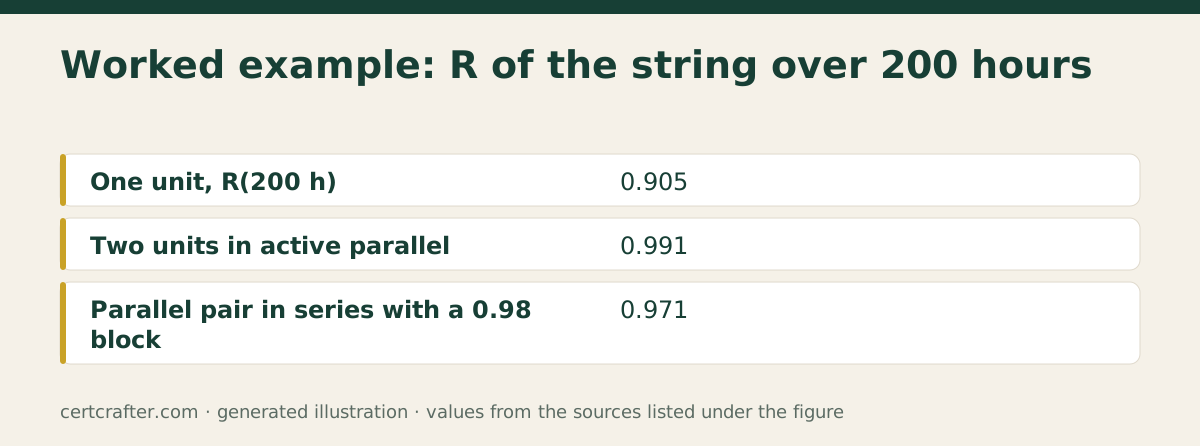
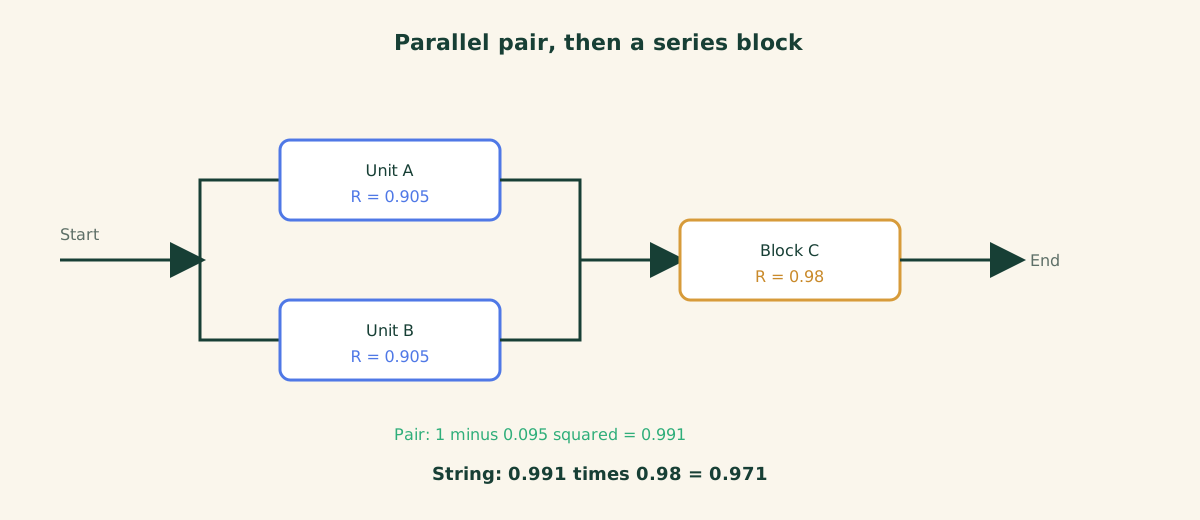
A unit has an MTBF of 2000 hours and a constant failure rate. Two of them run in active parallel and feed a third block with a reliability of 0.98 over the same mission. The mission is 200 hours. What is the reliability of the whole string?
- Convert one unit. The mission is a tenth of the MTBF, so
R = exp(-0.1), about0.905. - Combine the pair. Both must fail for the pair to fail, so
R = 1 - (1 - 0.905)^2. The unreliability of one unit is about0.095, its square is about0.009, and the pair is about0.991. - Combine the series. The pair and the third block must both work, so multiply
0.991by0.98. - The string reliability is about
0.971. - Sanity check. A string cannot beat its weakest series block, and
0.971is below0.98. It is.
The ASQ CRE practice test bundle works more of these under timed conditions, with every answer explained.
How is this used on real jobs?
Nobody on a project computes one string and stops. The same three steps run in a spreadsheet for every function in a system, and the useful output is the ranking. In the string above, the pair is already the stronger part, so the single series block is the weak point. Adding a third unit to the pair would buy almost nothing. Improving block C buys much more.
That ranking is the point of the exercise. A design review that spends its time on the strong part of the architecture has misread the numbers.

Availability gets the same treatment. A supplier quotes inherent availability from MTBF and MTTR. The operation sees downtime from spare-part delays and scheduled maintenance as well, so the figure on the quote is higher than the one the plant will live with. Ask which availability a number is before you compare it with another.
Where do candidates go wrong on exam questions?
The arithmetic is rarely the problem. The wrong options in a CRE question are usually correct calculations of the wrong thing, so reading the stem is half the work.
Watch for three patterns:
- Time units that do not match. An MTBF in hours and a mission in years gives an answer that is wrong by the number of hours in a year, and one of the options will be exactly that answer.
- The MTBF read as a median life. With a constant failure rate, reliability at the MTBF is about 0.368, not 0.5.
- The wrong availability. Inherent, achieved and operational availability all appear, and the first line of the stem names the one wanted.
Voting structures are a fourth. A two-out-of-three arrangement of independent channels is neither series nor parallel, and our free sample questions include a furnace trip built on one. Another asks for the reliability of a bridge network of identical blocks, where the method is conditioning on the bridging block, not multiplying along paths. Try both in the free sample quiz before you decide what to practice.
How do you practice this without memorizing?
Work the same system three ways. First as a series, then with one block doubled in parallel, then as two out of three. The numbers change, and so does the question you ask first. Write that question on the card, not the formula: what fails, what do the failures share, and what time are we looking at.
Then check the calculator. ASQ says computer-based exams include a basic scientific calculator on screen, and programmable models are not allowed. Run an exponential and a power on a basic one until it is routine.
What should you do next?
Take the string in this post and change one thing: double the mission length. Redo the three steps and see which block becomes the weak point. Then open the certification guide for the scoring and the five areas of the Body of Knowledge, and use the guides hub for the posts that go area by area, including the ten most common mistakes.
Comments
Comments are read by a person before they appear. How we moderate.