Plenty of reliability engineers have eight years in the field and still get a hold message. The years are there, but the three that ASQ calls decision-making are hard to show.
Who is eligible to take the ASQ CRE exam?
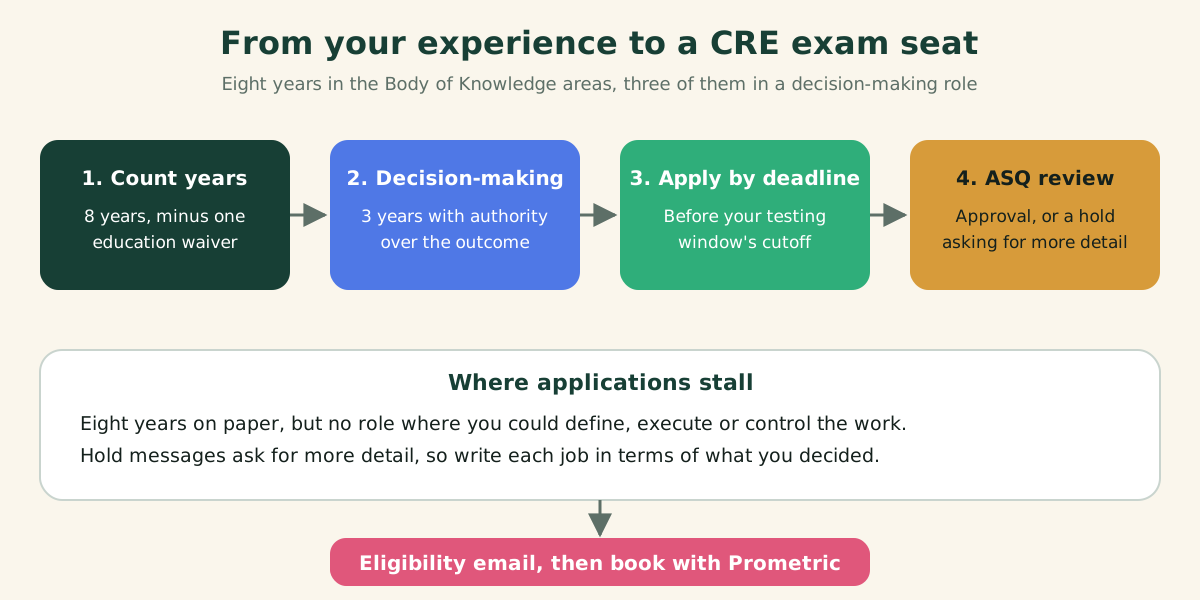
ASQ sets eligibility on its certification page: eight years of on-the-job experience in one or more areas of the CRE Body of Knowledge. Three of those eight years must be in a decision-making position, and the candidate must have worked in a full-time, paid role.
ASQ defines a decision-making position as the authority to define, execute or control projects or processes, and to be responsible for the outcome. It may or may not include management or supervisory titles. That last sentence matters on a real plant, because the person who owns the failure analysis program or signs off the test plan often has no direct reports at all.
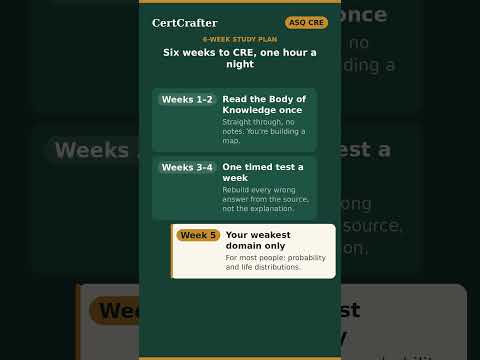 ASQ CRE — Six weeks to CRE, one hour a night. Watch on YouTube · CertCrafter
If you are already part way there, our channel has a short on how to plan six weeks to the CRE, one hour a night. Eligibility comes first, though.
How do degrees reduce the eight years?
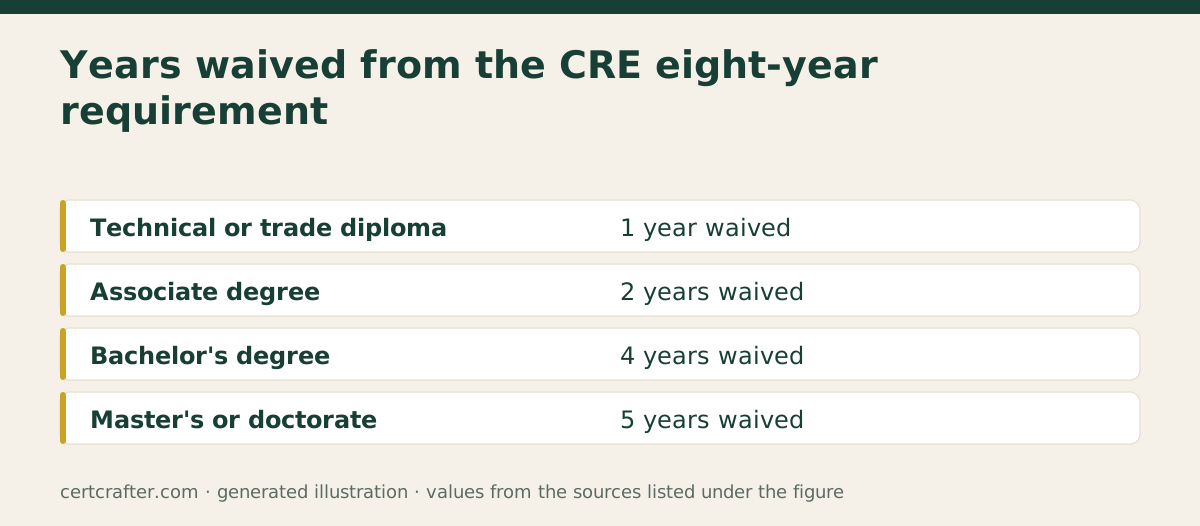
A completed degree from a college, university or technical school waives part of the eight-year requirement. The page lists four steps.
| Education | Years waived |
|---|---|
| Diploma from a technical or trade school | 1 |
| Associate degree | 2 |
| Bachelor’s degree | 4 |
| Master’s or doctorate | 5 |
You may claim only one of these. A bachelor’s followed by a master’s does not add up to nine years waived.
Prior ASQ credentials also count in your favor. ASQ says candidates previously certified as a quality engineer, quality auditor, software quality engineer or quality manager can often apply the experience that qualified them toward the CRE.
What counts as decision-making experience on a real project?
Think about who decided. A reliability engineer who chooses which failure modes go into the FMEA, sets the life test sample size and decides whether a Weibull fit is good enough to release a design is defining and controlling the work. Someone who runs the analysis a colleague specified is executing, and that fits the wording too, but only if they answer for the result.
Work that sits next to reliability is thinner. Pulling field return data for someone else, or building the spreadsheet another engineer interprets, is useful experience in the Body of Knowledge areas. It is a hard fit for the three decision-making years.
Worked example: checking your own years
Take an engineer with a bachelor’s degree and five years of full-time work in reliability.
- Start from eight years required.
- Claim the bachelor’s waiver of four years. That leaves four years of experience.
- Count the full-time, paid years in the Body of Knowledge areas. Five is above four, so the total is met.
- Now check the decision-making rule. ASQ states it as three years. ASQ’s page states the waiver against the eight-year total, so check with ASQ whether it also reduces the three.
- If only two of the five years carried real responsibility for the outcome, the application is at risk even though the total looks generous.
The total is the easy part. The decision-making years are where holds come from.
The ASQ CRE practice tests cannot fix a short experience record, but once ASQ says yes they give you six full open-book exams to rehearse with, every answer explained.
How do you apply, and what happens next?
ASQ lays out the process in four steps. You submit the application. ASQ reviews it, which takes 1 to 2 business days for online applications and 3 to 5 for hardcopy ones. You then get either an approval email or a hold message that says what more is needed. If ASQ decides you do not meet the requirements, you get a refund minus a $130 processing fee.
After approval, computer-based candidates receive an eligibility email 1 to 2 business days later, with instructions for scheduling through Prometric. You book inside the testing window you chose at application. Paper-based candidates get no eligibility email, but a seating letter about two weeks before the exam.
Write your application the way a reviewer reads it. For each role, give the dates, the employer, and one line on what you decided or controlled. A job description copied from HR does not do that.
What are the testing windows, deadlines and fees?
ASQ lists these computer-based windows on the CRE page.
| Testing window | Application deadline |
|---|---|
| November 1 to 30, 2026 | October 12, 2026 (passed) |
| January 1 to 31, 2027 | December 7, 2026 |
| March 1 to 31, 2027 | February 8, 2027 |
The exam fee is $550 and a retake is $350. ASQ members save $100 on the initial examination fee. Candidates who fail can apply at a reduced retake rate for 2 years from the previous attempt. Moving an appointment costs $130, and you must change it at least five days before. Skipping it loses all application fees.
On the day, arrive 30 minutes before your appointment. A late arrival means you cannot test and you forfeit the fee.
How does eligibility connect to how the exam is written?
The CRE is open book, and ASQ built it for people who have used these methods at work. The exam gives you the reference, so the skill it tests is picking the right method, not looking one up. That is the same bar as the decision-making rule: ASQ wants engineers who choose.
So the years you count are also your best preparation. If your decision-making experience sits mostly in risk and FMEA work, plan extra time for the statistics and test planning areas you have used less. Our common mistakes post shows where experienced candidates still drop marks, and the exam format post covers the 165 questions, the 150 that are scored and the scaled 550 out of 750 pass mark.
What should you do next?
Count your years against the table, then list each role with dates and the decisions you owned. If you want the January 2027 window, the deadline is December 7, 2026, so start now. Read the ASQ CRE guide, try the free sample questions, and browse the other CRE posts.
Comments
Comments are read by a person before they appear. How we moderate.