Most people plan a CRE attempt around the exam window. The date that actually binds is the application deadline, which falls weeks before the window opens, and the experience requirement behind it.
What does the ASQ CRE exam look like on the day?
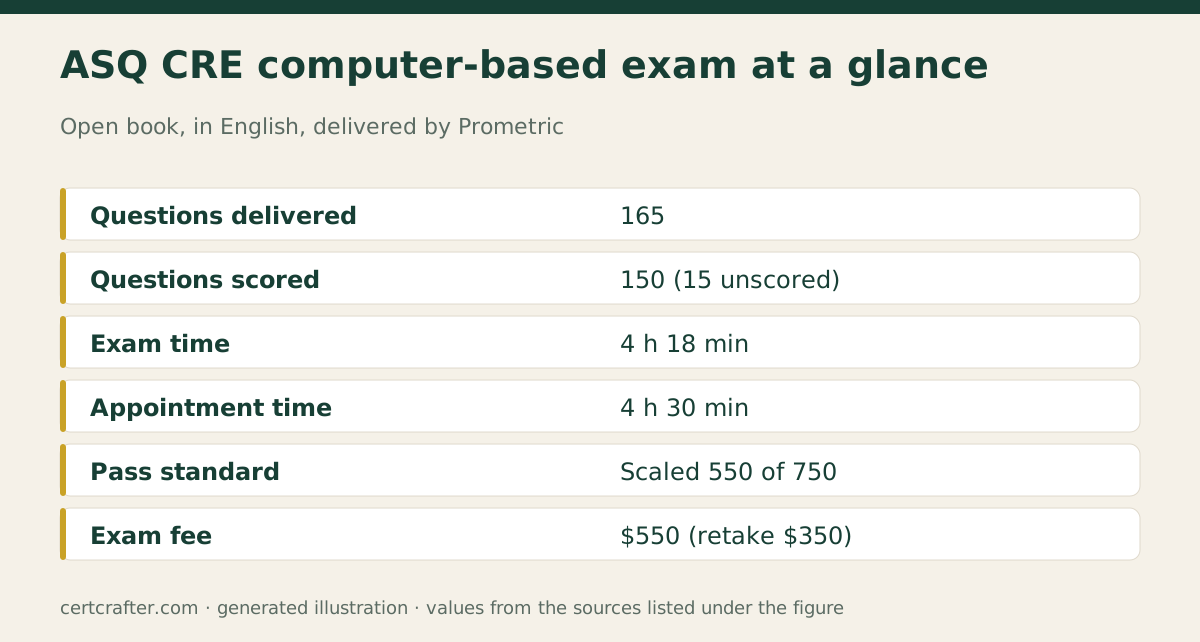
One part, 165 multiple-choice questions, in English only. Of those, 150 are scored and 15 are not. ASQ gives you an appointment of four and a half hours, and the exam clock itself runs 4 hours 18 minutes. The rest is check-in and housekeeping.
Do the arithmetic and each question gets a little over a minute and a half. That is fast for an exam with failure-rate calculations in it. The design only works if you already know which method a question is asking for.
ASQ also runs a paper-and-pencil version in certain locations: 150 questions, four hours, offered in English, Korean and Mandarin. The computer version is delivered through Prometric.
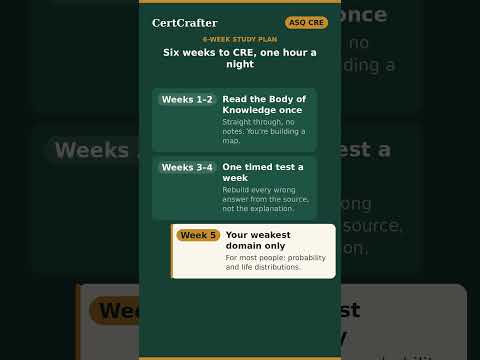 ASQ CRE — Six weeks to CRE, one hour a night. Watch on YouTube · CertCrafter
The channel has a short plan for the weeks before an attempt: six weeks to CRE, one hour a night.
Is the CRE really open book?
Yes, and it changes what you study. All ASQ exams are open book, and you bring your own references. Every reference and every form of notes must be bound: stitched or glued, or fastened inside a cover with fasteners that go through all the pages. Ring binders, spiral binders and screw posts count. Hand-stapled sheets do not. Post-its are allowed as book tabs only, and they must be attached before you enter the test center.
Calculators follow a simple rule. A basic scientific calculator is on screen in computer-based exams, and any silent, handheld, battery-operated calculator with no programmable memory is allowed. A TI-89 or similar is not.
A reliability group on a plant does the same thing with a binder on the shelf. Nobody memorizes the Weibull table. The skill is picking the right model for the failure data in front of you. The exam rewards that same skill, because a formula you can look up will not tell you which one applies.
How is the CRE scored?
The standard is a scaled 550 out of 750, set for each form by a modified Angoff procedure. Scaling keeps the standard steady across forms that differ a little in difficulty. So the number of raw correct answers behind a 550 changes from form to form, and ASQ does not publish it.
Treat any percentage you read online as somebody’s guess. The 15 unscored questions are not flagged, so answer all 165 as if each one counts.
On a computer-based attempt you see your result as soon as you submit. An email confirms it within 3 to 5 business days. If you do not pass, you get a performance summary by email in the same window, and for 2 years from that attempt you can apply at the reduced retake rate.
When are the next CRE windows and deadlines?
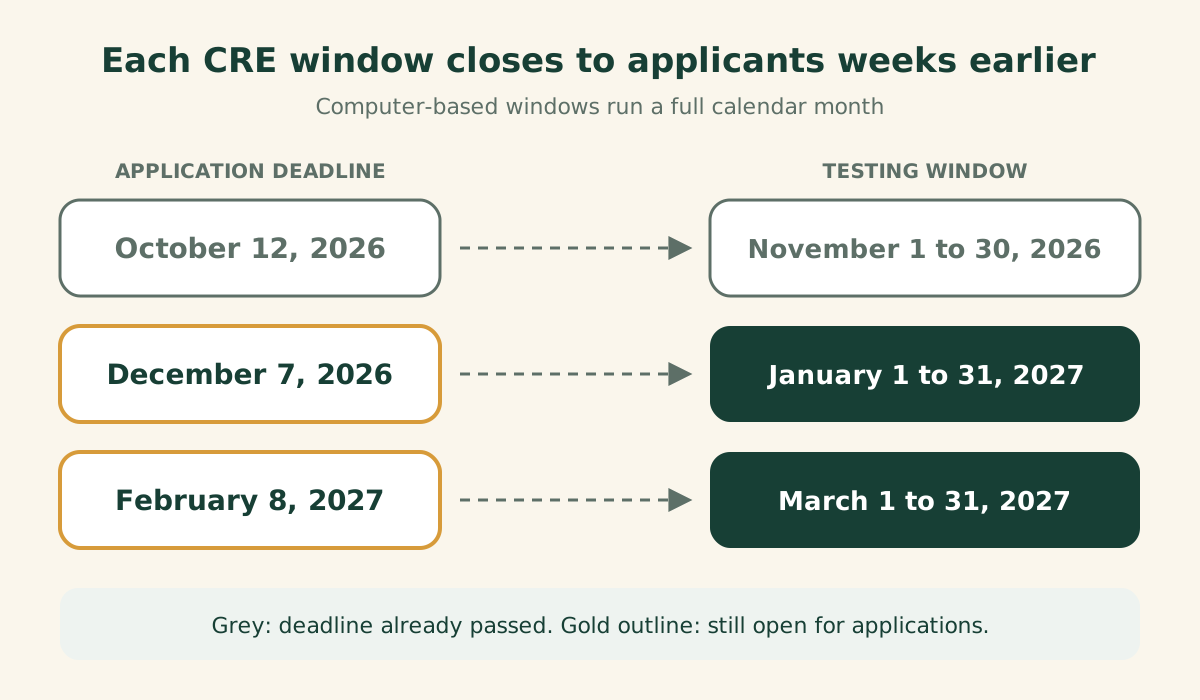
ASQ runs computer-based testing in a full calendar month, with the application closing well ahead. Here is what the page showed on November 7, 2026.
| Testing window | Application deadline |
|---|---|
| November 1 to 30, 2026 | October 12, 2026 (passed) |
| January 1 to 31, 2027 | December 7, 2026 |
| March 1 to 31, 2027 | February 8, 2027 |
Applications for the November window closed on October 12. The next one you can still apply for is January, and you have until December 7, 2026.
What does the CRE cost, and what if you need to move?
The exam fee is $550 and a retake is $350. ASQ members save $100 on the initial exam fee. After approval, you schedule your appointment with Prometric inside the window you chose on the application.
Changing an appointment costs $130, and you must do it at least five days before. Fail to appear and you lose all application fees. Arrive 30 minutes early, because a late candidate is not allowed to test and forfeits the fee. If ASQ finds you do not meet the requirements, the refund is the fee minus a $130 processing fee.
Who is eligible, and how does the experience requirement work?
ASQ asks for 8 years of on-the-job experience in one or more areas of the Body of Knowledge, in a full-time, paid role. At least 3 of those years must be in a decision-making position, meaning you have the authority to define, execute or control projects or processes and answer for the outcome. A title with “manager” in it is not required.
Education waives part of the eight years, and only one waiver can be claimed.
Worked example: a candidate with a bachelor’s degree
- Start with the 8 years the Body of Knowledge area experience requires.
- A bachelor’s degree waives 4 years, so 8 minus 4 leaves 4 years of on-the-job experience to document.
- The 3-year decision-making requirement still applies to the experience you claim.
- Compare: a technical or trade school diploma waives 1 year, an associate degree 2, and a master’s or doctorate 5.
- Apply online. Review takes 1 to 2 business days for an online application and 3 to 5 for hardcopy.
That arithmetic is the one thing to settle before you pay. People who work out the waiver after booking sometimes find a gap.
Where do candidates go wrong on the format?
Three patterns show up. They bring a spiral binder with a loose insert and find out at the desk. They study a percentage that does not exist. And they run the whole exam at the same speed, so the calculation questions eat the minutes the easy ones would have saved.
A habit that helps: first pass for the questions you can answer in under a minute, second pass for the calculations. With a binder you built yourself, the second pass is faster, since you know where each method lives. The ten most common CRE mistakes goes through the others, and the Reliability Fundamentals post covers what the first domain actually tests.
The ASQ CRE practice tests give you six full exams to rehearse that pacing, with every answer explained. The set holds 900 questions written to the 2025 Body of Knowledge.
What should you do next?
Open ASQ’s page and confirm the dates yourself. Then decide: apply by December 7 for January, or by February 8 for March. Write the deadline into your calendar before you do anything else.
Check your footing with the free sample quiz, read the certification guide and browse the other CRE posts. Dates change, so use ASQ’s own certification page as the source of truth.
Comments
Comments are read by a person before they appear. How we moderate.