ASNT UT Level II UT Equipment and Calibration: What the Exam Tests

By Sandeep Bandyopadhyay, Senior aerospace engineer · PMP, MBA, Six Sigma

TL;DR

ASNT publishes no weighting for equipment and calibration, but its topic list for UT exams after February 5, 2027 names the tasks: select equipment per procedure, set up and standardize it, calibrate contact, immersion or permanently installed systems. The UT General exam stays at 50 items in 2 hours. Expect situations where a probe, a couplant or a setting is wrong, and where the right answer is also about who may change it.

Original questions, not exam dumps. Every CertCrafter question is written from the published body of knowledge and the referenced codes. None is copied from a live exam, and CertCrafter is independent: not affiliated with or endorsed by any awarding body.

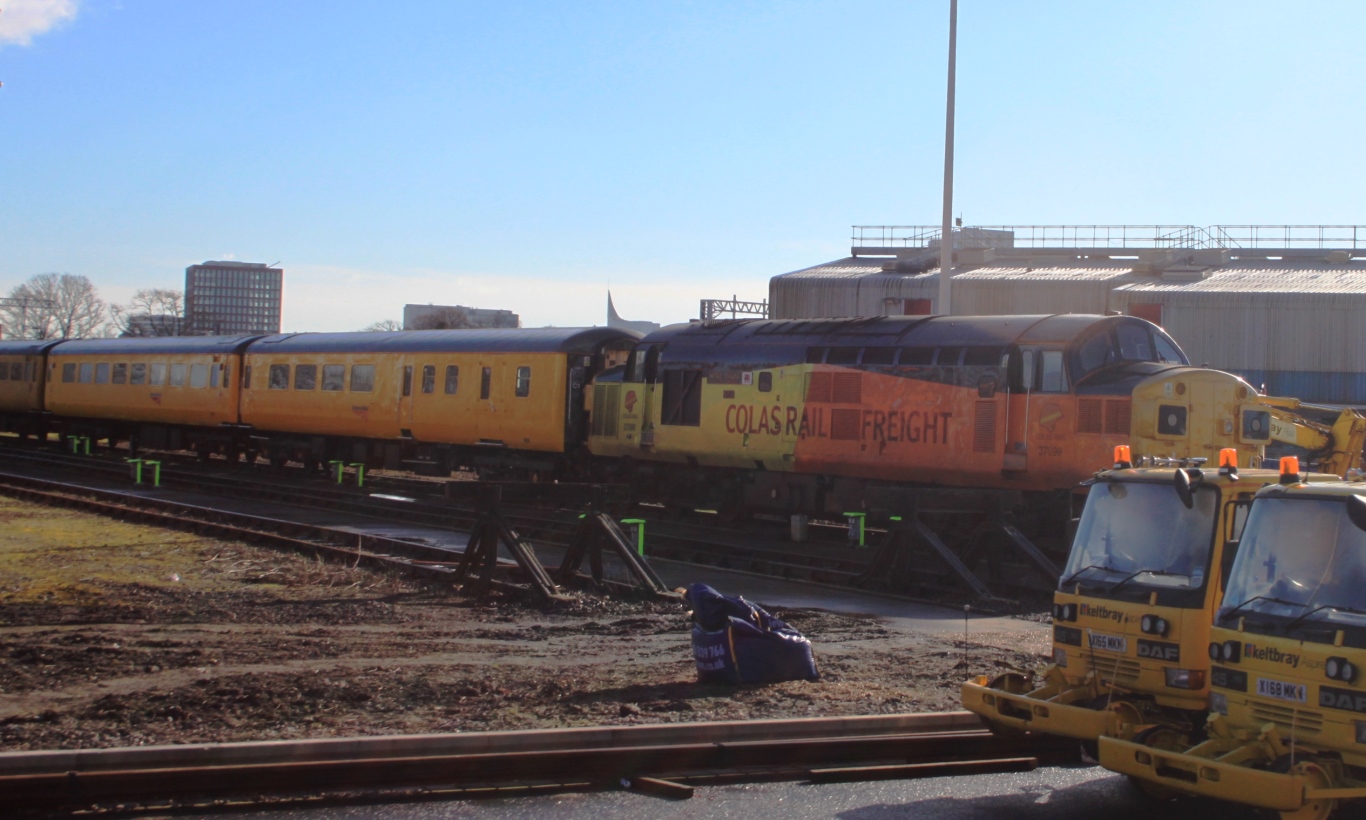
An ultrasonic test train used to inspect railway track
Photo: Reading Upper Triangle - Colas 37099 and Ultrasonic Test Train by Geof Sheppard (Wikimedia Commons), CC BY-SA 4.0, via Wikimedia Commons.

Most candidates can recite what a probe does. They lose marks when the stem hands them a worn wedge, a thin wall or a coarse casting and asks what to change, and whether they are even allowed to change it.

That is the whole domain. Equipment and calibration questions are decisions, and the decision has a physical reason and an authority attached.
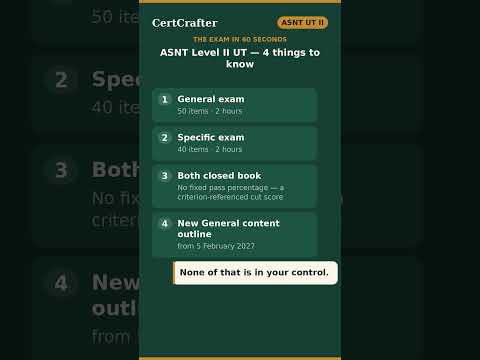
Video: ASNT UT II — The ASNT Level II ultrasonic exam in sixty seconds. ASNT UT II — The ASNT Level II ultrasonic exam in sixty seconds. Watch on YouTube · CertCrafter
Image: video thumbnail, source: CertCrafter on YouTube (@certcrafters).

What does ASNT actually list for UT equipment?

Less than you might hope, and more than the old outline did. ASNT’s examination page gives the UT General exam as 50 items in 2 hours and the Specific exam as 40 items in 2 hours. There are no percentages, so a weighting you read elsewhere is an estimate. Our certification guide covers how the central route differs from employer certification.

Under the outline for exams before February 5, 2027, equipment hides inside broad headings such as Review of Ultrasonic Techniques. After that date, the first group, UT Principles and Techniques, says it in plain verbs: manage UT equipment inventory, calibrate UT systems, select technique and equipment per procedure, and set up and standardize equipment. The examples in brackets name contact, immersion and permanently installed testing.

Our question banks use a domain called Equipment, Transducers and Calibration. That is our label for the study area, not an ASNT heading. The 2027 outline guide shows the change group by group.
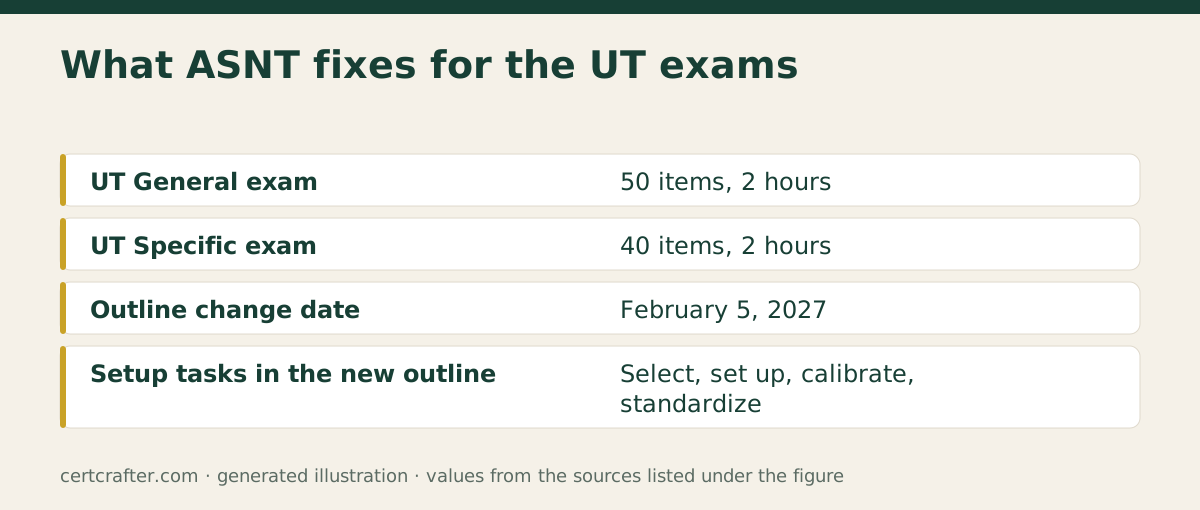
Four rows from ASNT's examination page: the UT General exam is 50 items in 2 hours, the Specific exam is 40 items in 2 hours, the outline changes on February 5, 2027, and the new outline names selecting, setting up, calibrating and standardizing equipment
What the exam page fixes for this domain. Illustration: CertCrafter, from ASNT NDT Level II Examinations: Information and Scheduling.

Why does a thin wall need a different probe?

Because the crystal is still ringing when the first echo comes home. A single element probe transmits and receives with the same crystal. On a pipe with roughly 4 mm of remaining wall, the back wall echo arrives while the transmit pulse is still decaying, and it is buried in the dead zone.

A dual element probe splits the work. One crystal transmits, the other receives, and an acoustic barrier sits between them. A small roof angle tilts the two toward each other so their beams cross at a shallow depth, which is where thin remaining wall lives.

One of our free questions asks why a corrosion mapping procedure forbids a single element contact probe on that pipe. The tempting options talk about near field length, higher frequency or no couplant. Near field is the argument backwards, frequency is a separate choice, and couplant is still needed, more so on a corroded surface. The right answer is the dead zone and the roof angle.

In the field, the same logic explains why a thickness crew keeps a dual element probe in the bag for pitted wall and does not reach for the probe on the instrument.

What does couplant have to do with calibration?

It is the reason the sound gets in at all. The sample question on immersion work makes the point, and it is the one worked example in this post.

Worked example: how much sound crosses from water into steel?

The question gives the acoustic impedance of steel and of water, at normal incidence on a flat front surface, and asks what share of the energy crosses into the steel.

  1. Subtract the two impedances. Steel is far larger than water, so the difference is nearly as big as steel’s own value.
  2. Add the two impedances.
  3. Divide the difference by the sum. The ratio comes out close to one.
  4. Square it, because the question asks about energy and the ratio is an amplitude measure. Squaring gives the share reflected, and it is still large.
  5. Subtract the reflected share from one. What is left is the share that crosses, and it is small.

Two slips make up the wrong options. Forgetting to square gives a transmitted share that looks far too good. Reporting the reflected share as the transmitted share swaps the two answers. Read the last line of the stem before you start.

Even the small share that crosses from water is generous. Between steel and air, almost nothing crosses, and displacing air is the whole reason for a couplant. The kit works more of these under timed conditions, with every answer explained.
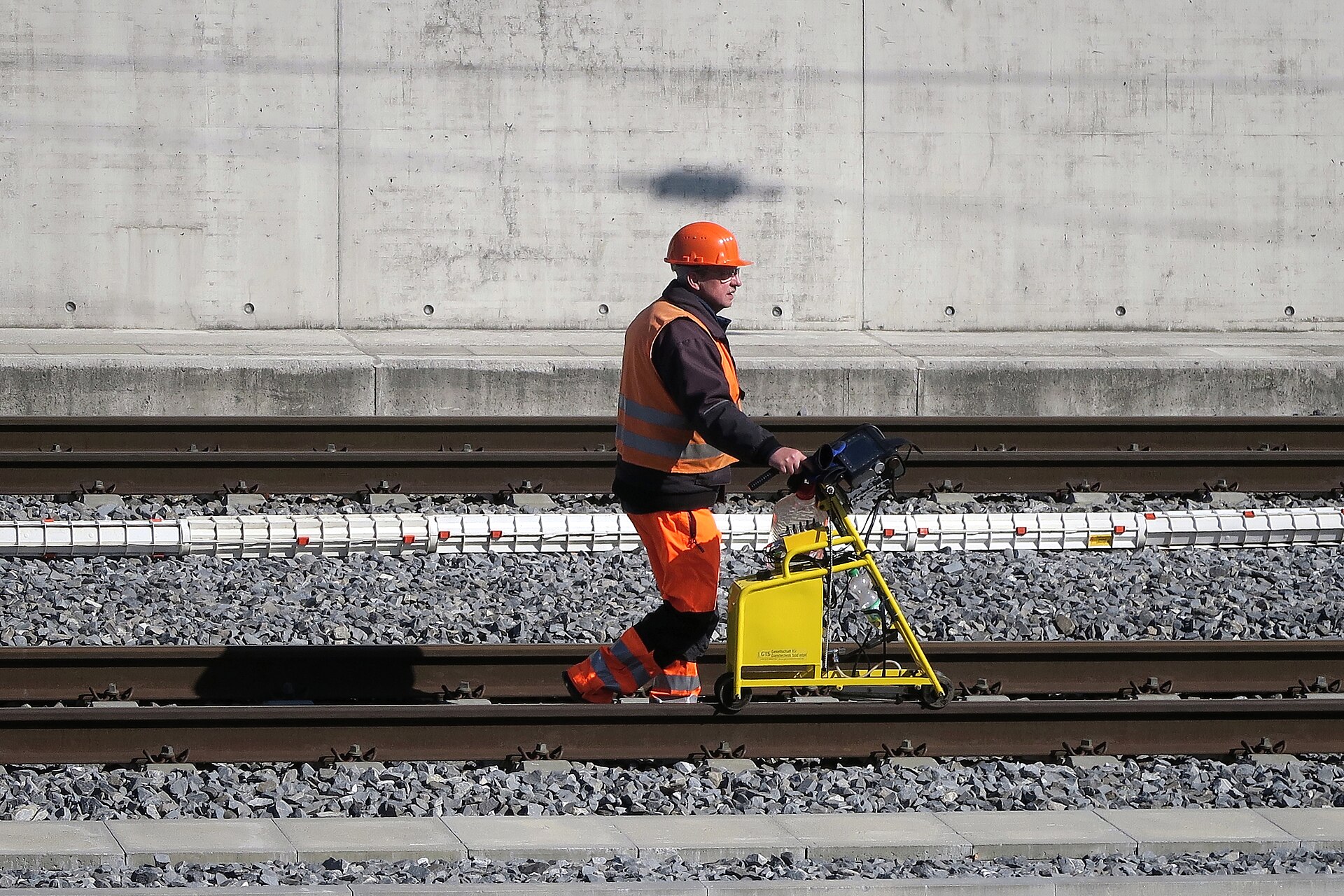
An ultrasonic testing machine on a work bench
Photo: SBB NEAT - Ultrasonic Testing (25479008920) by Kecko from Rural area, Eastern Switzerland (Wikimedia Commons), CC BY 2.0, via Wikimedia Commons.

What is the difference between setting up, calibrating and standardizing?

On the new outline they appear as separate tasks, and a stem can lean on the difference. Selecting equipment comes first, and it is done per procedure, not by preference. Setting up and standardizing is the hands-on part: the instrument, probe and cable are brought to the condition the procedure describes. Collecting data and verifying data quality come after, and both are tied to procedure requirements.
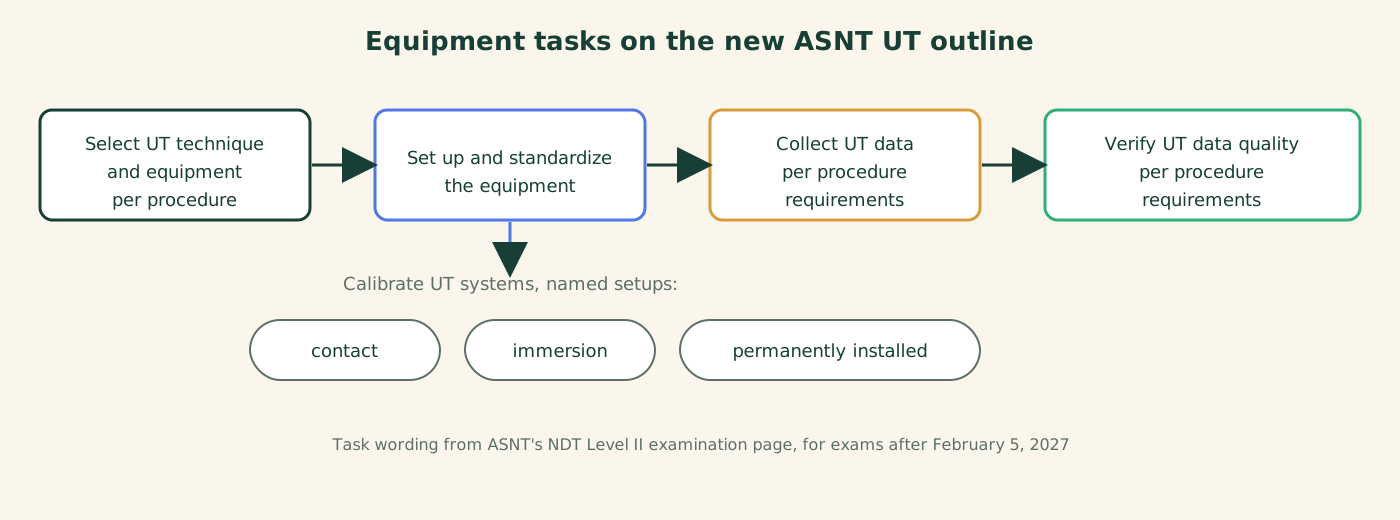
Four boxes in order: select UT technique and equipment per procedure, set up and standardize the equipment, collect UT data per procedure requirements, verify UT data quality per procedure requirements, with contact, immersion and permanently installed shown as setups for calibration
The order of the equipment tasks on the new outline. Illustration: CertCrafter, from ASNT NDT Level II Examinations: Information and Scheduling.

Notice what is missing from that list: choosing a different technique because you prefer it. Every box ends in the word procedure.

What happens on a job when the procedure’s frequency does not work?

A Level II is scanning a coarse grained austenitic casting. At the frequency the procedure specifies, the back wall echo fades and grass rises. The technician is sure a lower frequency would penetrate.

His physics holds. Grain scatter climbs steeply with frequency once the grains are large against the wavelength, so a lower frequency, with its longer wavelength, usually restores the back wall. But the free question we use here is not a physics question. It asks what he is permitted to do.

A Level II may set up equipment, calibrate, interpret, evaluate and report. The procedure is a controlled document, so a specified frequency is not his to change. The right move is to record the attenuation and the loss of back wall, work to the procedure, and take the change to the Level III for a revision. Declaring the casting untestable throws away a technique nobody has tried yet. Adding gain is the worst option, since grass and signal rise together and the ratio does not improve.

On a plant job this is a Tuesday afternoon. The crew writes down what they saw, the Level III reviews it, the procedure is revised, and only then does the new probe go on the part.

How do candidates lose marks in this domain?

First, by answering with true physics to the wrong question. A dual element probe does have a pseudo-focus, but the exam asks why it is chosen for thin wall, and that reason is the dead zone.

Second, by treating gain as a repair. Raising it lifts noise and signal by the same amount.

Third, by using the Level II role loosely. Setting up and calibrating belong to a Level II. Changing a procedure parameter does not.

Fourth, by mixing up amplitude and energy. When a stem says energy or percent of energy, square the amplitude ratio before you answer.

How should you study it?

Take each piece of equipment and attach one situation to it: a dual element probe to thin wall, a couplant to the impedance gap, a frequency change to the Level III. Then try the free ten-question sample and note which explanations surprise you. The UT physics guide covers the refraction and dead zone ideas that sit under all of this, and the study guides hub lists the rest. Our channel also has a short video on the exam: the ASNT Level II ultrasonic exam in sixty seconds.

Tonight, write one situation where changing a setting is the wrong call, and name who would approve it.

Try these free questions

  1. A corrosion mapping procedure for a pipe with roughly 4 mm of remaining wall specifies a dual element probe and forbids the use of a single element contact probe. What technical justification is the procedure relying on?

    1. A dual element probe has a longer near field, so thin sections fall outside the confused zone
    2. A dual element probe automatically works at a higher frequency, giving finer thickness resolution
    3. Separate transmit and receive crystals remove the initial pulse dead zone, and the roof angle crosses the beams inside the thin remaining wall
    4. A dual element probe needs no couplant, which matters on the rough surface left by corrosion
    Show the answer and explanation

    Answer: C. In a single element probe the crystal is still ringing from the transmit pulse while the first echo from a thin wall is arriving, so the back-wall signal is buried in the dead zone. A dual element probe splits the functions: one crystal transmits, the other receives through an acoustic barrier, so the receiver is not blinded by the main bang. The small roof angle tilts the two elements towards each other so their beams cross at a shallow depth, which is where the useful sensitivity for thin remaining wall sits. The first option has the near field argument backwards; the pseudo-focus of a dual element probe shortens the effective usable zone near the surface rather than lengthening it. The second option confuses probe construction with frequency, which is a separate choice. The fourth option is simply untrue, since couplant is still required, and rough corroded surfaces in fact demand more attention to coupling, not less.

  2. An immersion tank couples through water. Steel has an acoustic impedance of 45.4 x 10^6 kg/m2s and water 1.48 x 10^6 kg/m2s. At normal incidence on the flat steel front surface, what percentage of the incident energy crosses from the water into the steel?

    1. About 6 percent
    2. About 88 percent
    3. About 94 percent
    4. About 12 percent
    Show the answer and explanation

    Answer: D. The energy reflection coefficient at a normal interface is the square of the impedance difference divided by the impedance sum. The difference is 45.4 minus 1.48, which is 43.92, and the sum is 46.88, so the ratio is 0.937. Squaring gives 0.878, meaning about 88 percent of the energy comes straight back off the front surface and roughly 12 percent gets into the steel. That mismatch is far smaller than the one between steel and air, where almost nothing crosses, and displacing air is the whole reason a couplant is used at all. The 88 percent option reports the reflected share as though it were the transmitted share, a simple mix up of the two. The 94 percent option forgets to square the ratio and then reports it as transmission. The 6 percent option forgets to square as well but subtracts correctly afterwards, giving 100 minus 93.7, and both of those errors come from working in amplitude while the question asks about energy.

  3. A Level II scanning a coarse grained austenitic casting watches the back wall echo fade while grass rises across the screen at the 5 MHz the procedure specifies. He is confident 2.25 MHz would penetrate. What is he permitted to do?

    1. Switch to 2.25 MHz on his own authority, since a Level II is qualified to select equipment, set it up and calibrate it.
    2. Stop and declare the casting untestable by ultrasonics, because grain scatter at any frequency will mask genuine reflectors.
    3. Record the attenuation and the loss of back wall, work to the 5 MHz called for, and take the frequency change to the Level III for a procedure revision.
    4. Add 20 dB of gain instead, which brings the back wall echo back up to its former height without any departure at all from the parameters the written procedure specifies.
    Show the answer and explanation

    Answer: C. His physics is right and his authority is not. Scattering from coarse grains climbs steeply with frequency once grain size becomes appreciable against the wavelength, so dropping to 2.25 MHz lengthens the wavelength, cuts scatter and usually restores the back wall. A Level II may set up equipment, calibrate, interpret, evaluate and report, and may give on the job training under a Level III, but the procedure is a controlled document and changing a specified parameter is the Level III's call. The correct move is to record what he sees, work to the procedure and raise the change formally. Declaring the casting untestable throws away a technique that has not been tried yet. Piling on 20 dB is the worst option because grass and signal rise together, so the signal to noise ratio does not improve at all and the screen simply fills with noise while the operator convinces himself he has gained penetration.

Take the full free 10-question sample with scoring →

Frequently asked questions

Does ASNT publish how much of the UT exam is equipment and calibration?

No. ASNT lists topics and tasks but does not release weights. Any percentage you see for this area is an estimate, not an ASNT figure.

Is calibration named in the new UT General outline?

Yes. For exams after February 5, 2027, the UT Principles and Techniques group lists calibrating UT systems, with contact, immersion and permanently installed systems as examples, and setting up and standardizing equipment.

Can a Level II change a frequency that the procedure specifies?

A Level II may set up equipment, calibrate, interpret, evaluate and report. The procedure is a controlled document, so changing a specified parameter goes to the Level III.

Official sources

  1. ASNT NDT Level II Examinations: Information and Scheduling — accessed 13 November 2026
  2. ASNT NDT Level II Certification: Foundational Credential — accessed 13 November 2026

Exam rules change. Check the awarding body's official page before you apply. CertCrafter is independent and is not affiliated with or endorsed by any awarding body.

Was this helpful?

Comments

    Comments are read by a person before they appear. How we moderate.