Most UT Level II candidates can recite the impedance formula and still lose the question. They multiply at the wrong surface, or forget that the sound crosses the front surface twice.
The formulas are short. The order you use them in is what gets tested.
 ASNT UT II — Six weeks to Level II UT while working shifts. Watch on YouTube · CertCrafter
What is the chain of ideas behind UT calculations?
It is a chain of three links, and each feeds the next. Acoustic impedance, written Z = ρ × V, is the density of a material times the speed of sound in it. When a wave meets a boundary where the two impedances differ, part of it reflects and part crosses. The bigger the difference, the more reflects. Whatever does not reflect is transmitted, so the two energy fractions always add to one.
NDE-Ed.org, the NDT education site we use as a source here, states the energy version of this plainly. The reflected fraction is R = ((Z2 − Z1) / (Z2 + Z1)) squared, and the transmitted fraction is T = 1 − R. Amplitude coefficients exist too, and they do not add to one, which is a trap we come back to.
Snell’s law is the fourth formula and it works on angles: the sine of the angle divided by the velocity is the same on both sides of the boundary. It is the reason a wedge sends a beam into the steel at a different angle than it meets the interface. Our UT physics guide shows how that plays out in angle beam setup, so this post stays with impedance and energy.
That is the whole kit for the sums below. Four formulas, and a fifth only if you count T = 1 − R separately.
Why do impedance mismatches matter on a real job?
Because they decide how much of your signal exists at all. Couplant is the everyday example. A probe pressed on dry steel leaves an air gap, and the impedance mismatch between air and steel is so large that almost nothing crosses. Water, gel or oil closes the gap and the mismatch drops.
Immersion tanks make the same point from the other side. Water is a far better match to steel than air, yet most of the energy still bounces off the front surface. Technicians who set up scans of forgings or plate learn to expect a strong front surface echo and a weak return from the back, and they set gain with that in mind.
The practical lesson: a weak back wall is not always a fault in the part. Check the interfaces first, then the part.
Worked example: a steel block in an immersion tank
This is the case NDE-Ed.org itself walks through, and it is a good template for exam questions. A transducer sends sound through water into a steel block. Take the reflected energy at the water to steel front surface as 88%, which the source gives for this pair of materials. Attenuation inside the steel is ignored.
- Find what crosses the front surface. Transmitted energy is one minus the reflected fraction, so
1 − 0.88 = 0.12. Twelve percent enters the steel. - Follow it to the back surface. Steel to water is the same pair of materials viewed from the other side, so the mismatch is the same and 88% of that 12% reflects. That is
0.12 × 0.88, which is 10.6% of the original energy. - Send it back out. The return trip crosses the front surface once more, and again only 12% gets through. So
0.12 × 0.106gives about 1.3% of the original energy back at the transducer. - Read the result. Of everything the probe sent, roughly one percent comes home, even with no flaw and no attenuation.
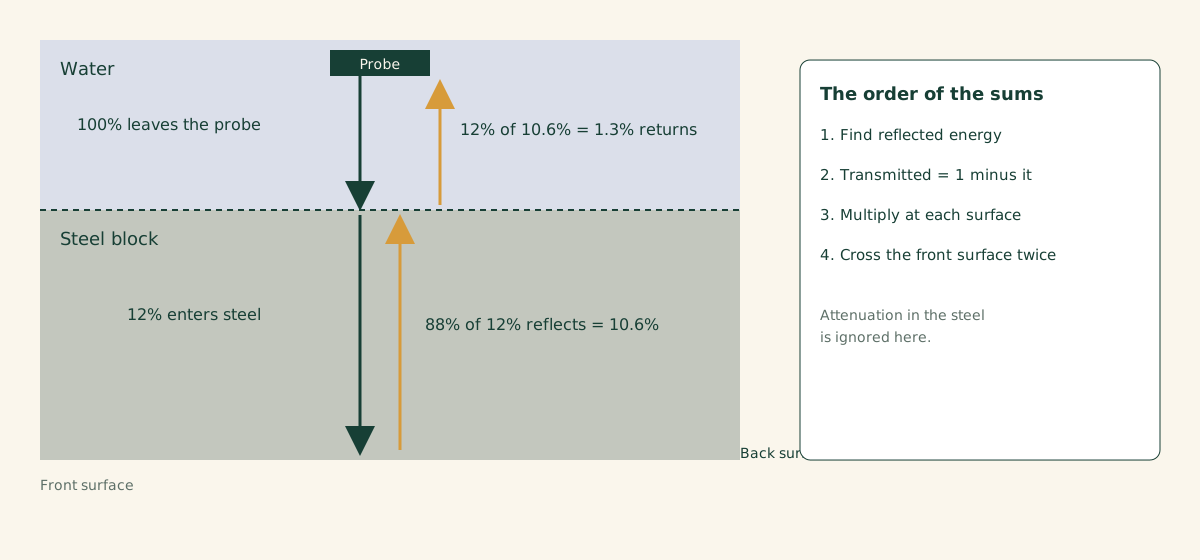
Notice the shape of the method: reflect, subtract, multiply, repeat for each surface crossed. Any exam question with two interfaces uses it.
The practice test bundle work more of these under timed conditions, with every answer explained.
Where do candidates go wrong on the calculations?
The traps are rarely in the arithmetic. They are in the setup.
The first is using the amplitude coefficient where the question asks about energy. The two do not match, and NDE-Ed.org notes that the amplitude reflection and transmission coefficients do not add to one because amplitude is not conserved across the boundary. Energy is. If a stem says energy, intensity or percentage of energy, square the ratio.
The second is stopping after one surface. A question that mentions a back wall and a return to the probe is asking for at least two crossings. Count the interfaces in the sentence before you touch the calculator.
The third is reading the impedance values backward. The reflected fraction does not change if you swap Z1 and Z2, since the difference is squared. Candidates still lose time worrying about which is which. Sign matters only for the amplitude version.
The fourth is skipping the procedure. A free question in our sample puts a forging procedure in front of you with a 3 mm flat bottom hole reference and a separate back reflection limit. It tests whether you read both criteria, which is a procedure skill and not a formula.
How is this framed on the ASNT exam?
The General exam is 50 items in 2 hours, and it is closed book. ASNT’s examination page lists topic headings and gives no formula list or weighting. Its General outline changes on February 5, 2027, so confirm which outline applies to your booking.
Stems give you the numbers. Expect impedances, velocities or angles in the question and a request for a percentage, a ratio or a decision. ASNT publishes no fixed pass percentage, so there is no score to chase on the calculation items. The aim is to make them routine.
The terms people mix up post covers the vocabulary side, such as attenuation against impedance mismatch.
What should you do next?
Take one pair of impedance values from your training text and run the four steps above on paper, twice, without looking. Then try the free ten-question sample to see how the stems are framed. The certification guide explains the ASNT central route against employer certification, and the study guides hub lists the rest of the series.
Comments
Comments are read by a person before they appear. How we moderate.