Most people who fail or stall on ASNT Level II do not fail on sound physics. They fail on the things around it: which certification they are chasing, which outline they studied, what the paperwork needs, and what a Level II is allowed to decide. Here are the ten that show up most, with the reason each one bites on a job and in the exam.
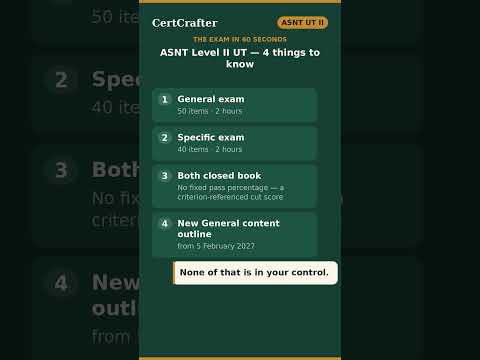 ASNT UT II — The ASNT Level II ultrasonic exam in sixty seconds. Watch on YouTube · CertCrafter
If you want the short version first, our channel has the ASNT Level II ultrasonic exam in sixty seconds.
Which route am I actually on: ASNT central or SNT-TC-1A?
This is mistake one, and it poisons everything after it. ASNT NDT Level II is ASNT’s own central programme. SNT-TC-1A is a recommended practice under which your employer certifies you against its written practice. Two routes, two sets of rules.
On a plant, the difference decides who owns your certificate when you change jobs and whose procedure you work to. In the exam, it decides which facts apply to you. Check your route before you read a single study note, because plenty of material blurs the two.
Is there a fixed pass percentage?
Not one that ASNT publishes. Mistake two is memorizing a number. ASNT uses a criterion-referenced cut score for its central exams, and our product data notes ASNT gives no fixed percentage.
The famous “70, 70, 80” rule belongs to SNT-TC-1A employer certification, and the version in circulation is garbled. The actual rule is at least 70% on each of the general, specific and practical examinations, plus a composite average of at least 80%. Studying to a magic number wastes effort that should go into the weak topics.
Which outline applies to my booking?
Mistake three costs the most hours. ASNT lists the UT General exam under two outlines: one for exams prior to 5 February 2027, one for exams after it. Both are 50 items in 2 hours. The old outline has six headings. The new one has four groups, written as tasks: calibrate UT systems, develop scan plans, characterize indications, administer UT tests.
If your date falls after the change and you studied the old list, you prepared for the wrong paper. Our guide to the 2027 outline walks through both. Pick your date first, then pick your notes.
Who gives the practical and the vision exam?
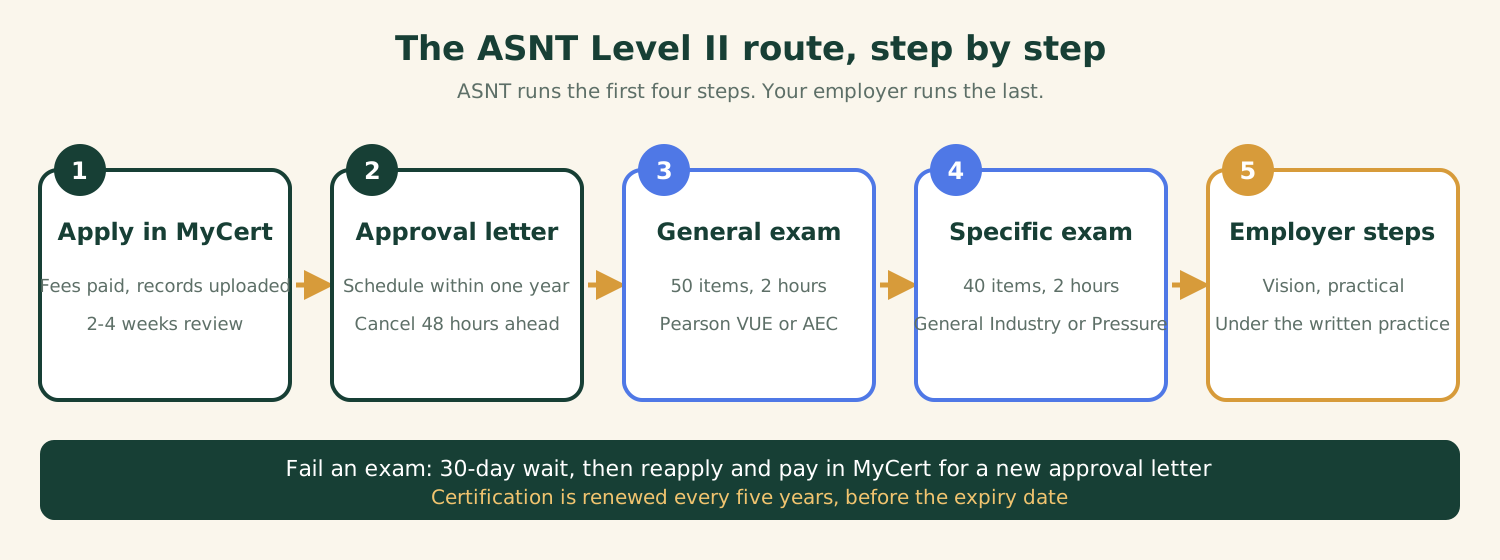
Not ASNT. Mistake four is assuming the central exams complete the job. ASNT’s pages say employers carry out visual acuity, practical and any job-specific exams their written practice needs.
So the computer-based General and Specific papers get you through one door only. Ask your Level III early what your employer expects, how the practical is run and who signs it off. A candidate who passes both papers and then waits months for a practical slot has made a planning mistake, not a knowledge one.
Do I need both a General and a Specific exam?
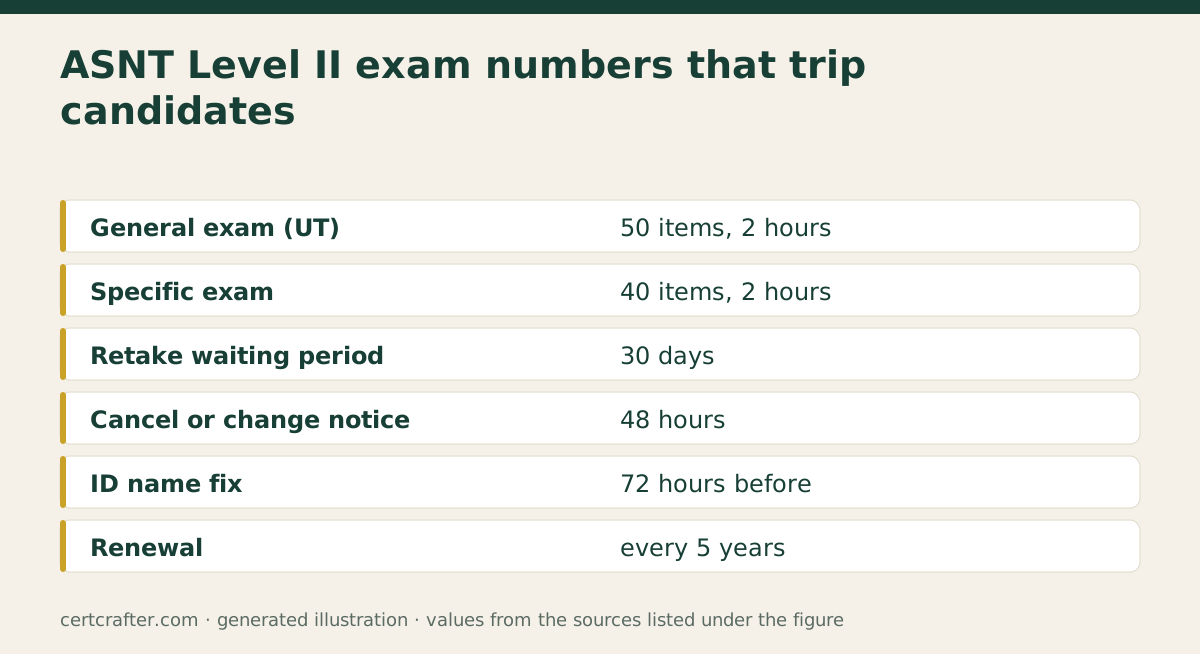
Yes, for initial certification. Mistake five is booking one paper. An initial applicant must apply for and pass at least one General exam and one Specific industry exam. The UT General is 50 items and the Specific is 40 items, each 2 hours, and the Specific comes in General Industry or Pressure Equipment Sectors.
Both are closed book. Many candidates over-invest in the General because it is the one with the long topic list, then meet the Specific with codes and applications they have never practiced.
What goes wrong on the day and in the paperwork?
Mistake six is treating logistics as an afterthought, and the rules are strict. ASNT’s page gives these:
- Bring two original, valid forms of ID, a primary government ID with name and signature and a secondary with name and signature or photo.
- The name on the ID must match your application and your MyASNT record. If it does not, contact ASNT at least 72 hours before the exam.
- Arrive at least 30 minutes early and plan at least half a day.
- Change or cancel at least 48 hours in advance, or lose your exam fees.
- Schedule and complete every exam you applied for within one year of the letter of approval.
What does a failed attempt really cost?
Mistake seven is assuming a retake is quick and cheap to arrange. ASNT’s fee table lists an initial UT exam at $740 for members and $820 for nonmembers, and a retake at $370 and $410. After a fail you wait 30 days, reapply through MyCert, pay, and wait for a new approval letter before you can schedule.
Budget the delay as well as the money. A project start date that depends on your certificate does not move because your retake window did.
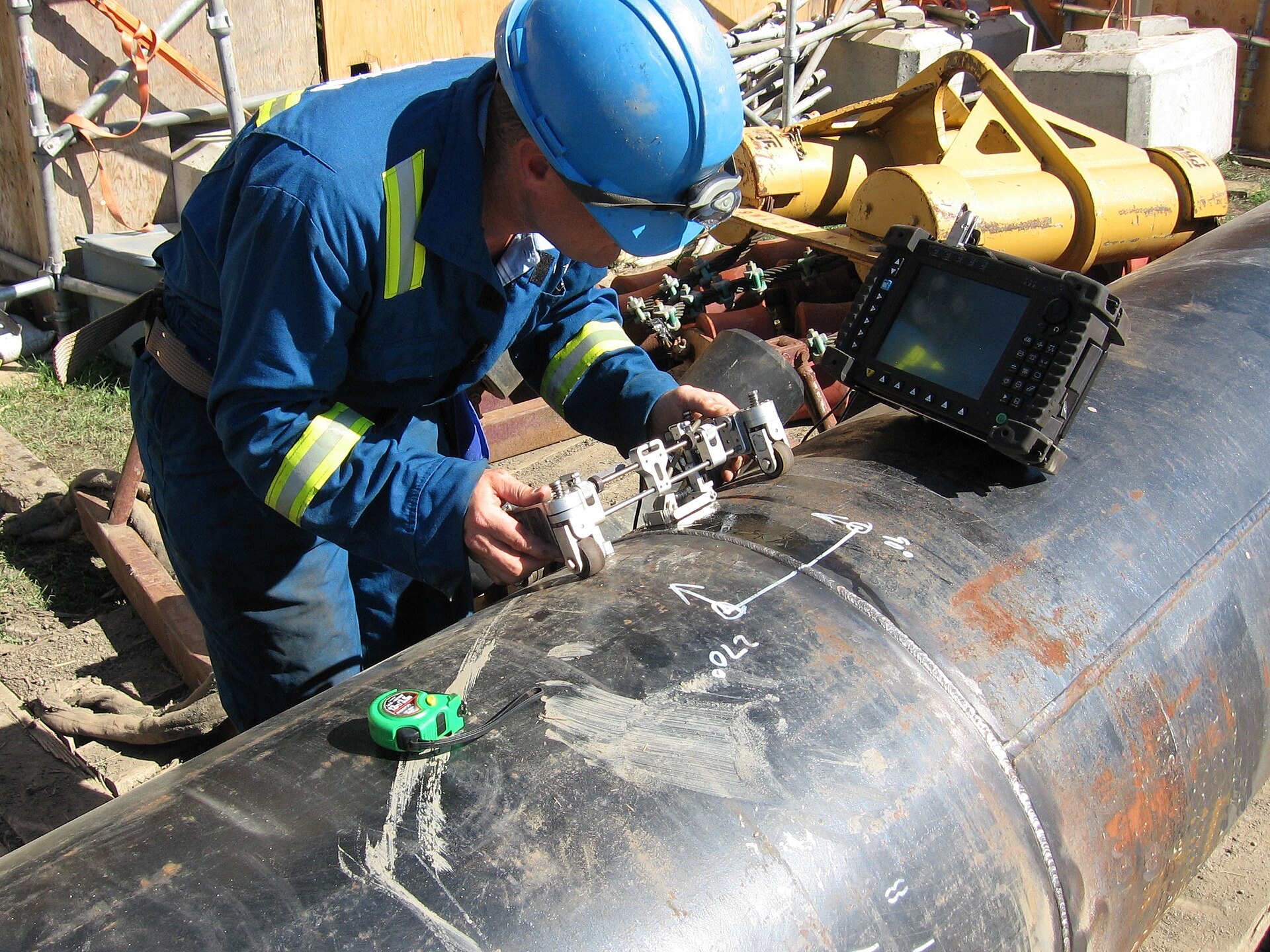
Can a Level II change the procedure on the spot?
No, and this is the mistake that separates the field from the textbook. Mistake eight looks like good judgment. Picture a coarse-grained austenitic casting where the back wall fades and grass climbs across the screen at the specified 5 MHz. The technician knows a lower frequency would penetrate better. His physics is right. His authority is not.
The procedure is a controlled document. A Level II records what he sees, works to the procedure and takes the frequency change to the Level III for a revision. Piling on gain instead is worse, because grass and signal rise together and the signal to noise ratio stays put.
The same logic applies when a customer offers the mill’s own scan report in place of a receiving examination and your written practice says nothing about outside data. You carry out the examination as written and pass the request to the Level III. In a question like that, “follow the written practice, refer the change” is almost always the sound answer. Both situations are in our free questions, so try the sample and watch how they are framed.
Worked example: reading the impedance question in the right order
Mistake nine is a maths slip, and it is about order, not arithmetic. Take an immersion tank where water couples the probe to a flat steel surface at normal incidence. The stem gives the impedance of each material and asks how much energy crosses into the steel.
- Subtract the two impedances, then add them.
- Divide the difference by the sum. That ratio is not an energy figure yet.
- Square it. The squared value is the share reflected at the front surface.
- Take that share away from the whole. What is left is the share that gets into the steel.
Each wrong option in that question sits on one skipped step. Stop at the ratio and you report a number that is neither share. Skip the last step and you report the reflected share as though it were the transmitted one. On the floor, the same mismatch is why a couplant is not optional: air is far worse than water, and almost nothing crosses. The mismatch between water and steel is large, but it is still far smaller than the one between steel and air.
Do shear waves cross adhesive layers better?
They do not. Mistake ten is a tidy-sounding rule that is backwards. Shear waves are heavily attenuated in adhesives, and they will not couple into air-filled core at all.
For disbonds on a honeycomb panel with thin bonded skins, pulse echo is a mess: the facesheet rings and its multiples crowd the part of the timebase where the bond line should be. Through transmission avoids that. One probe sends, the other receives on the opposite face, and a disbond or crushed core shows as a drop in transmitted amplitude. Look for the technique that fits the structure, not the wave mode that sounds clever.
How do I stop making these ten?
Sort them by where they hit. Four are planning errors: route, pass mark, outline, who gives the practical. Two are administrative: the day itself and the retake. Three are technical: the procedure, the impedance maths and the shear wave idea. Start with the planning ones, since an hour spent there saves months.
Then read the certification guide for the route and exam facts, and the UT physics post for the setup reasoning behind the technical three. The study guides hub lists the rest. When you want volume, the practice test bundle has six question banks.
Tonight, write down your route, your exam date and the outline that date falls under.
Comments
Comments are read by a person before they appear. How we moderate.