Physics is not a separate section you sit through and finish. In the Level II ultrasonic exam it is the reason behind nearly every setup question. A probe is chosen, a wedge is swapped, a reflector is machined, and each choice has a wave behavior underneath it.
That changes how you should study it. Reciting definitions gets you partway. Knowing which physical effect a situation is about gets you the answer.
 ASNT UT II — The ASNT Level II ultrasonic exam in sixty seconds. Watch on YouTube · CertCrafter
Where does UT physics sit in the ASNT Level II exam?
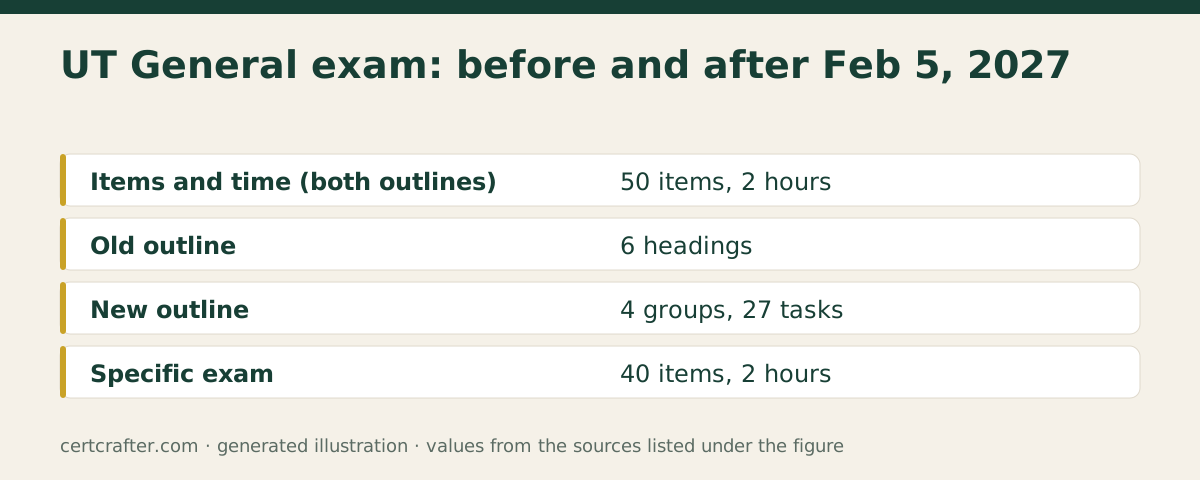
Everywhere, and ASNT does not say how much. Its examination page lists the UT General exam as 50 items in 2 hours and the Specific exam as 40 items in 2 hours. It gives topic headings, not percentages, so a weighting you read elsewhere is an estimate.
Before February 5, 2027 the General topics are six headings, starting with Review of Ultrasonic Techniques. After that date they are four groups, and the first is UT Principles and Techniques. It lists tasks such as calibrating UT systems, setting up and standardizing equipment, and applying UT theory and techniques for specific test situations.
Read that last phrase again. Theory is applied to a test situation. That is how the exam asks about physics. If you want the full picture of the change, our guide to the 2027 outline walks through it group by group.
Our own question banks use a domain called UT Physics and Wave Propagation. It is our label for the study area, not an ASNT heading. We cover the full list in the study guides hub.
What does refraction have to do with angle beam work?
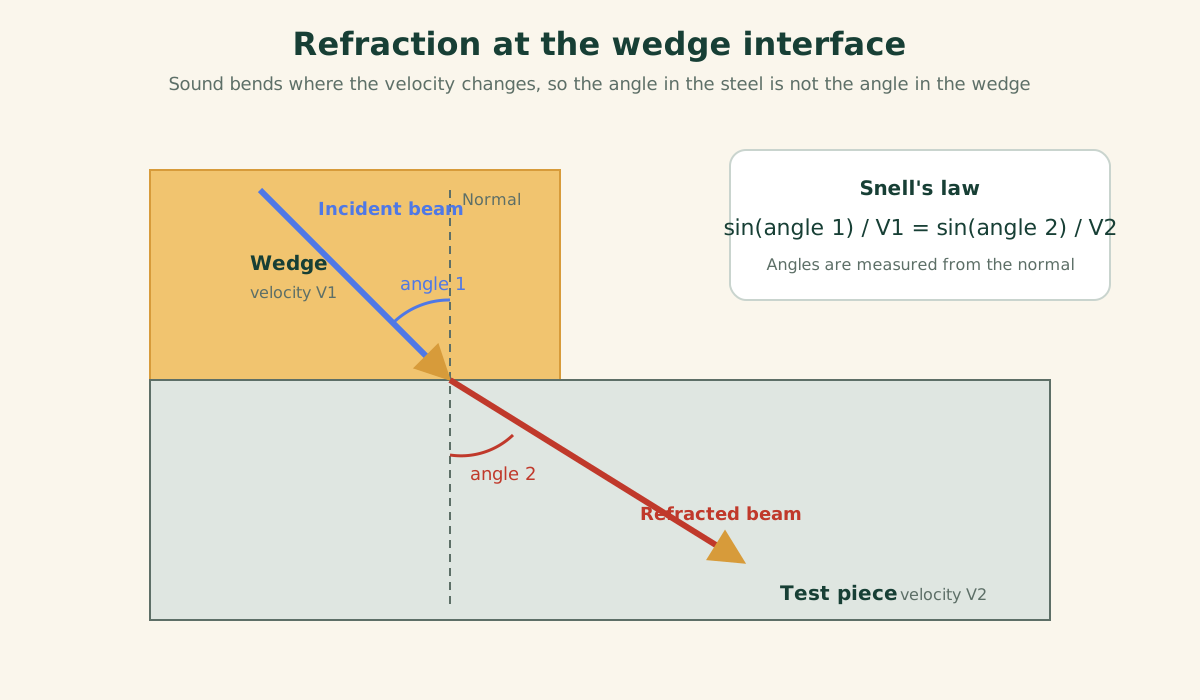
Everything. When a beam crosses from the wedge into the test piece, the velocity changes and the beam bends. Snell’s law ties the two angles to the two velocities: the sine of the angle divided by the velocity is the same on both sides, so a higher velocity in the part means a larger angle in the part than in the wedge.
On the exam this shows up as a question about what happens when something changes. Swap the wedge and the refracted angle can change, and so does the exit point. Our study plan says to work Snell’s law until refraction and the first and second critical angles are automatic, because most angle beam reasoning rests on them.
On the job, this is why a replacement wedge is never just a replacement wedge. A technician who fits a new shoe and starts scanning has changed the exit point and possibly the angle without checking either. Good practice is to reverify both before the first scan.
Why does the dead zone matter on thin wall?
Because the crystal is still ringing when the first echo arrives. In a single element probe the transmit pulse leaves the crystal vibrating, and on thin wall the back wall echo comes home while that ringing is still going. The echo is buried.
A dual element probe splits the job. One crystal transmits, the other receives, with an acoustic barrier between them, so the receiver is not blinded by the main bang. The roof angle tilts the two elements toward each other so their beams cross at a shallow depth, which is where the sensitivity sits.
One of our free questions turns on exactly this. A corrosion mapping procedure for a pipe with roughly 4 mm of remaining wall forbids a single element contact probe. The tempting wrong answers talk about near field length or frequency. The right one is about the dead zone and the roof angle.
That brings up a trap worth naming. The near field is a property of the probe and its range, not of the leg of the beam you happen to be using. Candidates drag it into questions where the real cause is something else.
How does mode conversion get tested?
Quietly. It is rarely the headline of a question. It is the reason one of the wrong options is wrong.
A beam reflecting from a surface can convert part of its energy into another wave mode. That is real physics. But in the half skip question in our free sample, the wrong option claims half skip is used to avoid mode conversion. Conversion does occur at the far surface, so the statement sounds educated. It just is not why the procedure asks for half skip.
The actual reason is geometry. The root of a single-sided weld, where the far surface meets the vertical face of an unfused root, forms two surfaces at right angles. At half skip the beam arrives at that corner on its first leg, and the corner sends the energy straight back along the incoming path. That corner trap is why lack of penetration and root cracks light up so well.
Shear waves bring a related trap. They do not cross adhesive layers more efficiently. They are heavily attenuated in adhesives and will not couple into air-filled core at all. For disbonds in honeycomb with thin skins, through transmission wins because the skin rings in pulse echo and buries the bond line signal. A disbond or crushed core blocks the path and shows as a drop in transmitted amplitude.
What do reflector choice and gain change?
Reflector choice changes how an angle shows up. A flat-bottom hole gives its maximum response only when the beam strikes its flat face squarely, which suits straight beam work. A side-drilled hole is a cylinder lying across the beam, so whatever the arrival angle, it presents about the same geometry. That is why it is the standard reference reflector when one distance amplitude curve must serve several refracted angles on the same weld.
Gain is the one people reach for first and should reach for last. Raising gain lifts the noise by the same amount as the signal, so the ratio between them does not change. The trace just saturates.
Worked example: noise that fills the sweep
This is the scenario from one of our free sample questions. A shear probe shows wedge noise across the first stretch of the sweep on a thin weld. The wedge is visibly worn and its damping serrations are rounded off. Root signals are masked.
- Name the source. Wedge noise is sound bouncing around inside the plastic shoe and returning to the element instead of being absorbed.
- Ask what controls it. Attenuating material and serrations break up those internal reflections. A shoe worn smooth has lost that control, so the noise grows.
- Test each tempting fix against the physics. Raising gain lifts noise and signal together. The reject control hides small real indications and is non-linear on many instruments, so procedures normally forbid it. Changing frequency changes resolution and penetration, not internal reflections.
- Fix the source. Fit a wedge with intact serrations and an unworn face.
- Reverify the exit point and the angle, because the new wedge can change both.
Five steps, and every one of them is physics used to reach a decision. The same pattern works on most questions in this area.
What are the common ways candidates lose marks?
Reading half a procedure is the classic. A forging procedure that rejects any indication above a 3 mm flat bottom hole reference response and also rejects any back reflection loss over its own stated limit has two independent criteria. A loss above that limit with no discrete indication is still a rejection. Loss of back reflection catches scattered or badly oriented material, such as fine porosity, coarse segregated structure or a flaw lying parallel to the beam.
A second trap is answering with the right physics to the wrong question. A shorter sound path at half skip is true, and it is still not the reason the procedure specifies half skip.
A third is solving a procedure problem with a physics trick. If the stem says what the written practice requires, the answer follows the practice. Physics will not overrule a criterion that was already failed.
Last, do the math with the numbers given. Questions supply velocities, angles and limits in the stem, so you apply them rather than recite them. Thickness with a known velocity, angle beam geometry and dB differences are the calculations to drill.
How should you study it?
Take each effect above and attach it to a situation: refraction to a wedge change, dead zone to thin wall, corner geometry to a root scan, rings in a skin to through transmission. Then test yourself with the free ten-question sample, which lets you see how these are framed, and note which explanations surprise you. The certification guide explains the ASNT central route against employer SNT-TC-1A certification, and our channel has a plan for fitting it around shift work: Six weeks to Level II UT while working shifts.
For volume, the practice test bundle has six question banks. Pick one effect tonight and write the one situation where it decides the answer.
Comments
Comments are read by a person before they appear. How we moderate.