ASNT UT Level II Practice Questions (Free, With Explanations)

By Sandeep Bandyopadhyay, Senior aerospace engineer · PMP, MBA, Six Sigma

TL;DR

Three free ASNT UT Level II practice questions sit further down this page, each with its full explanation. They cover a limited-access weld, a honeycomb bond and a root scan at half skip. The central exams are a 50-item General paper and a 40-item Specific paper, each 2 hours, closed book. ASNT publishes no fixed pass percentage, so practice the reasoning, not a target score.

Original questions, not exam dumps. Every CertCrafter question is written from the published body of knowledge and the referenced codes. None is copied from a live exam, and CertCrafter is independent: not affiliated with or endorsed by any awarding body.

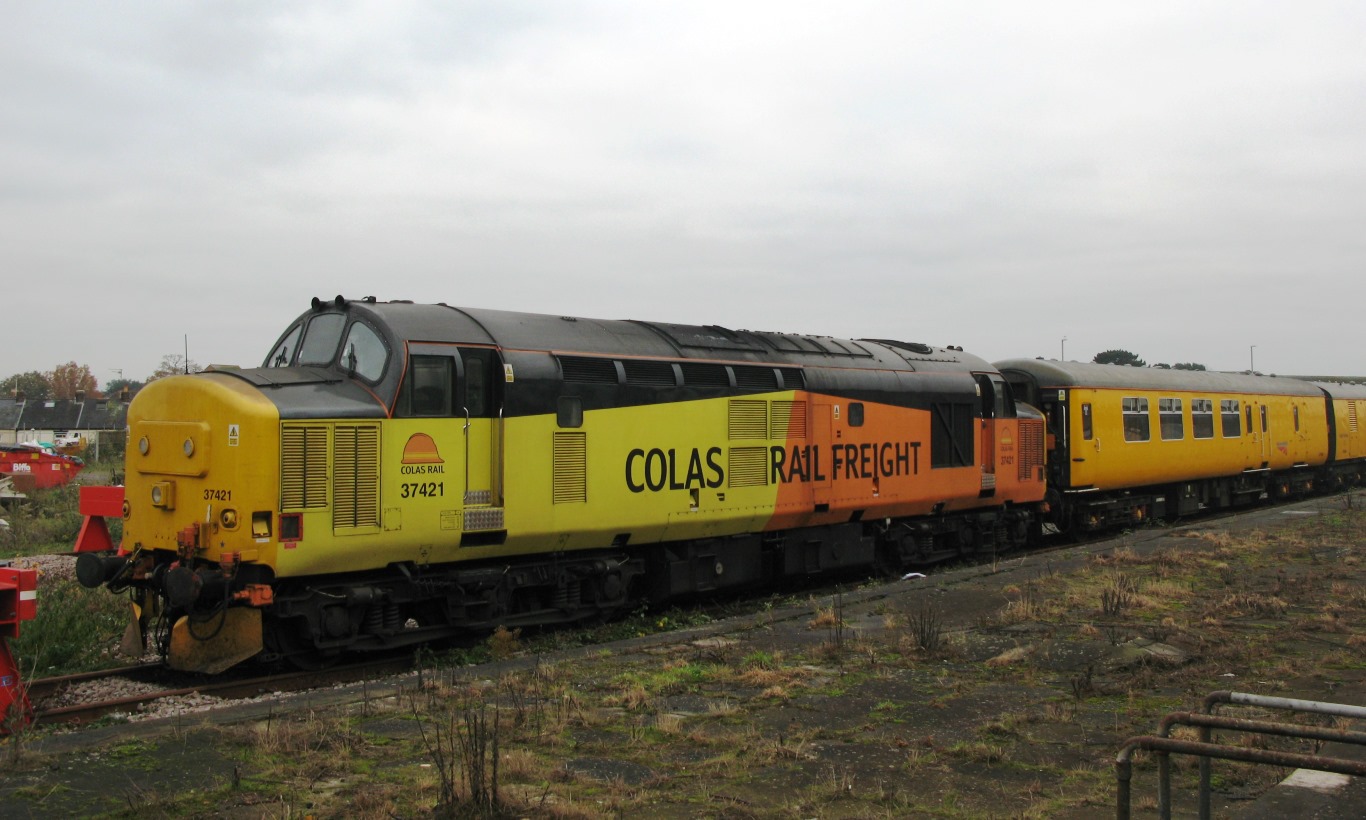
A railway ultrasonic test train standing in a station
Photo: Taunton - Colas 37421 with Ultrasonic Test Train by Geof Sheppard (Wikimedia Commons), CC BY-SA 4.0, via Wikimedia Commons.

Most free UT question sets test whether you can recite a velocity or a formula. The Level II paper asks what you would do at the scan, and that is where candidates lose marks.

What do these free ASNT UT Level II practice questions test?

The three questions further down are original, and each has a full explanation you can open once you have committed to an answer. They come from the same free sample behind the scored ASNT UT quiz.

One is about reporting. A weld seam can only be reached from one side, and the procedure assumes two. One is about technique selection on a bonded honeycomb panel. One is about why a procedure tells you to scan a weld root at half skip with an angle beam probe.

No question asks you to recall a table. None. Each one hands you a job and asks for the sound move. Our channel has the ASNT Level II ultrasonic exam in sixty seconds if you want the format first.
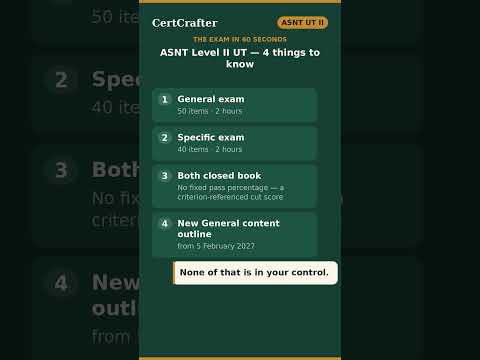
Video: ASNT UT II — The ASNT Level II ultrasonic exam in sixty seconds. ASNT UT II — The ASNT Level II ultrasonic exam in sixty seconds. Watch on YouTube · CertCrafter
Image: video thumbnail, source: CertCrafter on YouTube (@certcrafters).

How is the ASNT UT Level II exam built?

To earn ASNT NDT Level II certification you pass two computer-based exams. The General exam covers the method and has 50 items in 2 hours. The Specific exam covers applied knowledge for General Industry or Pressure Equipment Sectors and has 40 items in 2 hours. Our product data lists both as closed book.

ASNT also says employers carry out the visual acuity, practical and any job-specific exams their written practice needs. Passing both papers is one door, not the finish line, and plenty of candidates plan the study carefully and the practical badly.

The General outline is changing. ASNT lists one UT outline for exams prior to 5 February 2027 and another for exams after it, both at 50 items in 2 hours. Check which one your booking falls under before you study.

What does the exam cost, and what does a miss cost?

ASNT’s fee table lists an initial UT exam, General and Specific together, at $740 for members and $820 for nonmembers. A retake of a failed UT exam is $370 for members and $410 for nonmembers.
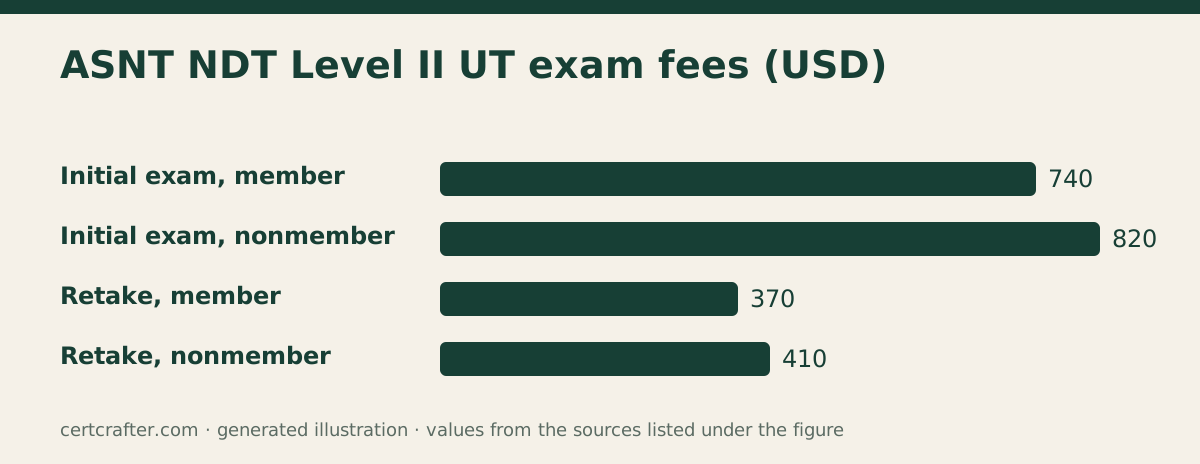
Bar chart of ASNT UT fees in US dollars: initial exam 740 member and 820 nonmember, retake 370 member and 410 nonmember
Initial and retake fees for the UT exam. Illustration: CertCrafter, from ASNT NDT Level II Certification: Foundational Credential.

After a fail you wait 30 days, reapply and pay through MyCert, and need a new approval letter before you can schedule. Money is the smaller cost. Time is the bigger one. A project start that hangs on your certificate does not move because your retake window did.

How should you work through the three questions?

Cover the options. Say what you would do on site, in a sentence, before you read anything. Then match that sentence to an option. Candidates who read the options first get pulled toward the one that sounds most technical.

Open the explanation after you pick, and read it even when you were right, because the reasoning in it is worth more than the letter. Each wrong option in this set is a move that people make on a real job, and each has a reason it fails.

What happens when you cannot reach the whole weld?

Picture a seam half covered by a welded support. The procedure was written for access from both sides. Nobody on a plant wants to be the person who writes that up, because it opens a conversation about schedule.

You write it up anyway. Always. A limitation is a finding in its own right, and an examination report that hides one is a false statement. The Level II does not decide what happens next, but has to hand over enough detail for someone else to decide.

Worked example: reporting a one-sided seam

  1. Scan every length you can reach, to the procedure as written.
  2. Mark the length you could not cover and measure where it starts and stops.
  3. Record the coverage you did get, and the angle and side it came from.
  4. Raise it with the Level III and the Authorized Inspector while an alternative, such as scanning from the inside or another method, is still possible.

Notice what is absent. You do not call it fully examined, you do not reject the weld, and you do not add gain to make up for geometry.

The ASNT UT Level II practice test bundle works more of these under timed conditions, with every answer explained.
An ultrasonic test train at a station platform
Photo: The Ultrasonic Test Train at Bristol Temple Meads - geograph.org.uk - 5635051 by Stephen Craven (Wikimedia Commons), CC BY-SA 2.0, via Wikimedia Commons.

Why is a weld root scanned at half skip?

The root of a single-sided weld sits where the far surface meets the vertical face of an unfused or unfilled root. At half skip, the beam reaches that junction still on its first leg. The two surfaces meet at right angles, so they act as a corner and send energy back along the way it came.

That is why root cracks and lack of penetration make such strong reflectors, and why the instruction is in the procedure instead of left to chance. A wrong option in the third question says half skip is about attenuation. The path is shorter, true, but that is a side benefit, not the reason.
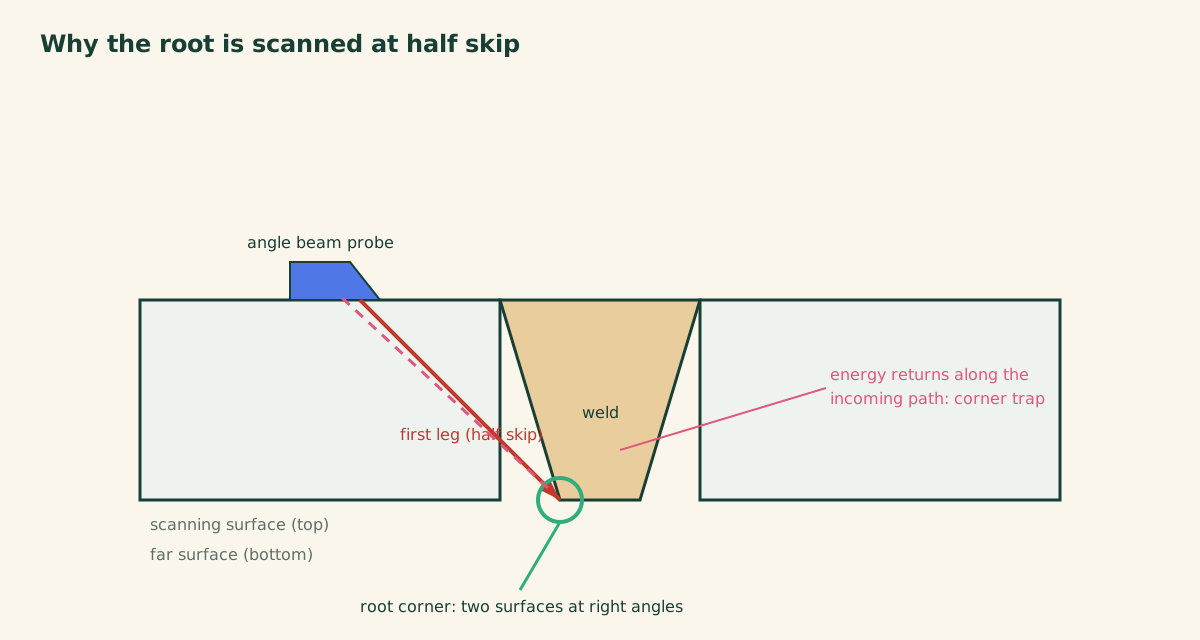
An angle beam probe sending a beam down the first leg to the root corner of a single-V weld, where it reflects back along the incoming path
The root corner returns the beam on the first leg. Illustration: CertCrafter, from ASNT NDT Level II Examinations: Information and Scheduling.

Where do candidates lose marks on questions like these?

Three habits show up. First, reaching for a tool when the answer is a report or a referral. Second, picking a wave mode because it sounds clever, as with shear waves in adhesive, which are heavily attenuated there. Third, choosing a statement that is true about ultrasonics in general but is not the reason this particular procedure gives, which is a quiet way to lose a mark you knew the physics for.

The honeycomb question rewards a different idea. Thin skins ring in pulse echo, so the multiples crowd the part of the timebase where the bond line sits. Measuring how much energy crosses the panel gets round that problem.

How should you use three free questions?

Not as a readiness test, and not as a score. Three questions cannot tell you whether you will pass, but they can expose a habit. Log every miss by topic and by the kind of slip: the reason, the authority, the wave mode or the outline.

Then read the certification guide for the route and exam facts, and the study guides hub for the other posts. The common mistakes post and the UT physics post cover the setup reasoning behind these.

Next step: open the three questions, answer each in one sentence before you see the options, and score yourself on the reason as well as the letter.

Try these free questions

  1. Half of a vessel circumferential seam is covered by a permanently welded support saddle, so only one side of the weld can be reached. The procedure assumes access from both sides. What is the right course?

    1. Scan what is reachable, record the restricted length and the coverage obtained, and raise the limitation with the Level III and the Authorized Inspector.
    2. Report the seam as fully examined, since a full skip taken from the accessible side sweeps the entire weld volume anyway.
    3. Reject the covered length of weld, because a weld that cannot be examined to the procedure as written has to be treated as unacceptable until somebody can reach it.
    4. Add 6 dB of gain when scanning from the accessible side, to make up for the scan surface that could not be used.
    Show the answer and explanation

    Answer: A. A limitation is a finding in its own right and it belongs in the report, described precisely enough that somebody can decide what to do about it. The Level II scans everything he can reach, states the length and location he could not cover, and raises it with the Level III and with the Authorized Inspector while there is still time to arrange an alternative such as a different angle, a scan from the inside, or another method. Calling it full coverage is a false statement about the examination, and a full skip from one side does not replace the second side because flaws tilted away from that beam can be missed. Rejecting the weld is not the technician's call and confuses inability to examine with a proven defect. Extra gain does nothing about geometry; it raises noise along with any signal and cannot recover a volume the beam never entered from that direction.

  2. An aluminium honeycomb panel with bonded epoxy skins has to be checked for disbonds. Pulse echo from the skin returns a confusing train of echoes from inside the thin facesheet before anything reaches the bond line. What setup should be used?

    1. Through transmission with transmitter and receiver aligned on opposite faces, judging the bond by how much amplitude crosses the panel.
    2. A 10 MHz shear wave probe on the skin, because shear waves cross adhesive layers more efficiently than longitudinal waves do.
    3. A single 5 MHz angle beam probe on a long delay line, which pushes the facesheet echoes out beyond the gate that matters.
    4. An immersion setup with a focused probe gated on the third back wall echo returning from the far skin of the panel.
    Show the answer and explanation

    Answer: A. A thin facesheet rings, and in pulse echo the multiples from it crowd the very part of the timebase where the bond line signal would sit. Through transmission sidesteps the problem entirely: one probe sends, the other receives on the opposite face, and the measurement becomes how much energy gets across rather than what comes back. A disbond or a crushed core blocks that path and shows as a drop in transmitted amplitude, which is why bond testing of honeycomb and composite structure is normally done this way. Shear waves are not better at crossing an adhesive layer; they are heavily attenuated in adhesives and will not couple into air filled core at all. A longer delay line moves the interface echo but does not stop the facesheet ringing, so the multiples still land on top of the bond signal. Gating a third back wall echo assumes clean multiples through a panel that scarcely returns a first one.

  3. A weld procedure requires the root of a single-V butt weld, welded from one side only, to be scanned at half skip with a 60 degree shear probe. What is the technical reason behind that instruction?

    1. Half skip gives the shortest sound path, so attenuation losses are at their lowest for the root region
    2. At half skip the beam meets the root corner square on, forming a strong corner trap
    3. At full skip the root would fall inside the near field, where amplitude cannot be relied on
    4. Half skip avoids the mode conversion that occurs whenever the beam reflects from the far surface
    Show the answer and explanation

    Answer: B. The root of a single-sided weld sits where the far surface meets the vertical face of an unfilled or unfused root. At half skip the beam arrives at that junction still on its first leg, and the two mutually perpendicular surfaces act as a corner reflector, sending energy straight back along the incoming path. That corner trap is what makes lack of penetration and root cracks such strong reflectors, and it is why root scanning is specified at half skip rather than left to chance. The attenuation option notices something true, that the path is shorter, but that is a secondary benefit rather than the reason. The near field option misplaces the near field, which is a property of the probe and its range, not of the leg being used, and the root at full skip would in any case be further away, not closer. The mode conversion option is wrong on the physics: reflection at the far surface does produce mode conversion, but that is not what half skip is avoiding.

Take the full free 10-question sample with scoring →

Frequently asked questions

How many free ASNT UT Level II practice questions are on this page?

Three, each with its options and a full explanation. They come from the free sample behind the scored quiz page. The paid bundle holds 900 questions across six question banks.

Is there a fixed pass percentage for the ASNT UT Level II exam?

ASNT publishes no fixed percentage for its central exams. It uses a criterion-referenced cut score, so the habit to build is sound reasoning on every question, not a number to aim at.

Can three questions show whether you are ready for Level II?

No. They show whether one way of reading a UT situation is sound. Readiness comes from timed runs across the General and Specific papers, with every miss logged by topic and by the kind of slip.

Official sources

  1. ASNT NDT Level II Examinations: Information and Scheduling — accessed 24 October 2026
  2. ASNT NDT Level II Certification: Foundational Credential — accessed 24 October 2026

Exam rules change. Check the awarding body's official page before you apply. CertCrafter is independent and is not affiliated with or endorsed by any awarding body.

Was this helpful?

Comments

    Comments are read by a person before they appear. How we moderate.