Two terms that sound alike get used for each other, and that is where the marks go. Dead zone and near field. Attenuation and impedance. Gain and reject. Each pair has a different cause, a different place on the sound path and a different fix.
This is a short field guide to the pairs. Read it as a set of “which one is this?” tests, because that is how the questions arrive.
 ASNT UT II — The ASNT Level II ultrasonic exam in sixty seconds. Watch on YouTube · CertCrafter
Why do UT physics terms get mixed up so often?
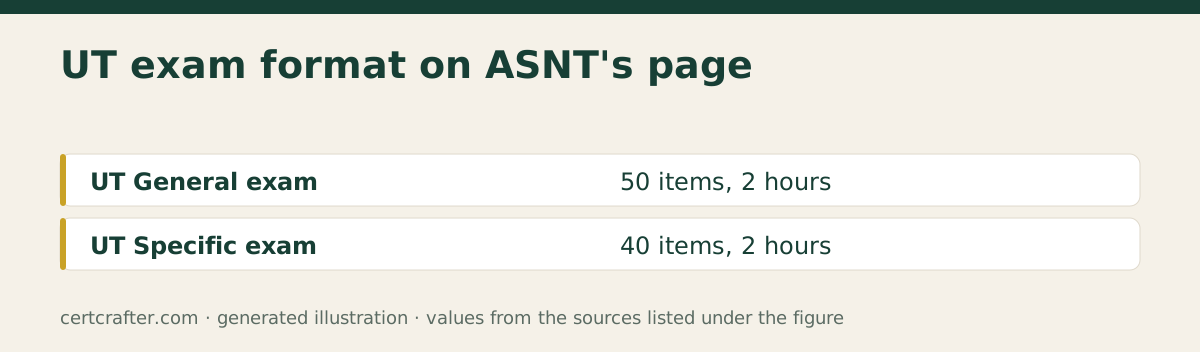
Because textbooks introduce them in one chapter, as a list, and the exam uses them one at a time, inside a situation. ASNT’s examination page shows the UT General exam as 50 items in 2 hours and the Specific exam as 40 items in 2 hours, and it gives topic headings rather than a glossary. Nothing there says which terms to memorize, so the grouping in this post is ours.
The new outline, used after February 5, 2027, includes the task “Apply UT theory and techniques for specific test situations and examinations”. Terms are tools for a situation. You are asked what is happening, and the wrong options are usually the right physics attached to the wrong place.
There is a video on the channel that walks through the exam in sixty seconds, and our UT physics domain guide covers the same ground by topic instead of by confusion.
Dead zone or near field: which one is it?
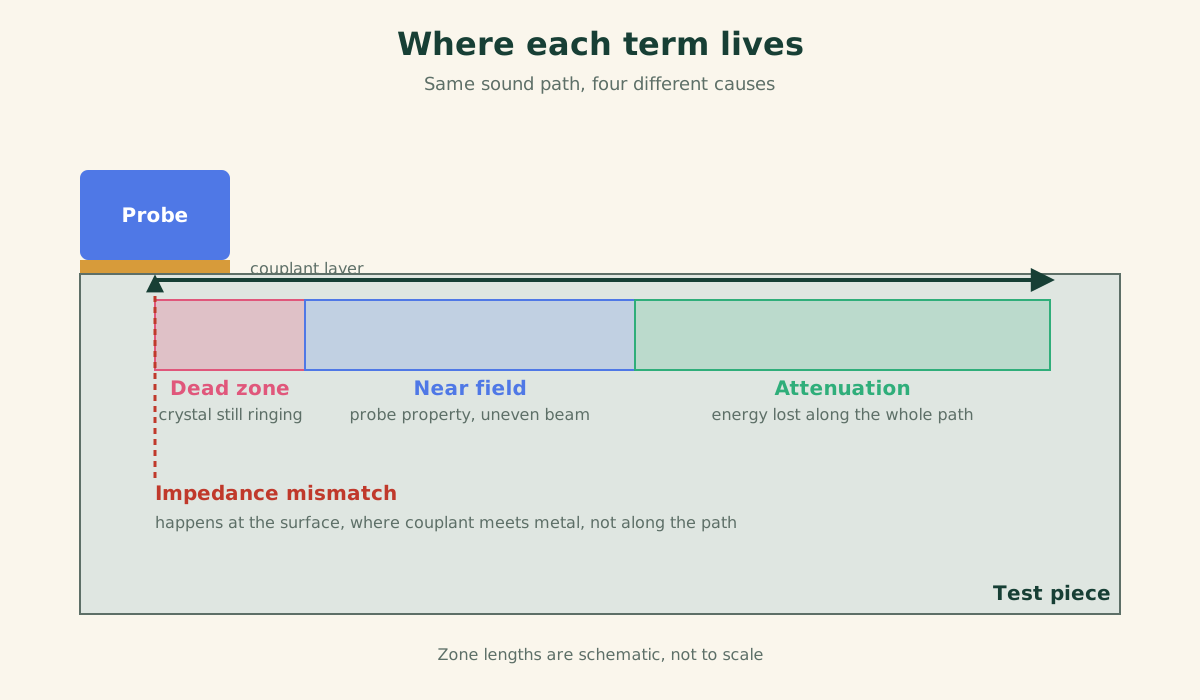
Ask where the problem comes from. If a thin wall hides its own back wall echo because the crystal is still ringing after the pulse, that is the dead zone. If the beam is uneven in the first stretch in front of the probe, that is the near field, and it belongs to the probe, not to the pulse.
| Term | What it is | Where it acts | What you do about it |
|---|---|---|---|
| Dead zone | Ringing after the transmit pulse | Right under the probe | Dual element probe, delay line |
| Near field | Uneven beam from the probe | Out to a distance set by the probe | Know the range, do not size inside it |
| Attenuation | Energy lost along the path | The whole path | Lower frequency, adjust expectations |
| Impedance mismatch | Energy reflected at an interface | At a surface | Couplant |
The shop-floor version is thickness gauging on corroded pipe. One of our free questions describes a corrosion mapping procedure for a pipe with roughly 4 mm of remaining wall that specifies a dual element probe and forbids a single element contact probe. The reason is the dead zone. The right answer says that separate transmit and receive crystals remove the initial pulse dead zone, and that the roof angle crosses the beams inside the thin remaining wall. Candidates who pick the near field option have the argument backwards.
What is the difference between attenuation and impedance mismatch?
Attenuation is a slow bleed. Impedance mismatch is a toll booth.
Attenuation is energy lost along the sound path, from scattering and absorption. Coarse grain scatters more as frequency rises, which is why a casting that looks hopeless at one frequency can behave at a lower one. Impedance mismatch happens only at the boundary between two materials, and the size of the loss depends on how different the two materials are, not on how far the sound travels.
On a job, this is the difference between a probe that needs a better couplant and a probe that needs a different frequency. Mix them up and you fix the wrong thing. A technician sees the back wall fading in a coarse casting and keeps adding couplant. The couplant was never the problem.
The exam makes you do the arithmetic once. A free question gives the acoustic impedance of steel and of water and asks what share of the energy crosses from water into steel at normal incidence. The reflection coefficient is the square of the impedance difference divided by the impedance sum. Work it through and most of the energy comes straight back off the front surface, and only a small share gets into the steel. That gap is much smaller than steel to air, where almost nothing crosses, and displacing air is the whole reason a couplant exists.
The trap is in the options. One reports the reflected share as though it were the transmitted share. Another forgets to square the ratio. Know which number the question wants before you start dividing.

Worked example: sorting a bad trace into the right term
Take a thin-wall reading that looks wrong. The first echo is missing and the baseline is cluttered near the start. Sort it in four steps.
- Locate the problem on the sweep. Close to the start points at the dead zone or the near field. Spread across the whole sweep points at attenuation.
- Ask whether it is the probe or the pulse. The near field is a fixed property of the probe, while ringing after the pulse is the dead zone.
- Look at the surface. A weak signal that is weak from the first echo onward points at coupling or impedance, not at the path.
- Pick the control that matches. A dual element probe for the dead zone, a lower frequency for scatter, better couplant for the interface.
Four questions, four different fixes. If two of your answers seem to fit, you have probably blended two terms.
Gain or reject: which control fixes what?
Neither fixes noise at its source. Raising gain lifts the noise by the same amount as the signal, so the ratio is unchanged. The reject control suppresses low amplitude signals, but it is non-linear on many instruments and hides small real indications along with the noise, which is why procedures normally forbid it.
A free question puts a 70 degree shear probe on a thin weld with a worn wedge, and wedge noise fills the early part of the sweep. The tempting answers raise gain by a large step or advance reject. The right one fits a wedge with intact damping serrations and then reverifies the exit point and the angle. Frequency change is a decoy too, since it alters resolution and penetration and does nothing for a worn shoe.
Which other pairs catch candidates out?
Three more show up often enough to name.
Half skip and full skip. The reason a root is scanned at half skip is geometry. The beam meets the root corner square on and forms a corner trap. A shorter path is true and secondary.
Mode conversion and half skip. Conversion can happen at the far surface, and the option that says half skip avoids it sounds educated. It is not why the procedure asks for half skip.
Reference reflectors. A side-drilled hole answers similarly over a wide span of angles, which is why one distance amplitude curve can serve several probe angles. A flat-bottom hole is strongly angle dependent.
Each of these has the same shape as the earlier pairs: one true statement about the wrong place.
How do you stop mixing terms up?
Make a card for each pair with three lines: where it acts, what causes it, what fixes it. Then drill without looking. Our study guides hub and the piece on common mistakes show where these same slips cost marks elsewhere.
The free ten-question sample is the quickest way to test the cards, and the certification guide explains the ASNT central route against employer certification. For volume there is the practice test bundle.
Tonight, write the four-row table from this post from memory and check it.
Comments
Comments are read by a person before they appear. How we moderate.