My 4 engineering books go FREE on Kindle Fri 6 – Tue 10 Nov (PT). See the books → FREE on Kindle now: all 4 engineering books, until Tue 10 Nov 11:59 pm PT. Ends in . Grab yours → My 4 books: FREE on Kindle Fri 6 – Tue 10 Nov (PT). See → FREE on Kindle now: 4 books, left Grab yours →

ASNT UT Level II Practice Questions, Set 2 (Free)

By Sandeep Bandyopadhyay, Senior aerospace engineer · PMP, MBA, Six Sigma

TL;DR

This second free set has three ASNT UT Level II questions with full explanations: a thin-wall corrosion probe, a procedure with two rejection limits, and a frequency change that is not yours to make. Before any exam, ASNT asks for 120 days of UT experience and 12 days of UT training. The central papers are 50 and 40 items, 2 hours each, closed book, with no fixed pass percentage.

Original questions, not exam dumps. Every CertCrafter question is written from the published body of knowledge and the referenced codes. None is copied from a live exam, and CertCrafter is independent: not affiliated with or endorsed by any awarding body.

An ultrasonic test train standing at a station platform
Photo: 37421 Ultrasonic test train at King's Cross - 2024-10-03 by James Petts (Wikimedia Commons), CC BY-SA 2.0, via Wikimedia Commons.

Plenty of candidates know the physics and still lose marks on the first read of a question. They answer the topic they expected, not the situation the stem describes.

Why do the second set’s questions feel different?

The first free set leaned on reporting, bonded structures and root scans. This one moves to equipment choice, a procedure with more than one rejection rule, and the limits of what a Level II may change. Each question is original and comes with a full explanation you can open once you have committed to an answer. They come from the free sample behind the scored ASNT UT quiz.

Three ideas run through them. Probes are chosen for a reason that a procedure often states in one line. A written procedure is read whole, not skimmed for the first number. And a good technician separates what physics says from what the technician is allowed to do about it.

Our channel has a short video, six weeks to Level II UT while working shifts, if you want a view of the study side first.
Video: ASNT UT II — Six weeks to Level II UT while working shifts. ASNT UT II — Six weeks to Level II UT while working shifts. Watch on YouTube · CertCrafter
Image: video thumbnail, source: CertCrafter on YouTube (@certcrafters).

What do ASNT ask for before you can sit the UT exam?

The exams come last. According to ASNT’s Level II program page, you apply online through MyCert, upload your documents and pay all fees at the time of application. ASNT then asks you to allow 2 to 4 weeks for review, and a letter of approval arrives by email. Only after that can you schedule.

For ultrasonic testing, the experience table lists 120 days in the method and 229 days of total NDT experience. Training is 12 days. One day means at least seven hours, which you can reach on a single day or by adding up hours. Experience has to be in nondestructive testing, under qualified supervision, in the method you are applying for.
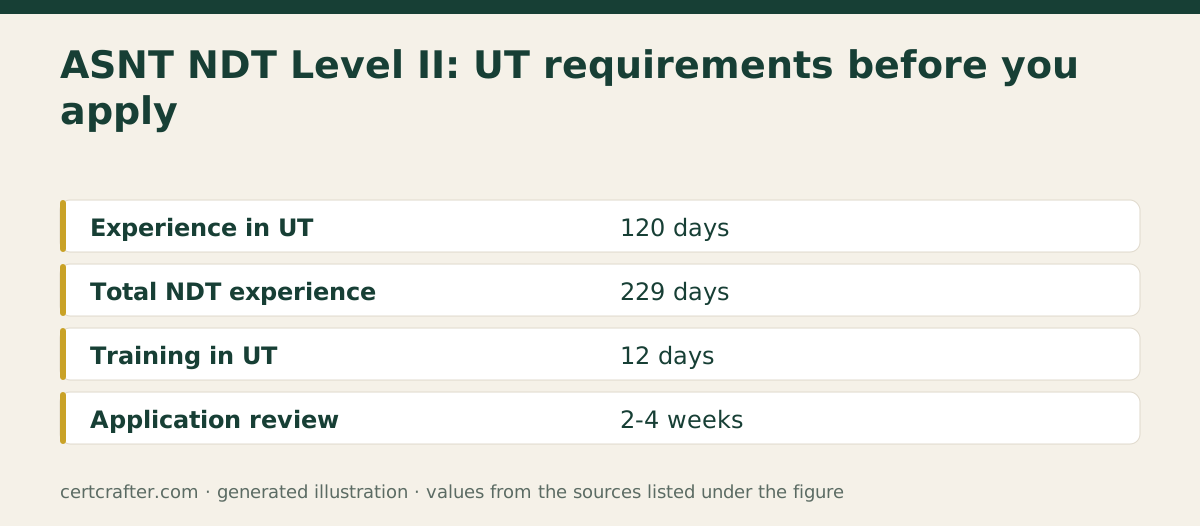
Figure listing the ASNT UT requirements: 120 days of UT experience, 229 days of total NDT experience, 12 days of UT training and a 2 to 4 week application review
ASNT UT experience, training and review time. Illustration: CertCrafter, from ASNT NDT Level II Certification: Foundational Credential.

Worked example: counting your days

  1. UT experience: count 120 days in the method, each day at least seven hours, from signed employer records.
  2. UT training: count 12 days of at least seven hours, from certificates or a signed statement.
  3. Add the 2 to 4 weeks ASNT allows for review, and plan your booking after the approval letter, not before it.

Employer paperwork is where this stalls. ASNT accepts documents signed by the employer, such as logbooks, reports or a statement from a Level III, and it does not accept training certificates as proof of experience. Ask for the signed statement early.

The ASNT UT Level II practice test bundle works more questions like these under timed conditions, with every answer explained.

Why does a thin pipe wall need a different probe?

On a corroded pipe with about 4 mm left, a single element probe struggles because the crystal is still ringing from the transmit pulse when the first back wall echo arrives. The echo sits inside the dead zone. A dual element probe separates the jobs, with one crystal sending and one receiving, so the receiver is not blinded by the main bang.

On a plant this decides what a corrosion survey can see. A technician who reads 4 mm off a screen with a single element probe may be reading an artifact. That is a bad number to hand to someone deciding whether a line stays in service.
An ultrasonic test train at a London station
Photo: 37421 Ultrasonic test train at London King's Cross - 2024-10-03 by James Petts (Wikimedia Commons), CC BY-SA 2.0, via Wikimedia Commons.

How do you read a procedure with two rejection rules?

Slowly, and to the end. A forging procedure may reject on a discrete indication and also on a loss of back reflection, and either one is enough. Loss of back wall catches conditions that return no clean echo: scattered material, coarse structure, or a flaw lying parallel to the beam.

The error is stopping at the first criterion. Candidates see a number they know, check it, and move on. The second question in this set is built around exactly that habit, and the explanation shows which options come from reading half a procedure.

What may a Level II change on the job, and what may not?

A Level II sets up equipment, calibrates, interprets, evaluates and reports. The procedure is a controlled document, and changing a specified parameter belongs to the Level III. ASNT’s own page says employers are responsible for practical and job-specific exams under their written practice, which is why the written practice matters so much on test day and on site.
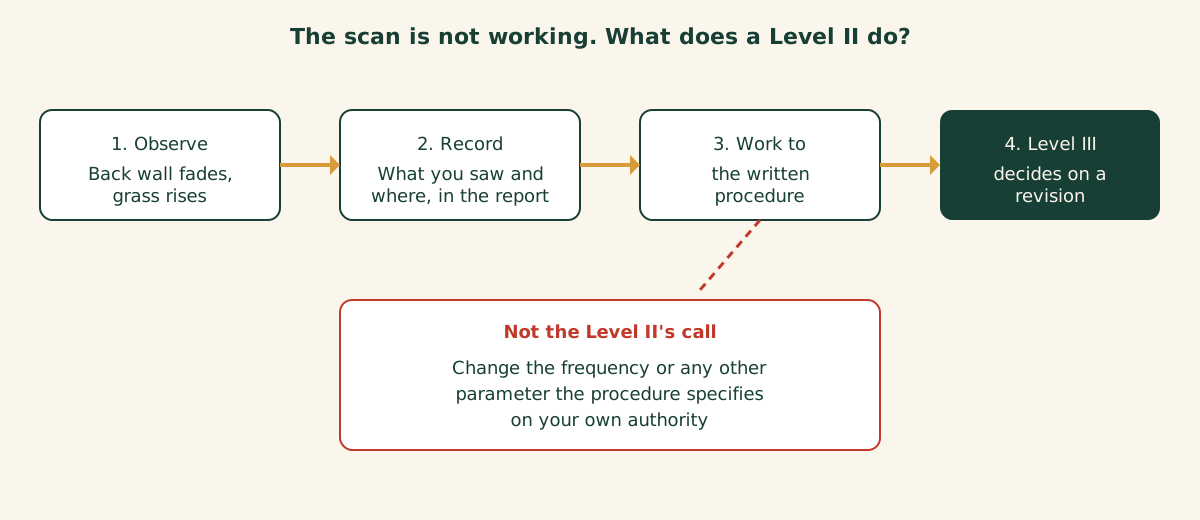
A four-step flow: observe the problem, record it, work to the written procedure, and let the Level III decide on a revision
What a Level II does when the setup does not work. Illustration: CertCrafter, from ASNT NDT Level II Examinations: Information and Scheduling.

The third question tests this. A technician is right about the physics of grain scatter and still not permitted to act on it. Cutting the frequency may well restore the back wall. Doing it alone is the mistake, and so is declaring a part untestable before a revision is even requested.

Where do candidates lose marks on questions like these?

Three places. They pick the answer with the most technical vocabulary instead of the one that fits the stem. They treat gain as a cure for everything, when gain raises noise along with signal. And they confuse a good idea with an authorized one.

The format helps you here. ASNT lists a General paper of 50 items and a Specific paper of 40 items in our product data, 2 hours each and closed book, with no fixed pass percentage published. You cannot memorize a target score, so what you can build is a reading habit: say what the stem asks for in one sentence before you look at the options.

How should you use the three questions?

Cover the options first. Write down what you would do on site, then match it to the option closest to it. After you answer, read the explanation even when you were right, because the wrong options each describe a move people really make.

Log every miss by topic and by kind of slip: wrong probe reason, half a procedure, or authority. Then read the certification guide for the exam facts and the study guides hub for related posts. The UT physics post covers dead zones and mode conversion, and the common mistakes post covers the procedure side.

Next step: open the three questions, answer each in one sentence first, and write down the reason, not just the letter.

Try these free questions

  1. A corrosion mapping procedure for a pipe with roughly 4 mm of remaining wall specifies a dual element probe and forbids the use of a single element contact probe. What technical justification is the procedure relying on?

    1. A dual element probe has a longer near field, so thin sections fall outside the confused zone
    2. A dual element probe automatically works at a higher frequency, giving finer thickness resolution
    3. Separate transmit and receive crystals remove the initial pulse dead zone, and the roof angle crosses the beams inside the thin remaining wall
    4. A dual element probe needs no couplant, which matters on the rough surface left by corrosion
    Show the answer and explanation

    Answer: C. In a single element probe the crystal is still ringing from the transmit pulse while the first echo from a thin wall is arriving, so the back-wall signal is buried in the dead zone. A dual element probe splits the functions: one crystal transmits, the other receives through an acoustic barrier, so the receiver is not blinded by the main bang. The small roof angle tilts the two elements towards each other so their beams cross at a shallow depth, which is where the useful sensitivity for thin remaining wall sits. The first option has the near field argument backwards; the pseudo-focus of a dual element probe shortens the effective usable zone near the surface rather than lengthening it. The second option confuses probe construction with frequency, which is a separate choice. The fourth option is simply untrue, since couplant is still required, and rough corroded surfaces in fact demand more attention to coupling, not less.

  2. The forging procedure rejects any indication exceeding the response from the 3 mm flat bottom hole reference, and separately rejects any loss of back reflection greater than 50 percent. Scanning radially through a die forging, the technician records a 62 percent back reflection loss with no accompanying indication. What is the disposition?

    1. Reject the area, because the procedure sets an independent limit on back reflection loss that has been exceeded
    2. Accept the area, because no indication above the 3 mm flat bottom hole reference response was recorded
    3. Accept the area after a repeat scan in the axial direction, since back reflection loss is not evaluated alone
    4. Reject the area only if a follow up angle beam scan also produces an indication above the reference level
    Show the answer and explanation

    Answer: A. The procedure supplied in the stem contains two independent rejection criteria, and either one on its own is sufficient. Loss of back reflection is a recognised way of catching scattered or unfavourably oriented material conditions that do not return a discrete echo to the probe, such as a cloud of fine porosity, coarse segregated structure or a flaw lying parallel to the beam. A 62 percent loss exceeds the stated 50 percent limit, so the area is rejectable regardless of whether any discrete indication was seen. The second option treats the amplitude criterion as the only one that counts, which is the classic mistake of reading half a procedure. The third option adds a condition the procedure does not contain; a scan in another direction is good practice for characterising the cause, but it cannot overturn a criterion that has already been failed. The fourth option makes rejection conditional on a confirming angle beam result, which again is not what the stated rule says.

  3. A Level II scanning a coarse grained austenitic casting watches the back wall echo fade while grass rises across the screen at the 5 MHz the procedure specifies. He is confident 2.25 MHz would penetrate. What is he permitted to do?

    1. Switch to 2.25 MHz on his own authority, since a Level II is qualified to select equipment, set it up and calibrate it.
    2. Stop and declare the casting untestable by ultrasonics, because grain scatter at any frequency will mask genuine reflectors.
    3. Record the attenuation and the loss of back wall, work to the 5 MHz called for, and take the frequency change to the Level III for a procedure revision.
    4. Add 20 dB of gain instead, which brings the back wall echo back up to its former height without any departure at all from the parameters the written procedure specifies.
    Show the answer and explanation

    Answer: C. His physics is right and his authority is not. Scattering from coarse grains climbs steeply with frequency once grain size becomes appreciable against the wavelength, so dropping to 2.25 MHz lengthens the wavelength, cuts scatter and usually restores the back wall. A Level II may set up equipment, calibrate, interpret, evaluate and report, and may give on the job training under a Level III, but the procedure is a controlled document and changing a specified parameter is the Level III's call. The correct move is to record what he sees, work to the procedure and raise the change formally. Declaring the casting untestable throws away a technique that has not been tried yet. Piling on 20 dB is the worst option because grass and signal rise together, so the signal to noise ratio does not improve at all and the screen simply fills with noise while the operator convinces himself he has gained penetration.

Take the full free 10-question sample with scoring →

Frequently asked questions

How many free questions are in this second ASNT UT Level II set?

Three, each with its options and a full explanation. They differ from the three in the first free set, and they come from the same free sample behind the scored quiz page.

How much experience and training does ASNT ask for in UT?

ASNT lists 120 days of experience in the UT method, 229 days of total NDT experience and 12 days of UT training. A day is at least seven hours, and it can be built up from shorter sessions.

Is there a fixed pass percentage for the ASNT UT Level II exam?

ASNT publishes no fixed percentage for its central exams. It uses a criterion-referenced cut score, so practice reasoning on every question instead of aiming at a number.

Official sources

  1. ASNT NDT Level II Examinations: Information and Scheduling — accessed 3 November 2026
  2. ASNT NDT Level II Certification: Foundational Credential — accessed 3 November 2026

Exam rules change. Check the awarding body's official page before you apply. CertCrafter is independent and is not affiliated with or endorsed by any awarding body.

Was this helpful?

Comments

    Comments are read by a person before they appear. How we moderate.