Candidates spend weeks on control charts and then lose easy marks on a scenario about a project team. The wrong answers in this area all sound like good management, and that is the trap.
How much of the CQE is Management and Leadership?
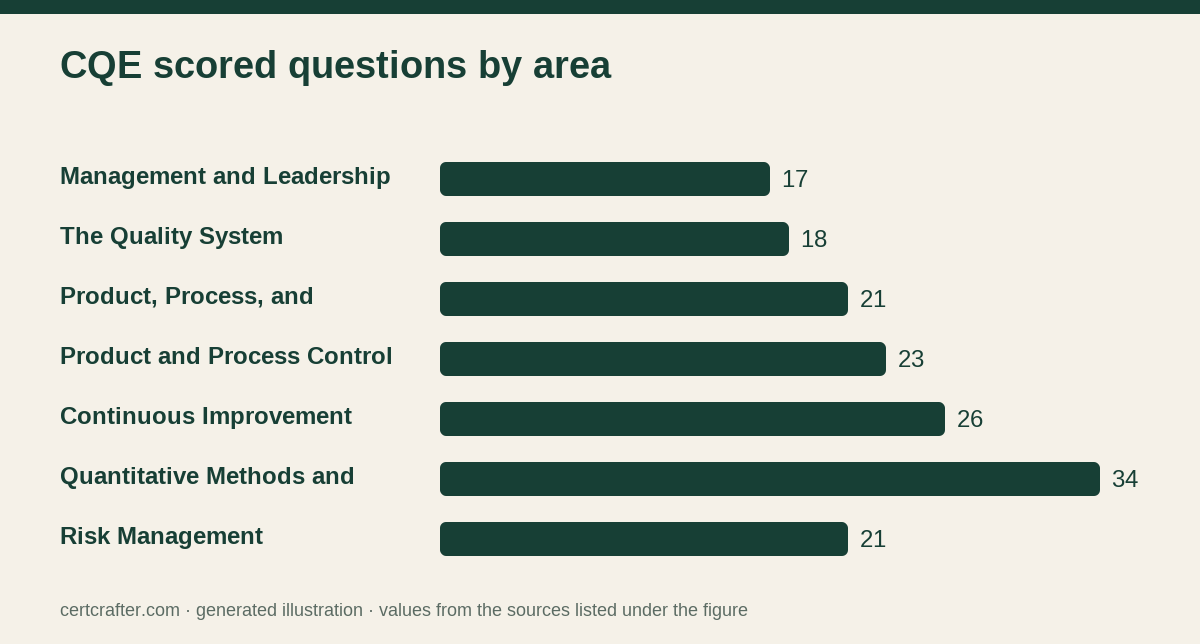
It is area I of the seven in the 2022 Body of Knowledge, and it carries 17 of the 160 scored questions. The exam itself is 175 multiple-choice questions in 5 hours 18 minutes, computer-based and open book, and 15 of the 175 are unscored, so you cannot tell which items count. ASQ’s CQE page states the format. The weights come from the kit’s product data.
It is the smallest slice of the score, so it is tempting to skip it. That is a mistake for a practical reason. Quantitative Methods and Tools carries 34 questions and takes months to learn. Management and Leadership carries 17 and can be learned in days, because it rewards a handful of ideas applied carefully. Cheap marks are still marks.
What does a quality engineer actually do in this area?
Less than the title suggests, and more than people admit. A quality engineer usually leads without authority. You do not manage the operators, the buyer or the maintenance planner, but your project needs all three to change what they do.
So the daily work is agreement. Who is accountable for the new inspection step? Who has to be asked before the work instruction is written? Is the team still arguing about the problem, or has it started solving it? These are the same questions the exam asks, wrapped in a short story.
On a real project the failures are rarely technical. A control plan gets written by one person, signed by a manager who never read it and ignored on the floor because the people who run the process were told rather than asked. Nothing in the statistics was wrong. The ownership was.
What is a RACI matrix and how do you check one?
A RACI matrix lists tasks down the side and people across the top, and marks each cell with one of four letters: R for responsible (does the work), A for accountable (owns the result and signs it off), C for consulted (asked before the work is done) and I for informed (told afterwards).
The rule everybody learns is one A per row and at least one R. It is necessary and it is not enough, which is exactly what exam writers exploit. A matrix can pass every row check and still be broken, because the problems hide in the columns.
Worked example: reviewing a five-task matrix
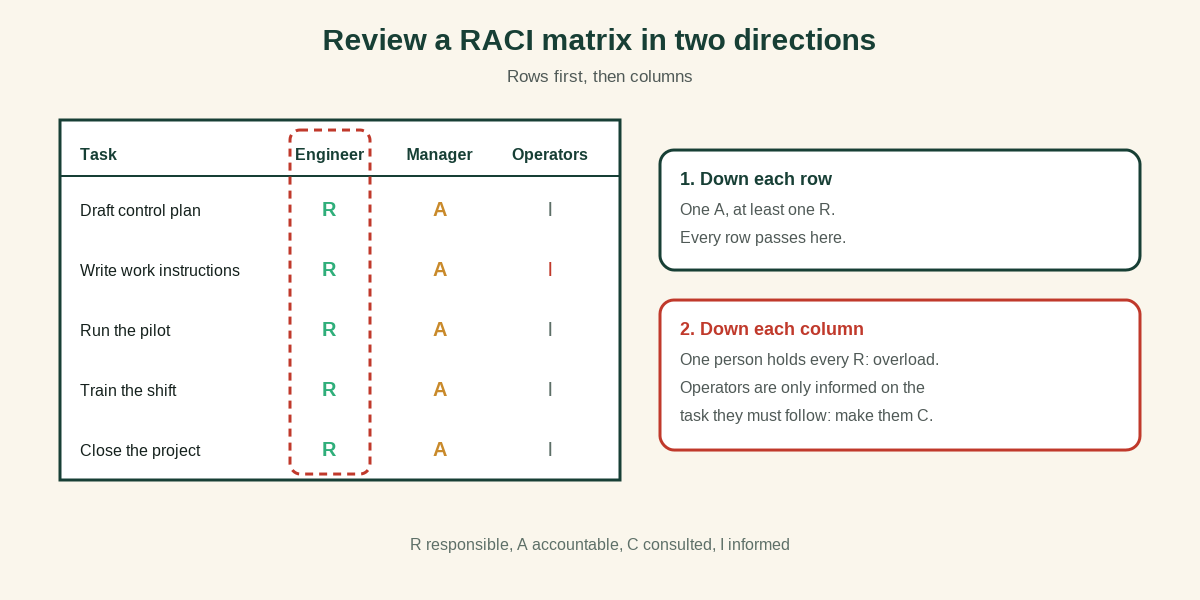
A team lists five tasks for a new control plan: draft the plan, write the work instructions, run the pilot, train the shift and close the project. The engineer is R on all five. The manager is A on all five. The operators are I on all five.
- Check the rows. Every row has one A and at least one R. Pass.
- Check the columns. The engineer holds five of five R entries. One person does all the work, and the pilot and the training will compete for the same afternoon. Overload.
- Check who the work touches. The operators will follow the work instructions every shift, yet they hear about them only afterwards. They belong in C on that task.
- Fix it. Move the training R to a team lead, and mark the operators C on the work instructions.
The corrected matrix has the same A column and a different R and C pattern. Look down the columns every time. The exam hides the fault there.
How do team stages show up on the exam?
The other classic is the team-stage question. Teams are described as forming, storming, norming and performing, and the questions give you behavior rather than a label. You read the behavior, name the stage, and pick the leader action that fits it.
The mapping is short. A forming team is polite and needs direction. A storming team argues and needs mediation and clear ground rules. A norming team has agreed how it works and needs the leader to step back. A performing team needs delegation and obstacles removed from outside.
The trap is reading the calendar instead of the behavior. A team five weeks in can still be storming, and a team that argues about data is not necessarily in conflict. Challenging each other’s numbers under agreed ground rules is what a healthy team does.
The free sample has one of these, coded I.D. Read the behavior first and decide the stage before you look at a single option.
Where do candidates lose marks on this area?
Three patterns repeat. First, picking the answer that sounds most decisive. Scenario options often include a firm, top-down action, and it is wrong whenever the team is already working well or the people affected were never consulted.
Second, applying a rule to the wrong target. One A per row is correct and the question is about the columns. Calling the stage by the calendar is correct logic on the wrong evidence.
Third, forgetting that the exam wants the best answer, not an acceptable one. Two options may both be defensible in a real plant. Choose the one that fixes the cause the scenario describes, not the symptom.
Your open-book binder helps with the definitions of the four RACI letters and the four team stages. It cannot tell you which one the question is describing, and with 175 questions in 5 hours 18 minutes this is not the place to hunt through pages. For the format and the clock, see the 2026 CQE exam format and scoring guide.
How should you study this area?
Short and often. Read one scenario, write down what it is about in one line, and only then read the options. For each wrong option, name the rule it tempts you to use. That habit is worth more than rereading the definitions.
Do the same after a mock exam. Look at your percentage for this area on its own, because a strong overall score can hide a weak 17-question slice. The CQE practice exam guide explains how to set up full mocks. The ASQ CQE Complete Exam Kit has an area drill for this one with an explanation for every option. For the other six areas, use the CQE guides hub.
What to do next
Take the two Management and Leadership questions in the free sample, and write one sentence on why each wrong option fails. Then check your column habits on a real RACI chart from your own workplace. Unofficial: CertCrafter is not affiliated with ASQ, and ASQ does not endorse this page.
Comments
Comments are read by a person before they appear. How we moderate.