Most CQE candidates lose the exam to the clock, not to the statistics. 175 questions in 5 hours 18 minutes is 1 minute 49 seconds each, and the open-book rule tempts people into looking up what they should already know.
What is the format of the ASQ CQE exam?
One sitting, 175 multiple-choice questions, computer-based. 160 of them are scored. The other 15 are unscored pretest items mixed in with no flag on screen, so you answer all 175 as if each one counts.
The exam time is 5 hours 18 minutes inside a 5 hour 30 minute appointment. The clock starts when the exam launches and does not pause. At a Prometric test center there are no planned breaks; when the exam is remotely proctored you may take up to three 10-minute breaks, and the clock keeps running through them. Plan your water and your lunch around that, because 5 hours is a long time to think about statistics with an empty stomach.
The forms are fixed and dichotomously scored. A question is right or wrong, with no partial credit and no penalty for guessing, so nobody should finish with blanks.
Results appear on screen at the end of a Prometric sitting and come by email in about seven days, or four weeks when a new Body of Knowledge is being piloted. A failing candidate receives a breakdown by subtopic. There is no limit on attempts, each at the retake fee, but a retake must happen within two years of the last one.
How is the CQE scored?
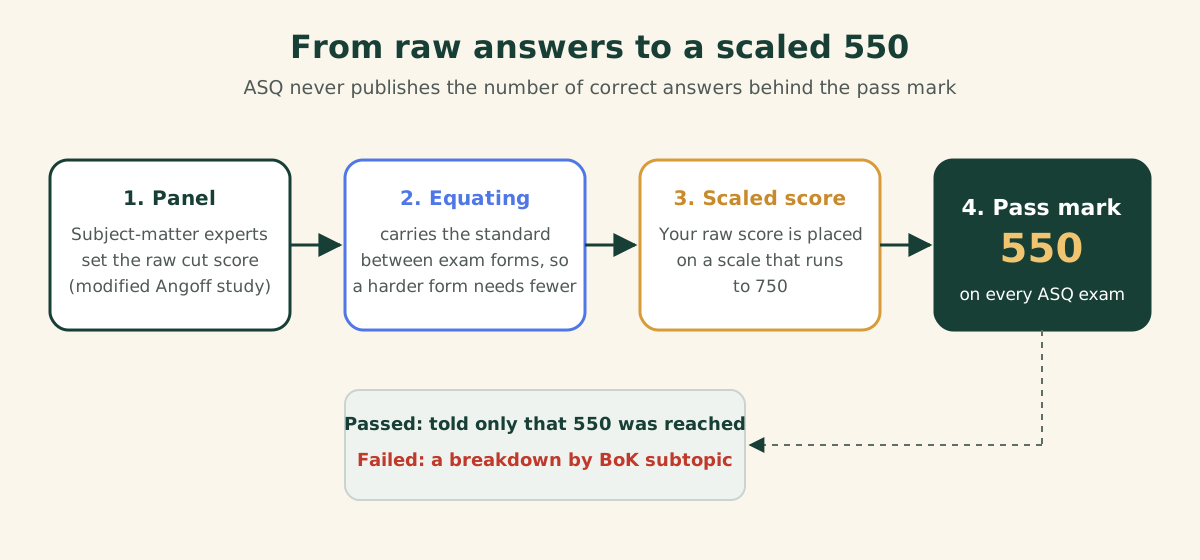
Passing is a scaled score of 550, on a scale that runs to 750. ASQ sets the raw cut score with a panel of subject-matter experts in a modified Angoff study, then carries that standard between forms by equating, so a slightly harder form needs slightly fewer correct answers. A passing candidate is told only that 550 was reached.
What ASQ does not publish is the number of correct answers behind 550. Every “you need 73%” figure in circulation is a third-party guess. Train against a margin, not against a rumor.
What are the seven Body of Knowledge areas and how are they weighted?
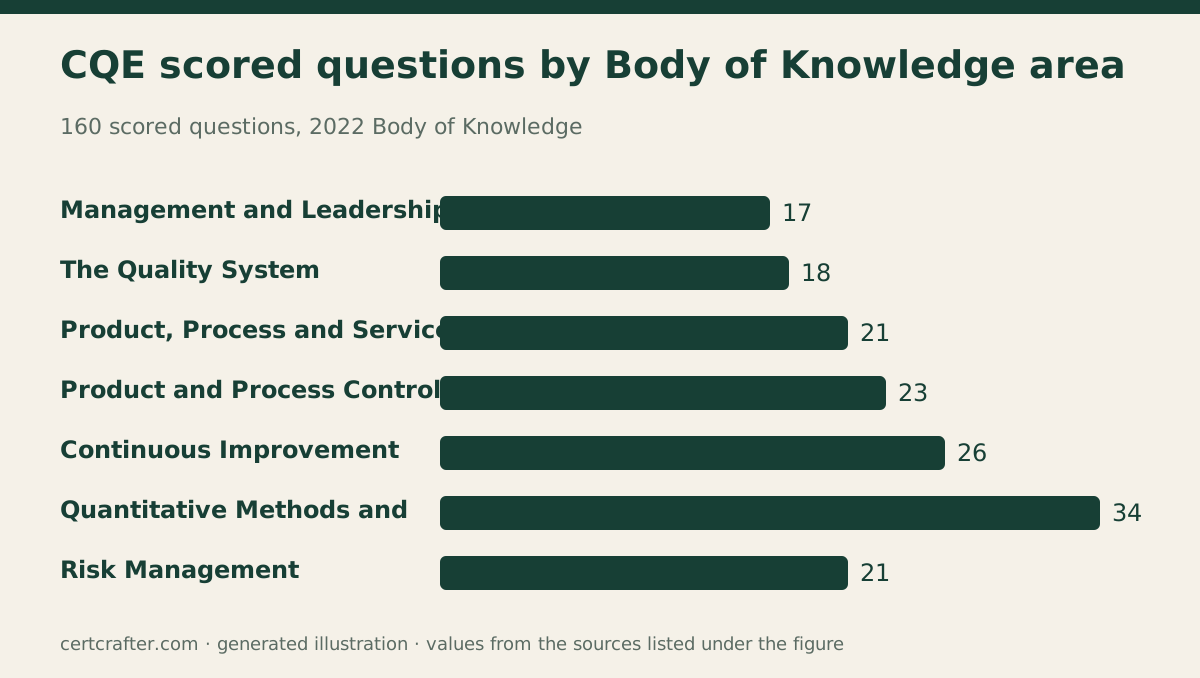
The 2022 Body of Knowledge has been in force since the October 2022 administration. It has seven areas, and the scored questions are split like this.
| Area | Scored questions | Share |
|---|---|---|
| I. Management and Leadership | 17 | 10.6% |
| II. The Quality System | 18 | 11.3% |
| III. Product, Process, and Service Design | 21 | 13.1% |
| IV. Product and Process Control | 23 | 14.4% |
| V. Continuous Improvement | 26 | 16.3% |
| VI. Quantitative Methods and Tools | 34 | 21.3% |
| VII. Risk Management | 21 | 13.1% |
Quantitative Methods alone is 34 questions, more than a fifth of the score. Risk Management grew from 15 to 21 when the 2022 edition replaced the 2015 one, with new subtopics on risk terminology, the risk management plan and treatment strategies, while theory of constraints, PERT/CPM and QFD were removed.
Every topic carries the maximum cognitive level at which it is tested, on Bloom’s revised taxonomy. Of the 102 leaf topics, 36 sit at Apply and 35 at Analyze, 19 at Evaluate, 11 at Understand and only 1 at Remember. That is the exam telling you it wants calculation and judgment, not recall.
What are the open-book and calculator rules?
Every ASQ exam is open book, and the rule that trips people is binding. References and all notes must be bound: stitched, glued, ring, spiral or snap binders, brads or screw posts all qualify. Hand-stapled papers, loose or blank pages, slide charts and wheel charts are prohibited. No electronic references. Collections of questions and answers are not allowed unless removed or obscured, and Post-it notes are fine only as tabs attached beforehand. The desk is about 48 in by 24 in, which is less room than it sounds once a binder and a calculator are on it.
A basic scientific calculator is shown on screen, and you may bring your own: any silent, hand-held, battery-operated calculator without an alphabetic keyboard, with programmable memory cleared. The TI-89 class is out. A backup is allowed. ASQ writes that the exam is set so a simple calculator is sufficient, which is true, but the on-screen one costs a mouse click per key. At a test center you get pencil and scratch paper; remotely proctored candidates use the on-screen scratchpad only.
On the shop floor the same principle applies. An inspector who has to look up which gage to use loses the batch to the clock. The open-book rule rewards the engineer who knows which method applies and opens the binder only for a constant or a table value.
What does the CQE cost, and who is eligible?
The 2026 fees are $550 list, $450 for ASQ members and $350 for a retake, in US dollars, with Canadian taxes added where they apply. Testing runs every month. Prometric windows fall in February, April, June, August, October and December, with application deadlines of 12 January, 9 March, 11 May, 13 July, 14 September and 9 November, and an alternate series covers the other six months.
Eligibility is eight years of full-time paid work in one or more Body of Knowledge areas, at least three of them in a decision-making position, meaning the authority to define, execute or control projects or processes and responsibility for the outcome. Education waives part of the eight years, once: a technical or trade diploma 1 year, an associate degree 2, a bachelor’s 4, a master’s or doctorate 5. Experience you used for CQA, CRE, CSQP, CSQE or CMQ/OE counts again here.
How should the format change the way you study?
Three things follow from the numbers above. The clock allows 1 minute 49 seconds a question, so every calculation has to be a routine you have run before, not a derivation. The weights say Quantitative Methods and Product and Process Control together carry more than a third of the score, so that is where the first weeks go. And the open-book rule says your binder should hold a formula sheet, the statistical tables and calculator notes you have already used under time pressure, not a textbook you hope to search.
The ASQ CQE Complete Exam Kit runs six full 175-question mock exams timed at 5 hours 18 minutes and weighted exactly like the exam, with an explanation for every option. The free 20-question sample shows how the questions are framed before you spend anything.
What to do next
Check the application deadline for the window you want and apply before it, because the paperwork date, not the exam date, decides when you sit. Then build the binder, bound the way the handbook allows, and sit one full-length mock with it before you decide you are ready. Unofficial: CertCrafter is not affiliated with ASQ, and ASQ does not endorse this page.
Comments
Comments are read by a person before they appear. How we moderate.