Most CQE candidates practice in short quizzes and meet a 5 hour 18 minute sitting for the first time on exam day. The statistics rarely beat them; the clock and the binder do.
What is the best way to prepare for the CQE exam?
Study the seven 2022 Body of Knowledge areas heaviest first, drill each area until its methods are routine, then sit full 175-question mock exams timed at 5 hours 18 minutes with your bound references. Stop when you reach 75% in every area on two consecutive mocks. Begin with a free sample to see how the questions are framed.
The rest of this page explains why each step is there.
What does the CQE exam test, and how is it scored?
The Certified Quality Engineer exam is one computer-based sitting of 175 multiple-choice questions. 160 are scored. The other 15 are unscored pretest items, mixed in with no flag, so every question gets your full effort.
Exam time is 5 hours 18 minutes inside a 5 hour 30 minute appointment, and the clock does not stop. It is open book, but references must be bound, and your calculator must have no alphabetic keyboard, with programmable memory cleared.
Passing is a scaled score of 550 on a scale that runs to 750. ASQ sets the raw cut with a panel of subject-matter experts in a modified Angoff study and carries it between forms by equating. It never publishes the number of correct answers behind 550.
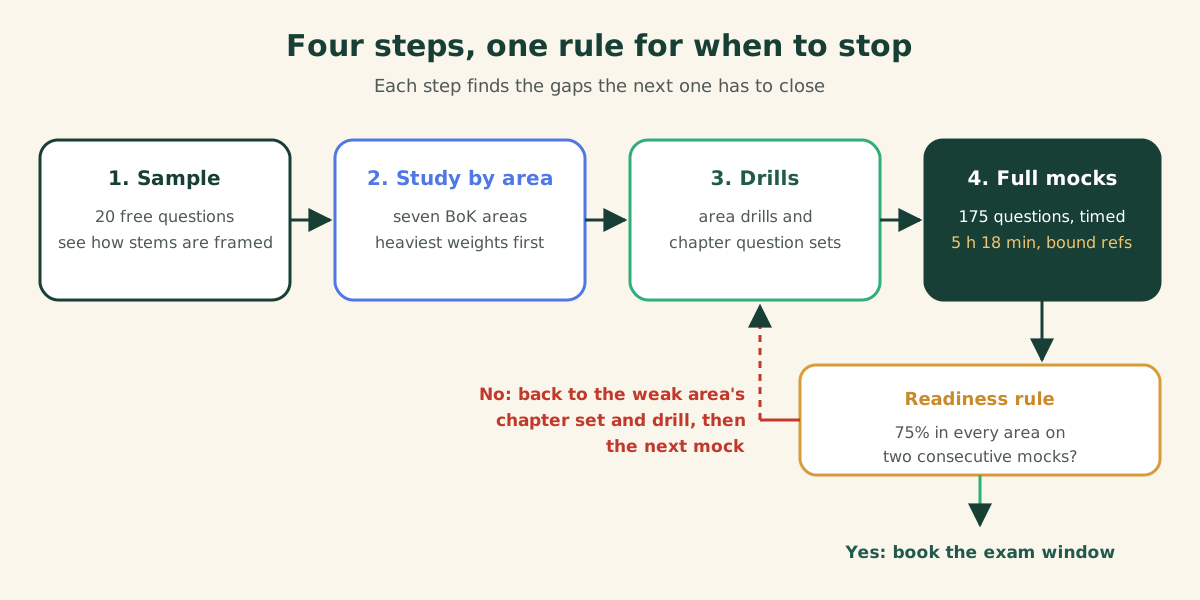
The 2022 Body of Knowledge splits the scored questions across seven areas: Management and Leadership 17, The Quality System 18, Product, Process, and Service Design 21, Product and Process Control 23, Continuous Improvement 26, Quantitative Methods and Tools 34, Risk Management 21. Of the 102 topics, 36 are tested at Apply, 35 at Analyze and 19 at Evaluate. This is a judgment and calculation exam. Fees in 2026 are $550 list, $450 for ASQ members and $350 for a retake. The CQE format and scoring guide has the full rules.
Why do full timed mocks matter for an open-book exam?
Because open book changes what is scarce. You can look anything up, but 175 questions in 5 hours 18 minutes leaves 1 minute 49 seconds each. A candidate who opens the binder for every control limit runs out of time before the last section and guesses the rest.
Stamina is the second reason. At a Prometric center there are no planned breaks. Remote candidates may take up to three 10-minute breaks, and the clock keeps running through them. A 25-question drill never shows you how your accuracy holds in hour four, when a Weibull question arrives after three hours of reading stems.
Quality engineers know this pattern from the shop floor. You don’t qualify a process on one good part; you run a capability study long enough to see the drift. A full mock is that study for your own preparation. It shows pacing, binder navigation and late-session accuracy together, which no short quiz can.
In what order should you prepare?
- Take a free sample. Answer 20 questions untimed and sort every miss into one of two piles: you picked the wrong method, or you picked the right one and slipped on arithmetic. The piles tell you what to study.
- Study by area, heaviest first. Quantitative Methods and Tools carries 34 scored questions, Continuous Improvement 26, Product and Process Control 23. Start there. Build your bound binder as you go, in your own notes, because that is what goes into the exam room.
- Drill until the method is routine. Area drills and chapter question sets turn “I understand capability” into “I can compute Cpk in under two minutes without opening the binder.”
- Sit full mocks and apply a readiness rule. Sit each mock in one sitting, timed, with the binder. Log the score per area. If any area sits under 75%, repeat its chapter set and drill before the next mock rather than sitting mocks back to back.
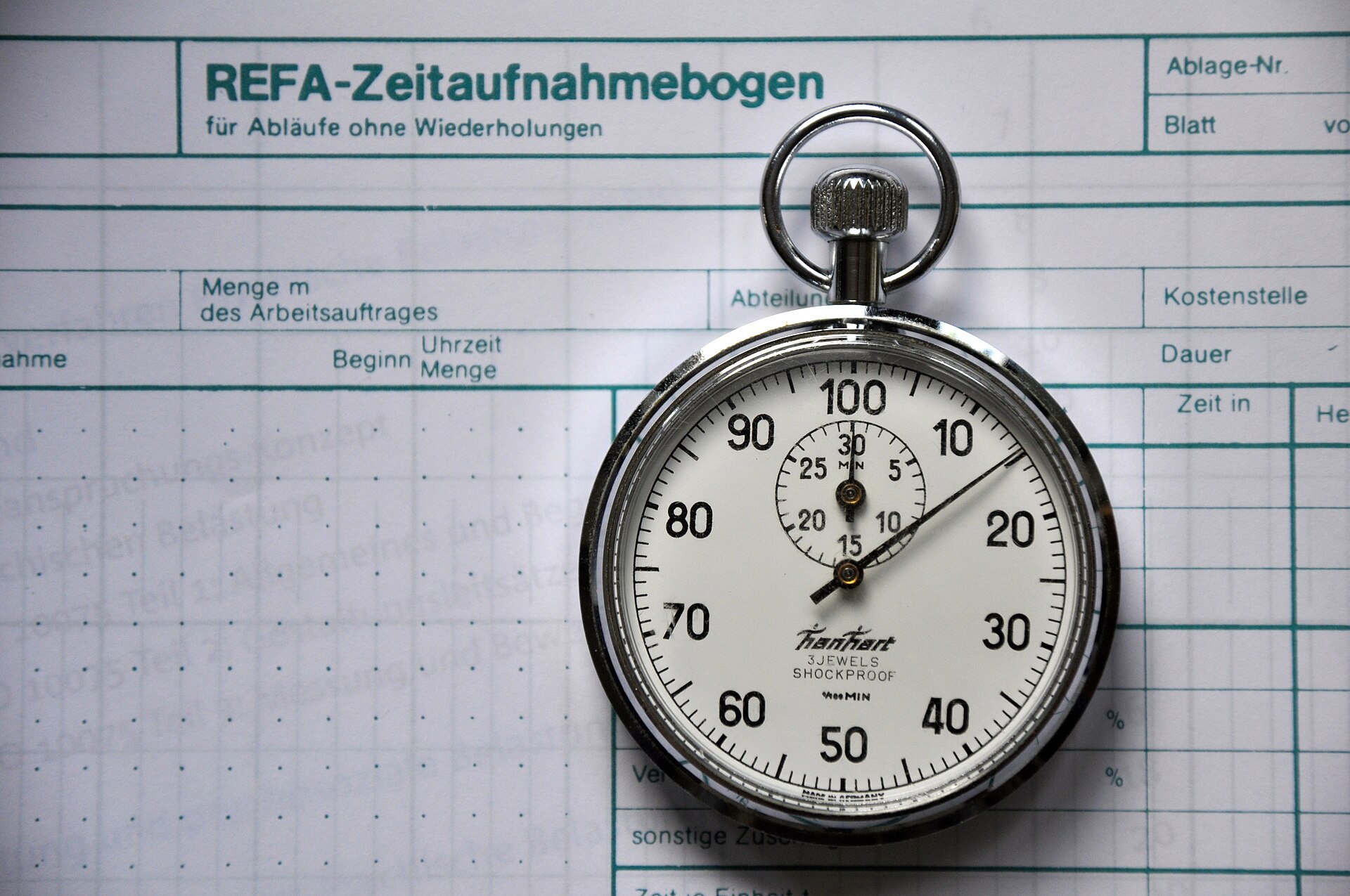
Why 75% in every area, on two in a row? ASQ reports only a scaled score, so any raw target is a training rule, not the pass mark. Two consecutive mocks guard against one lucky form. Per area guards against a strong total that hides a weak 21-question area like Risk Management.
What should good CQE prep material include?
These are the checks that matter for this exam.
| What to check | Why it matters on the CQE | How the CertCrafter kit meets it |
|---|---|---|
| Weighted to the 2022 Body of Knowledge | The 2015 BoK was withdrawn; Risk Management now carries 21 questions | Every question tagged with its 2022 BoK code and cognitive level |
| Full-length timed mocks | Pacing at 1 minute 49 seconds a question only shows over 175 questions | Six mocks of 175 questions, timed at 5 hours 18 minutes |
| Mocks weighted like the exam | A mock heavy on easy areas inflates your score | Split 19/20/23/25/28/37/23 by area, the exam’s own proportions |
| Scoring by area | ASQ gives a failing candidate a subtopic breakdown, so train the same way | Each mock result shows your percentage per area |
| An explanation for every option | Distractors are built from the common mistakes | Every option explained, with the arithmetic shown |
| Worked calculations you can trust | A wrong key teaches a wrong method | Every number recomputed in code by a validator |
| Formula sheet and tables to bind | Open book rewards a binder you have already used under time | Formula and method sheet, computed statistical tables, calculator guide |
| Original questions | You want questions written to the BoK, not to someone’s memory of a form | All questions original, written to the published BoK |
The ASQ CQE Complete Exam Kit covers every row of that table for $59, and the six mocks are where the readiness rule gets tested.
Where do candidates go wrong with practice exams?
They retake the same mock. By the third pass you remember the answers, and the score measures memory. Six different forms exist so that the two mocks behind a readiness decision are both fresh.
They practice without the binder. Then the first time they hunt for a table under pressure is the exam itself. Sit every mock with exactly the references you will bring.
They read only the right answer. On the CQE the wrong options are the lesson: the R chart constant used on the Xbar chart, the producer’s risk read as the probability of acceptance. If you can’t say why each distractor is wrong, you will meet it again.
They trust the overall percentage. A process can average inside the specification while one cavity runs out. Your score works the same way. An 80% total can hide 60% in Quantitative Methods, and that area alone is 34 questions. The CQE formula guide shows which methods those questions lean on.
What is in the ASQ CQE Complete Exam Kit?
It holds 1,425 original questions on the 2022 Body of Knowledge, each with an explanation for every option. Six full mocks of 175 questions, timed at 5 hours 18 minutes. Seven area drills of 25 questions and seven chapter question sets. A seven-chapter study guide with worked examples and 41 computed figures. A formula and method sheet, statistical tables computed for the kit, and a calculator guide. 484 flashcards, a 30-day plan, 8-week and 12-week planners, and a readiness tracker that logs each mock by area.
On accuracy: a validator recomputes every number in code before a question ships, and an independent blind review of 156 mock questions, answered by reviewers who saw only the stems and options, agreed with the keyed answer on all 156.
It costs $59 for lifetime access, online and view-only in your account. Nothing in it is ASQ material or recalled exam content, and nobody can honestly promise you a pass. What it gives you is realistic practice at full length, scored the way the exam is weighted.
What to do next
Take the free 20-question CQE sample tonight, time yourself, and sort your misses into method and arithmetic. If the method pile is bigger, start with the area chapters; if the arithmetic pile is, start drilling. More CQE topics are on the CQE guides hub. Unofficial: CertCrafter is not affiliated with ASQ, and ASQ does not endorse this page.
Comments
Comments are read by a person before they appear. How we moderate.