
Plenty of LPIC-3 candidates ask what experience they need. The better question is whether their LPIC-2 is still active, because that is the line LPI actually draws.
Who is eligible to take LPIC-3 305?
Start with what LPI says. On its LPIC-3 305 overview page, the prerequisite is that “the candidate must have an active LPIC-2 certification to receive the LPIC-3 certification.” The requirement is passing the 305 exam. There is no table of degrees and years like the one API publishes for its inspector exams, and LPI states no minimum work history.
That wording matters. The prerequisite is attached to receiving the certification, not to registering for the exam. If your LPIC-2 has lapsed, you can still study, but a pass would not turn into an LPIC-3 until the LPIC-2 is active again. Our certification guide reads it the same way.
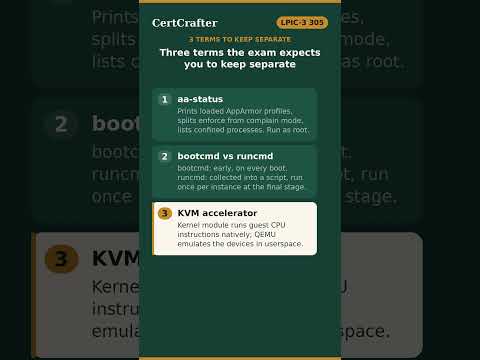 LPIC-3 305 — Three virtualization terms the exam expects you to keep separate. Watch on YouTube · CertCrafter
Our channel has a short on three virtualization terms the exam expects you to keep separate, which is a fair taste of the vocabulary you will need.
What does LPI mean by virtualization and containerization?
LPI describes the certification as covering the administration of Linux systems enterprise-wide with an emphasis on virtualization and containerization. LPIC-3 is the top level of its professional program, and there are four separate specialties. Passing any one of the four exams grants the LPIC-3 certification for that specialty.
So this is a specialty, not a ladder you must climb in order. A sysadmin who runs KVM hosts and Docker for a living can aim at 305 directly, provided the LPIC-2 is in place. A sysadmin whose work is clustering and storage would look at a different LPIC-3 exam.
What does the exam ask of you once you are eligible?
Exam 305 is 60 questions in 90 minutes, a mix of multiple-choice and fill-in-the-blank items. That is 90 seconds a question, and the fill-in-the-blank items are the slow ones, because you have to produce the command, flag or path yourself.
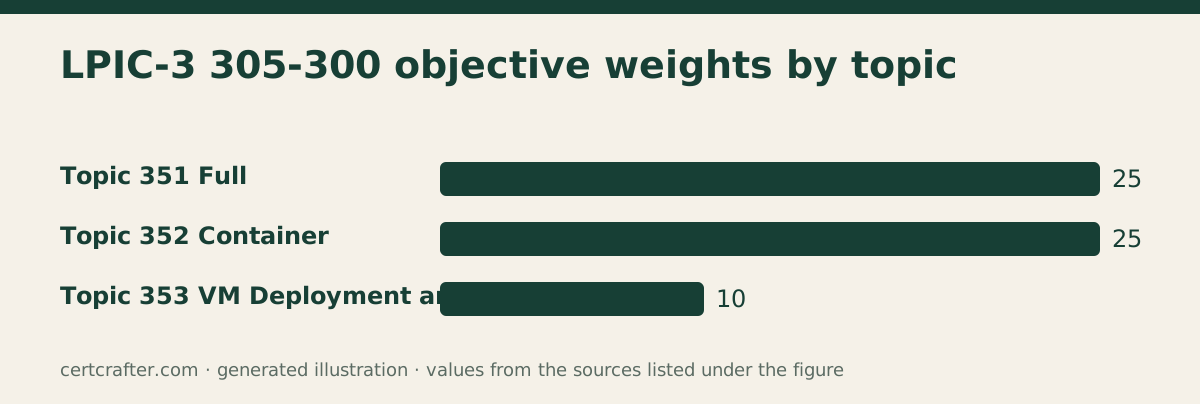
The objectives are version 3.0, exam code 305-300. LPI weights each objective, and the weights tell you where the questions go. Here they are added up by topic.
| Topic | What it covers | Combined weight |
|---|---|---|
| 351 | Full Virtualization | 25 |
| 352 | Container Virtualization | 25 |
| 353 | VM Deployment and Provisioning | 10 |
The combined weight is 60, the same number as the questions, though LPI describes weights as relative importance, so treat them as a guide and not a promise. The two heaviest single objectives are 351.4 Libvirt Virtual Machine Management and 352.3 Docker, each weighted 9.

How does this look in real work?
In practice, the people who pass 305 are the ones who run these systems. They build a KVM host, create guests with virsh instead of a graphical tool, read the libvirt XML, and then change it on purpose. They start a container, break it, and find out which namespace or cgroup setting caused the problem.
Employers read an LPIC-3 as evidence of that hands-on work, which is why LPI keeps the prerequisite chain intact. A certificate whose lower level has lapsed is harder to vouch for, and the rule is a quiet way of keeping the levels meaningful.
If you manage a team, the useful habit is a calendar entry for each person’s LPIC-2 renewal, set well before any LPIC-3 booking. It costs nothing and it avoids the awkward case of a pass that cannot be awarded.
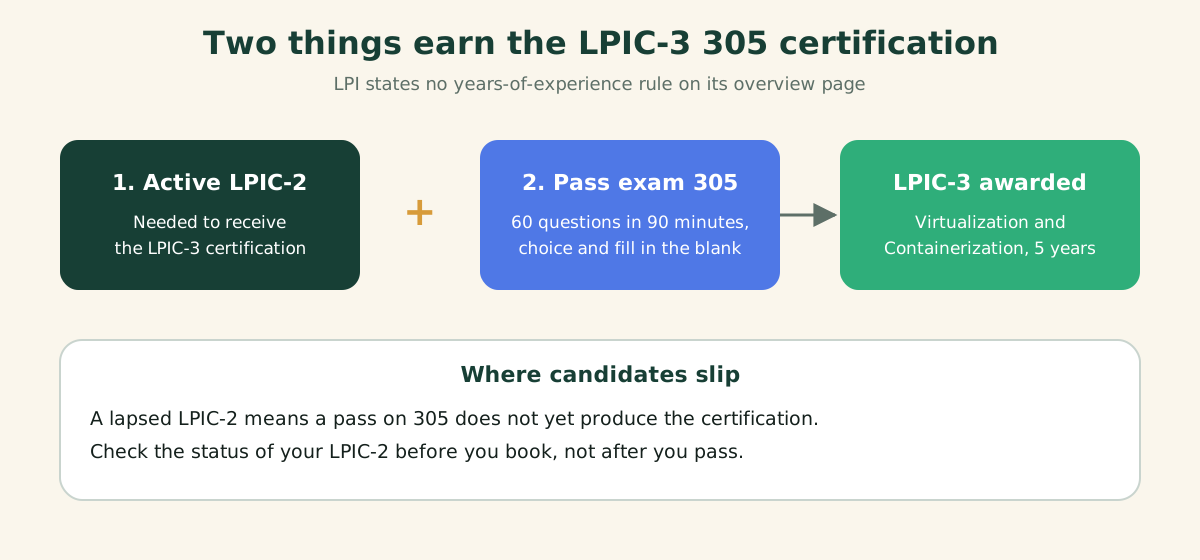
Worked example: planning your route to LPIC-3 305
Take a sysadmin who passed LPIC-2 a few years ago and now wants the virtualization specialty.
- Check the status of the LPIC-2 first. If it is active, the prerequisite is met. If not, deal with that before anything else.
- Confirm the specialty. LPIC-3 has four, and 305 is Virtualization and Containerization. Passing it grants that specialty.
- Choose where to sit it: a VUE test center or online through OnVUE. Both offer English and Japanese.
- Buy a voucher. LPI lists the price per country, so read its exam pricing page for yours.
- Budget the time. Sixty questions in 90 minutes is 90 seconds each, so rehearse the fill-in-the-blank items under that clock.
- After the pass, the certification is valid for 5 years, so plan the extension options early.
The LPIC-3 305-300 Complete Exam Kit rehearses that clock under timed conditions, with every answer explained.
Where do candidates slip before the exam?
Three things come up again and again. The first is the lapsed LPIC-2 already described. The second is booking before reading the objectives, so the first look at libvirt, Xen and cloud-init happens in week one of study, not week one of planning. The third is treating 353 as an afterthought because it carries the smallest weight. Packer, cloud-init and Vagrant together are 10 of the 60, and our common mistakes post shows how often candidates under-prepare them.
None of this is exotic. It is the same discipline you apply to a change on a production host: check the prerequisites, read the spec, then act.
How does eligibility show up in exam questions?
It does not appear as a question. What carries over is the principle behind it. LPI wants someone who can operate these systems, so the questions favor exact subcommands, options and file paths over general understanding. If you can only recognize a command when you see it, the blank-fill items will cost you time you do not have.
Read the format, scoring and booking detail in our LPIC-3 305 exam format post, and use the free sample questions to find out where your gaps are. The rest of our writing on this exam sits in the LPIC-3 305 hub.
What to do next
Open your LPI account today and look at the status of your LPIC-2. If it is active, read the 305 objectives line by line and mark the ones you have never touched on a real host.
Comments
Comments are read by a person before they appear. How we moderate.