My 4 engineering books go FREE on Kindle Fri 6 – Tue 10 Nov (PT). See the books → FREE on Kindle now: all 4 engineering books, until Tue 10 Nov 11:59 pm PT. Ends in . Grab yours → My 4 books: FREE on Kindle Fri 6 – Tue 10 Nov (PT). See → FREE on Kindle now: 4 books, left Grab yours →

LPIC-3 305 Practice Questions, Set 2 (Free)

By Sandeep Bandyopadhyay, Senior aerospace engineer · PMP, MBA, Six Sigma

TL;DR

This second free set gives three LPIC-3 305-300 questions with full explanations: one on AppArmor and container confinement, one on Docker image storage, one on how libvirt picks a driver. They match an exam of 60 questions in 90 minutes, multiple choice and fill-in-the-blank, scored 200 to 800 with a pass at 500. Docker and libvirt carry 9 weighted points each, so both reward hands-on time more than reading.

Original questions, not exam dumps. Every CertCrafter question is written from the published body of knowledge and the referenced codes. None is copied from a live exam, and CertCrafter is independent: not affiliated with or endorsed by any awarding body.

Wide panorama of a large data center building and its surroundings
Photo: Utah Data Center Panorama (cropped) by Swilsonmc (Wikimedia Commons), CC BY-SA 3.0, via Wikimedia Commons.

Candidates who can start a container still lose marks on what holds it in place, and on which tool owns a connection. Set 2 aims at exactly those two gaps.
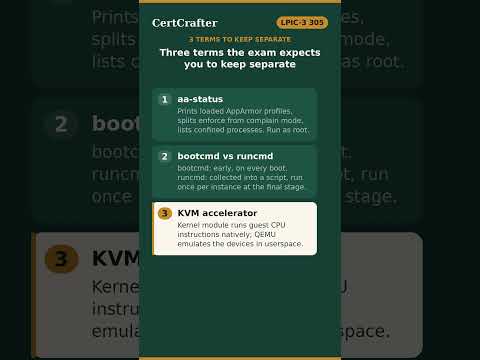
Video: LPIC-3 305 — Three virtualization terms the exam expects you to keep separate. LPIC-3 305 — Three virtualization terms the exam expects you to keep separate. Watch on YouTube · CertCrafter
Image: video thumbnail, source: CertCrafter on YouTube (@certcrafters).

What do these free LPIC-3 305 questions cover?

Three questions, three habits. One asks you to read the state of a container host, one asks what a storage line says about how images sit on disk, and one asks what libvirt does when you hand it a connection URI. None is a definition question. Each gives you a command or a line of output and asks what follows from it.

The first set is on a separate page, so you can do both in a sitting. Take every question cold: write your answer down, then open the explanation. The channel also has a short clip on three virtualization terms the exam expects you to keep separate if you want a warm-up.

How does Linux actually confine a container?

A container is not a small virtual machine. It is a normal process on the host kernel, fenced in by several separate mechanisms. LPI’s objective for container concepts names them: kernel namespaces, control groups, capabilities, and the role of seccomp, SELinux and AppArmor. It also says LXC and Docker both use these.
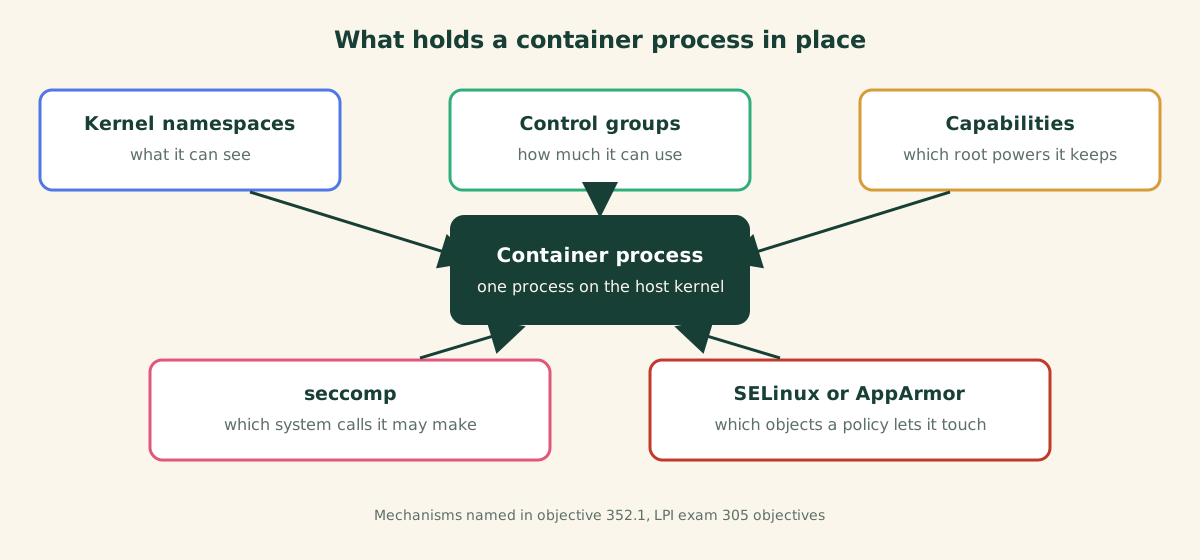
Diagram of a container process on the host kernel surrounded by five mechanisms: namespaces for what it can see, control groups for how much it can use, capabilities for which root powers it keeps, seccomp for which system calls it may make, and SELinux or AppArmor for which objects a policy lets it touch
Illustration: CertCrafter, from the LPI exam 305 objectives. Illustration: CertCrafter, from LPIC-3 Virtualization and Containerization Exam 305 Objectives.

Each layer answers a different question, and that is the whole trick. When a stem describes a symptom, ask which layer could cause it.

Mechanism What it limits A command or path to know
Namespaces What the process can see unshare, nsenter, /proc/PID/ns
Control groups How much it can use /sys/fs/cgroups
Capabilities Which root powers it keeps capsh
seccomp Which system calls it may make named in 352.1
SELinux, AppArmor Which objects a policy lets it touch profiles loaded per host

The listed utilities come straight from the objective. Anyone who has run unshare by hand and looked at the entries under /proc has an easier time than anyone who has only read about it.

What do administrators check first on a confined host?

In practice you rarely start from theory. A container cannot write somewhere, or a service that works on one host fails on another, and the question is whether a profile is involved. The first move is to see what is loaded and what is enforced, not to disable the profile and hope.

Teams that skip that step end up turning confinement off to get a deploy through, then leaving it off. A better habit is a short checklist per incident: which profile, which mode, which process. The first free question below is built around that habit, and it expects you to know which tool reports state and which tools merely change it.

Which Docker facts does the exam expect you to read from output?

Docker carries 9 of the 60 weighted points, tied with libvirt for the heaviest objective. LPI’s list for it includes dockerd, /etc/docker/daemon.json and /var/lib/docker/, plus images, volumes, logging, networking and Dockerfiles. Notice how many of those are places on a filesystem. The exam likes to hand you a line from a command and ask what it implies.
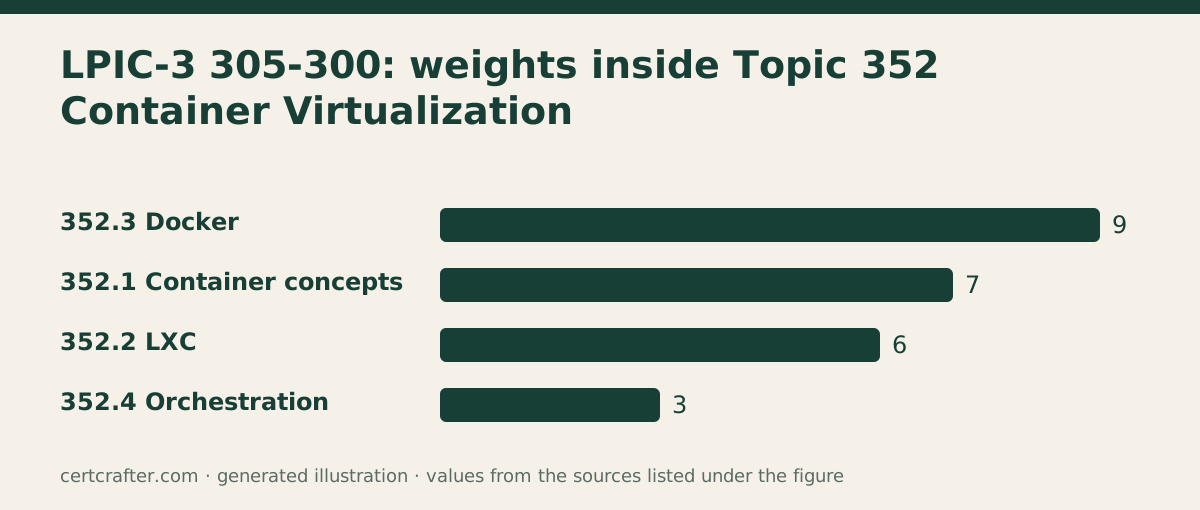
Bar chart of objective weights inside Topic 352: Docker 9, Container concepts 7, LXC 6, Orchestration 3
Illustration: CertCrafter, from the LPI exam 305 objectives. Illustration: CertCrafter, from LPIC-3 Virtualization and Containerization Exam 305 Objectives.

On a real build runner the same skill saves an afternoon. When a disk fills or a pull is slow, reading the storage driver and the backing filesystem tells you where to look before you touch anything. The second free question below is about that reading.
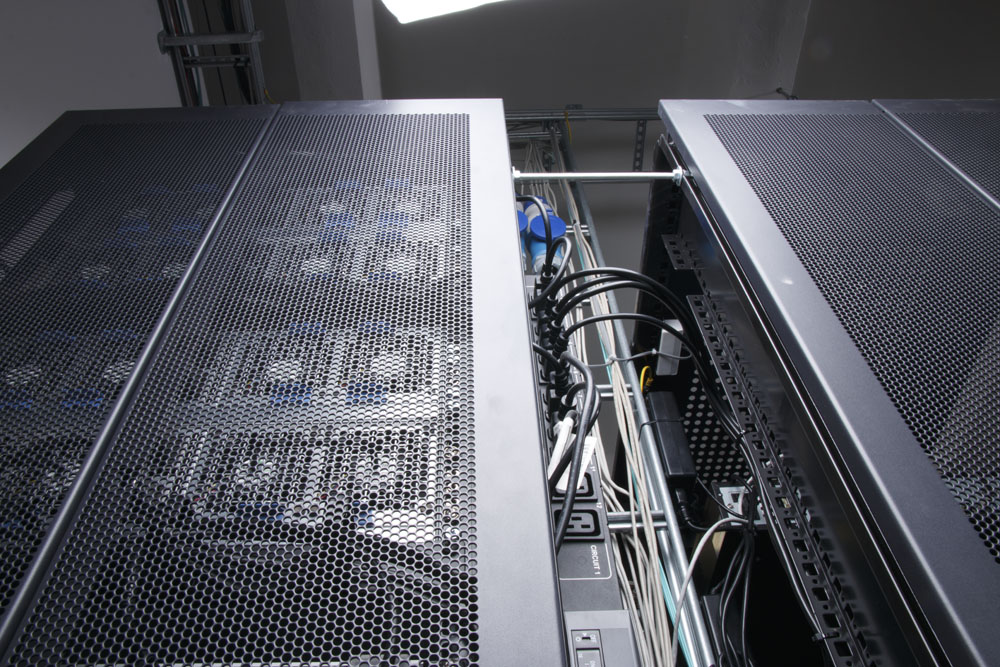
Rows of server racks with network cabling in a data center
Photo: Bacloud.com data center 2 by Fleshas (Wikimedia Commons), CC BY-SA 4.0, via Wikimedia Commons.

How does libvirt choose which hypervisor to talk to?

Objective 351.4 is the other 9-point objective. LPI asks you to understand how libvirt interacts with Xen and QEMU, to manage connections and nodes, and to create and manage domains, storage pools, volumes and virtual networks. The files and tools it lists are libvirtd, /etc/libvirt/ and virsh with its subcommands.

One idea ties much of this together: the connection decides which driver does the work. The same virsh binary can manage different hypervisors, and on a mixed estate that is exactly why a command that looked right ran against the wrong host. Before you run anything destructive, check which connection you are on. The third free question tests whether you know the order of events.

Where do candidates lose marks on these topics?

Two patterns show up again and again. The first is mixing up tools that report state with tools that change it, which costs marks wherever a stem asks what a command does and offers five names that look alike. The second is reasoning by analogy: treating a container like a virtual machine, or assuming that a driver is chosen by what is installed rather than by the connection.

Both fixes are practical. Run the commands on a lab host, read the output, and break something on purpose. LPI says the objectives should sit at the core of any study plan, so keep them open beside the terminal and tick off what you have run. The LPIC-3 305 common mistakes guide covers more habits like these, and the command walkthroughs show a command from start to finish.

For the full fact sheet see the LPIC-3 305-300 guide, and the hub of 305-300 guides lists the rest.

What these three questions will not do

They are not copied from a live exam. They are written from LPI’s published objectives, and three questions cannot tell you whether you are ready for 60 in 90 minutes. They show whether a habit is sound.

The LPIC-3 305-300 practice test bundle picks up where these stop, with six tests and 720 questions, every answer explained. You can also try the free scored quiz. Next step: open the first question and commit to an answer before you read the explanation.

Try these free questions

  1. Which command lists the AppArmor profiles currently loaded and the processes they confine?

    1. apparmor_parser -l
    2. aa-complain --list
    3. aa-status
    4. aa-enforce --list
    Show the answer and explanation

    Answer: C. aa-status, from the apparmor-utils package, prints how many profiles are loaded, splits them into enforce and complain mode, and lists the processes currently confined by each. It needs root privileges to read that process list. apparmor_parser loads, replaces and removes profiles rather than reporting on them, and its -r and -R options are the ones normally used. aa-complain and aa-enforce switch a named profile between the two modes and expect a profile name or path rather than a --list flag. Container runtimes load their own profiles, so a confined container appears in aa-status output under a runtime-specific profile name.

  2. 'docker info' on build-runner reports 'Storage Driver: overlay2' and 'Backing Filesystem: extfs'. What do those two lines tell you about how image layers are stored?

    1. Layers are stacked as directories under /var/lib/docker on ext4
    2. Layers are stored as thin LVM volumes carved out of an ext4 volume group
    3. Layers are kept as btrfs subvolumes and ext4 holds only the container logs
    4. Layers are single archive files unpacked into a tmpfs at container start
    Show the answer and explanation

    Answer: A. overlay2 is a union filesystem driver. Each image layer is a directory under /var/lib/docker/overlay2, and a container receives an upper directory stacked over the read-only image layers plus a merged view that its processes actually see. The Backing Filesystem line reports the filesystem holding /var/lib/docker, and extfs means ext4 there; overlay2 supports it as well as xfs formatted with ftype=1. Thin LVM volumes belong to the devicemapper driver, a different storage driver entirely and no longer a common choice. btrfs subvolumes belong to the btrfs driver, and the backing filesystem line would say btrfs if that were in play. Layers are never unpacked into tmpfs; they persist on disk and are shared between images that have layers in common, which is why pulling a second image from the same base downloads very little.

  3. An administrator runs 'virsh -c qemu:///system start web01' on a host where both the QEMU and Xen drivers are available. Which step does libvirt perform first?

    1. It matches the URI scheme to the QEMU driver before touching any domain state
    2. It launches a qemu-system process first and then decides which driver should own it
    3. It reads the domain XML from /etc/libvirt/qemu and picks a driver afterwards
    4. It queries XenStore for a matching domain identifier before selecting any driver
    Show the answer and explanation

    Answer: A. The URI scheme is what selects the driver. libvirt parses qemu:///system, matches the scheme to the QEMU hypervisor driver, and only then does that driver look up the domain called web01 and assemble a command line for it. Driver selection happens before any domain state is touched, which is why the same virsh binary manages QEMU guests one moment and Xen guests the next with nothing changed but the connection URI. Option 2 inverts the order, since no process is spawned until a driver has been chosen and the XML parsed. Option 3 puts the work in the wrong sequence as well, because libvirt has to know which driver owns the connection before it knows where a definition lives. Option 4 describes what the Xen driver would do, and XenStore is never consulted on a QEMU connection. Remote forms such as qemu+ssh://kvm-host-03/system follow the same rule, with the transport handled before the driver sees anything.

Take the full free 10-question sample with scoring →

Frequently asked questions

How is this set different from the first free LPIC-3 305 set?

It uses three different questions, on container security, Docker storage and libvirt connections. At most a few ideas overlap with set 1, and each question comes with its options and a full explanation.

How many questions are on the LPIC-3 305-300 exam?

LPI describes the exam as 60 multiple-choice and fill-in-the-blank questions in 90 minutes. The score is scaled from 200 to 800 with a pass at 500.

Do I need LPIC-2 before LPIC-3 305 is awarded?

Yes. LPI states that the candidate must hold an active LPIC-2 certification to receive the LPIC-3 certification, and that passing the 305 exam is the other requirement.

Official sources

  1. LPIC-3 Virtualization and Containerization Exam 305 Objectives — accessed 6 November 2026
  2. LPIC-3 Virtualization and Containerization overview — accessed 6 November 2026

Exam rules change. Check the awarding body's official page before you apply. CertCrafter is independent and is not affiliated with or endorsed by any awarding body.

Was this helpful?

Comments

    Comments are read by a person before they appear. How we moderate.