
Most candidates who miss the 500 mark on 305-300 knew the material in outline. They lost marks on a handful of habits that show up the moment a question asks for an exact command, file or layer.
Why do capable administrators still fall short on LPIC-3 305?
The exam is 60 questions in 90 minutes, a pace of 90 seconds each. It mixes multiple choice with fill-in-the-blank items. That combination punishes anyone whose knowledge is wide but loose.
On a real host you can run a command, read the error and adjust. On the paper you cannot. So the mistakes below are less about ignorance and more about how people prepare. Each one has a fix you can do in an afternoon.
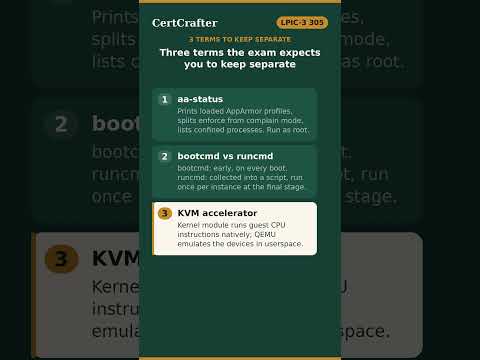 LPIC-3 305 — Three virtualization terms the exam expects you to keep separate. Watch on YouTube · CertCrafter
The channel has a short clip on three virtualization terms the exam keeps apart, which covers the first trap in the next section.
Which mistakes come from misreading the syllabus?
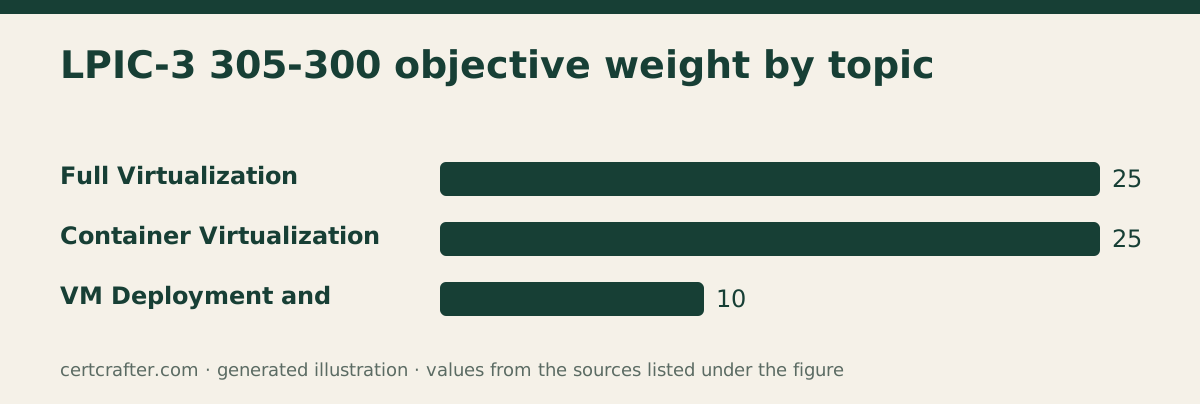
Reading the weights as trivia. LPI gives every objective a weight and says higher weights are covered by more questions. The thirteen weights add up to 60, the same as the number of questions. Topics 351 and 352 hold 25 each, and Topic 353 holds 10. Candidates see that 353 is smaller and drop it.
Skipping the small topic. Packer is weighted 2, cloud-init 3 and Vagrant 3, with cloud management tools at 2. That is about one question in six. Because most people under-prepare it, it is the cheapest place to gain ground.
Over-studying Xen. Xen is weighted 3. LPI says the focus is Xen version 4.x and lists Domain0, DomainU, xl and xentop. Learn those, then stop. Libvirt at 9 and Docker at 9 are the highest weights on the whole paper and deserve most of your lab hours.
Which mistakes come from how you practice?
Recognizing instead of typing. A multiple-choice option jogs your memory. A blank field does not. If you only ever pick from a list, you will know that virsh can snapshot a domain and still freeze when asked for the subcommand. Practice by writing the command from a cold start, then checking it.
Never opening the libvirt XML. Objective 351.4 says to understand libvirt XML configuration files. Graphical tools hide them, so people who learned on a web console have never read one. In a team that keeps domain definitions under version control, the XML is the thing reviewed in a pull request. Define one domain by hand and change a setting on purpose.
Mixing up the layers. KVM is a set of kernel modules (kvm, kvm-intel, kvm-amd) behind /dev/kvm. QEMU is the userspace program that starts the guest. Libvirt manages domains for QEMU and Xen alike. A question may describe a symptom and ask which layer owns it. Name the layer first, then the tool.

Forgetting the disk image side. Objective 351.5 names raw, qcow2 and VMDK, and the tools qemu-img, guestfish and the virt-v2v family. Moving a physical server into a guest or a guest between formats is routine work, and it is a regular source of questions.
Which mistakes come from treating containers as small VMs?
This is the one that costs the most, because it feels right. A container is a process on the host kernel, not a machine with its own kernel.
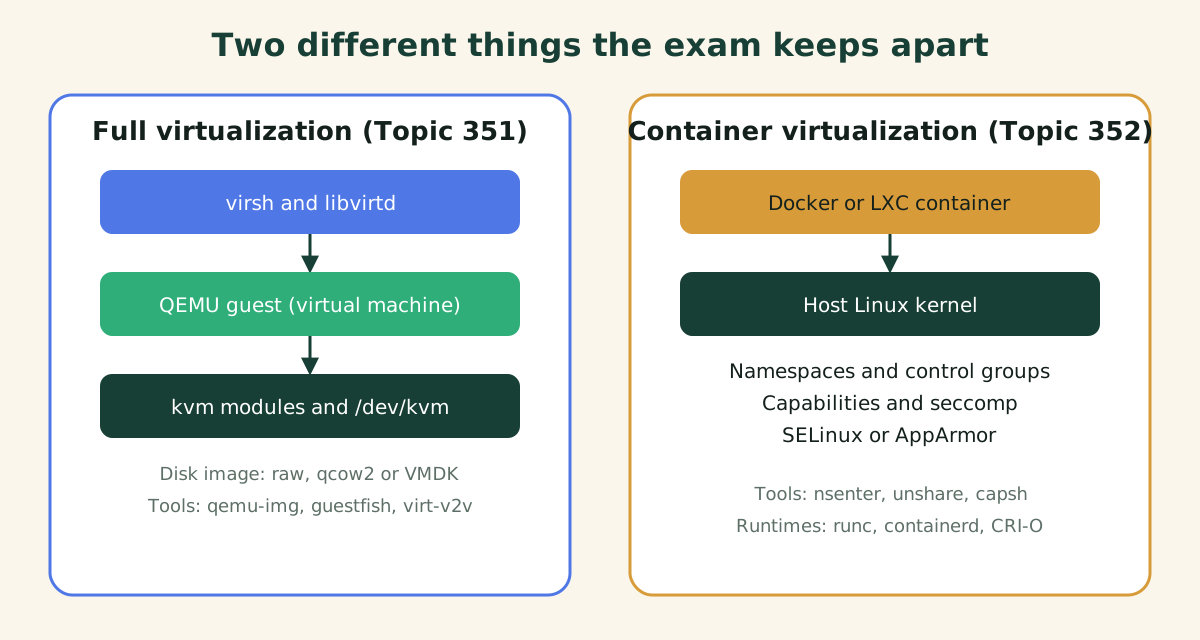
Skipping the kernel features. Objective 352.1 asks you to understand and analyze namespaces, control groups and capabilities, and the role of seccomp, SELinux and AppArmor. It also expects you to know how LXC and Docker use them. On a job, this is how you debug a container that cannot see a device or hits a resource limit: you look at the namespaces and cgroups, not at Docker. Try nsenter and unshare by hand before you touch an image.
Learning Docker as a list of commands. Objective 352.3 covers the architecture and components of Docker, images and volumes, logging, networking, Dockerfiles and running a registry from the registry image. It names dockerd, /etc/docker/daemon.json and /var/lib/docker. Knowing where the daemon is configured and where data lives matters as much as docker run.
Blurring LXC and LXD. Objective 352.2 covers system containers with LXC and LXD, version 3.0 or higher, including LXD profiles, networking and storage. Application containers and system containers are different ideas, and a question will test the difference.
Treating orchestration as a footnote. Objective 352.4 is weighted 3. It asks for the key concepts of Docker Compose, Docker Swarm, Kubernetes and Helm. You do not need a cluster to answer, but you do need to say what each one is for.
Worked example: where 90 minutes should go
Use the weights to plan lab time, not just the clock.
- Start with the pace: 90 minutes for 60 questions is 90 seconds each.
- Convert weights to rough question counts: Topic 351 about 25, Topic 352 about 25, Topic 353 about 10.
- Split your lab hours the same way, then move a few hours toward typed commands, because the fill-in-the-blank items need exact syntax.
- Check the result against the highest weights. Libvirt and Docker, at 9 each, should have the most hours of any single objective.
These counts are estimates built from the weights. LPI does not publish a question count per objective.
The LPIC-3 305-300 practice tests work these topics under a timed 90-minute limit, with every answer explained.
Which mistakes come from the rules around the exam?
Planning around a percentage. The score is scaled from 200 to 800 with a pass at 500. LPI states that the number of correct answers needed for 500 depends on the questions you receive. Aim for strength across all three topics, not a target count.
Ignoring the LPIC-2 requirement. An active LPIC-2 is required to receive the LPIC-3 certification. Check its status before you book, because a passing score on 305-300 will not produce the certificate if it has lapsed.
What should you do this week?
Pick the two mistakes that sound most like you. If it is the layers, build one KVM host and define a domain through libvirt. If it is the containers, start a process with unshare and look at its namespaces.
Then read the certification guide and try the free sample to see how questions are framed. The LPIC-3 305 hub lists every topic post, including Full Virtualization: what the exam tests. LPI’s own objectives page has the full key knowledge list.
Comments
Comments are read by a person before they appear. How we moderate.