
My 4 engineering books go FREE on Kindle Fri 6 – Tue 10 Nov (PT). See the books → FREE on Kindle now: all 4 engineering books, until Tue 10 Nov 11:59 pm PT. Ends in . Grab yours → My 4 books: FREE on Kindle Fri 6 – Tue 10 Nov (PT). See → FREE on Kindle now: 4 books, left Grab yours →

LPIC-3 305 Practice Questions (Free, With Explanations)

By Sandeep Bandyopadhyay, Senior aerospace engineer · PMP, MBA, Six Sigma

TL;DR

Three free LPIC-3 305-300 practice questions sit on this page, each with its full explanation. They follow the exam's shape: 60 questions in 90 minutes, multiple choice and fill-in-the-blank, scored on a scale of 200 to 800 with a pass at 500. LPI weights the thirteen objectives, and the weights add up to 60, so they work as question counts. One question each from virtualization, containers and provisioning shows how the paper mixes topics.

Original questions, not exam dumps. Every CertCrafter question is written from the published body of knowledge and the referenced codes. None is copied from a live exam, and CertCrafter is independent: not affiliated with or endorsed by any awarding body.

Server racks in a data center with cables and indicator lights
Photo: Wikimedia Foundation Servers-8055 16 by Victorgrigas (Wikimedia Commons), CC BY-SA 3.0, via Wikimedia Commons.

Most 305-300 candidates know what a hypervisor is and still miss the question, because the paper asks what a specific host is doing right now. The three free questions below are written that way.
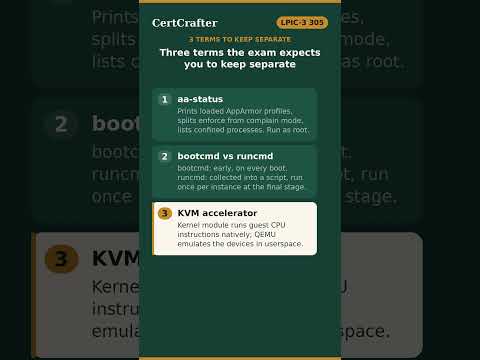
Video: LPIC-3 305 — Three virtualization terms the exam expects you to keep separate. LPIC-3 305 — Three virtualization terms the exam expects you to keep separate. Watch on YouTube · CertCrafter
Image: video thumbnail, source: CertCrafter on YouTube (@certcrafters).

What do these free LPIC-3 305 questions test?

One question comes from each of the exam’s three topics: Full Virtualization, Container Virtualization and VM Deployment and Provisioning. Each one hands you a small piece of a real system, such as a command line, a bridge setting or a config file, and asks what follows from it. That is how an administrator thinks on the job, and it is how the questions are framed.

They come from the free sample behind the scored LPIC-3 305-300 quiz. Take them cold, commit to an answer, and only then open the explanation. The channel has a short clip on three virtualization terms the exam expects you to keep separate, a good warm-up before you start.

How is the 305-300 exam built?

LPI describes the exam as 90 minutes, 60 multiple-choice and fill-in-the-blank questions. That is an average of 90 seconds each. The score is scaled from 200 to 800 with a pass at 500, and LPI states that the number of correct answers behind 500 depends on the exact set you get.

An active LPIC-2 certification is required before LPIC-3 is awarded, and the certification is valid for five years. Check the status of your LPIC-2 before you book, because a pass without it will not produce the certificate.

The fill-in-the-blank items matter most for how you study. You type a command, an option or a path, so recognizing it in a list is not enough. A habit worth building early: write the command on paper before you look at any options.

Which objectives carry the most questions?

LPI assigns every objective a weight and says higher weights get more questions. The thirteen weights sum to 60, the same as the number of questions on the paper, so a weight of 9 is close to nine questions. The five heaviest:

Objective Weight
351.4 Libvirt Virtual Machine Management 9
352.3 Docker 9
352.1 Container Virtualization Concepts 7
351.1 Virtualization Concepts and Theory 6
352.2 LXC 6

The two nines are where lab hours pay back first. On the job it is the same story: you spend far more of your week in libvirt and Docker than in Packer.
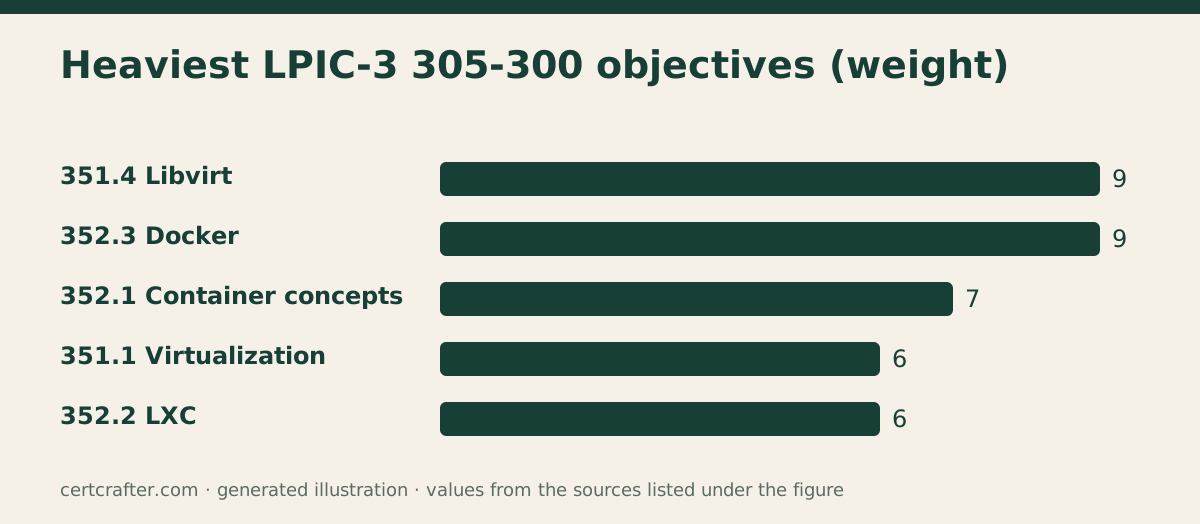
Bar chart of the five heaviest LPIC-3 305-300 objectives by weight: 351.4 Libvirt 9, 352.3 Docker 9, 352.1 Container concepts 7, 351.1 Virtualization concepts 6, 352.2 LXC 6
Illustration: CertCrafter, from the LPI exam 305 objectives. Illustration: CertCrafter, from LPIC-3 Virtualization and Containerization Exam 305 Objectives.

What does the virtualization question look for?

It sits in the QEMU objective, which asks you to understand QEMU’s architecture including KVM. LPI’s list for that objective names the kvm, kvm-intel and kvm-amd kernel modules and the /dev/kvm device. Those are not trivia. In practice they are the first things you check when a guest runs slowly: is the module loaded, does the device exist, and is the guest really using the accelerator?

The exam version of that habit is to ask which component does which job. Decide what runs in userspace and what runs in the kernel before you read the options, and the wrong answers stop looking plausible.

What does the container question look for?

Containers are where candidates reason by analogy with virtual machines and get hurt. LXC and LXD work with system containers, and the objective expects you to manage instances, networking and storage through LXD. On a real project the networking is where tickets come from: an instance that cannot reach the outside, a bridge with the wrong address range, a profile that was never applied.

The question asks you to follow a setting down to the mechanism it triggers on the host. Think about what the host has to do for the traffic to leave, not about which feature sounds right.

Server hardware in a rack with network cables in a Wikimedia data center
Photo: Wikimedia Foundation Servers-8055 22 by Victorgrigas (Wikimedia Commons), CC BY-SA 3.0, via Wikimedia Commons.

What does the provisioning question look for?

Topic 353 is small, 10 of the 60 weighted points, which is exactly why people skip it. The cloud-init objective lists user-data and /var/lib/cloud/ among its terms. In the field, cloud-init decides what a new machine does on its first boot and on every boot after it, and teams get bitten when a directive they assumed ran once runs every time, or the reverse.

The exam asks you to separate the stages. When two similar directives appear side by side, ask when each one runs and how often.

The LPIC-3 305 common mistakes post covers the habit of skipping this topic in more detail, and the command walkthroughs post shows a command from start to finish.
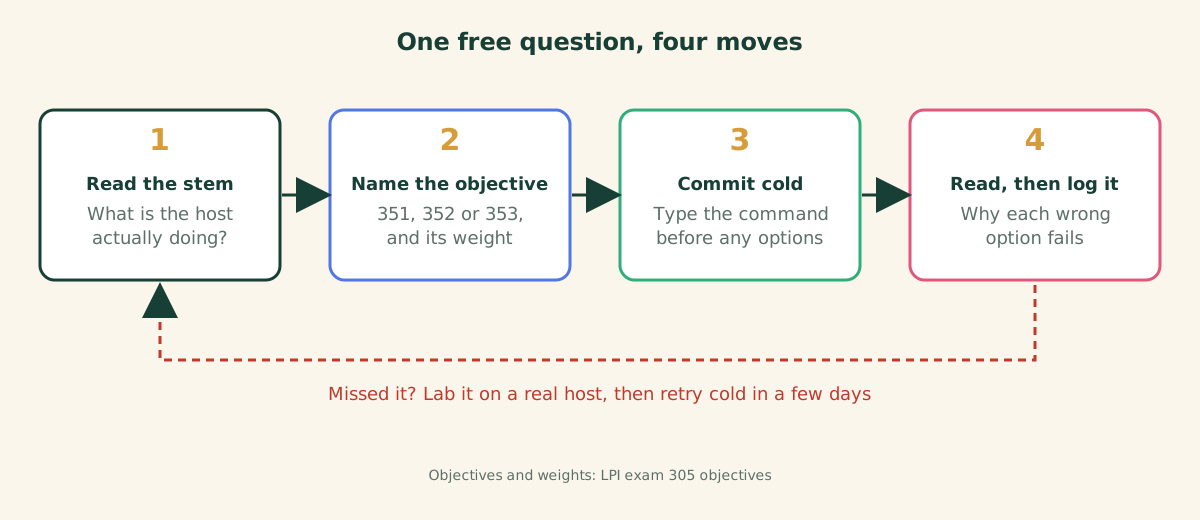
A four-step loop for one practice question: read the stem, name the objective, commit to a command cold, then read the explanation and log the miss, with a return arrow to lab the miss on a real host
Illustration: CertCrafter, from the LPI exam 305 objectives. Illustration: CertCrafter, from LPIC-3 Virtualization and Containerization Exam 305 Objectives.

How should you use three free questions?

Not as a readiness test. They expose habits. Read every explanation, including on the ones you got right, because the wrong options show you what the exam writers consider a believable mistake.

When you miss one, log it by objective number and by the kind of slip: a command you could not type, a stage you mixed up, a setting you skimmed past. Then reproduce the situation on a lab host. Ten minutes at a prompt beats an hour of rereading, and the fill-in-the-blank items reward exactly that familiarity.

LPI says the objectives should sit at the core of any study plan, so keep them open beside you and tick off what you have actually run, not only read. The LPIC-3 305-300 guide has the full fact sheet and the hub of 305-300 guides lists the rest.

What these questions will not do

None is copied from a live exam. They are original, written from LPI’s published objectives, and no practice set replaces time on a real host.

The LPIC-3 305-300 practice test bundle picks up where these three stop, with six tests and 720 questions, every answer explained. Next step: open the first question below and commit to an answer before you read the explanation.

Try these free questions

  1. qemu-system-x86_64 is started with '-accel kvm' on a host where the kvm_intel module is loaded. How is the work divided between QEMU and the kernel?

    1. The kernel module runs guest CPU instructions natively while QEMU emulates the devices in userspace
    2. QEMU translates every guest instruction and the module only accelerates disk access
    3. The kernel module emulates devices while QEMU schedules vCPU threads onto cores
    4. QEMU becomes a thin loader and the module provides CPU and device emulation
    Show the answer and explanation

    Answer: A. With the KVM accelerator, QEMU opens /dev/kvm and asks the kernel module to run guest code. The module puts the physical CPU into guest mode, so ordinary guest instructions execute at native speed with no translation involved. Control returns to QEMU on a VM exit, which fires when the guest touches something the hardware cannot handle directly, typically an emulated device register or an unusual instruction. QEMU services that access in userspace and then resumes the vCPU. The division is therefore CPU and memory virtualization in the kernel, device emulation in userspace. Without an accelerator, QEMU falls back to its tiny code generator and translates guest instructions, which is far slower. The module does not emulate devices, and QEMU is no thin loader: the vCPU threads, the guest memory layout and every virtual device still live inside the QEMU process.

  2. An LXD managed bridge is created with 'ipv4.address=10.0.5.1/24' and 'ipv4.nat=true'. Which mechanism then gives instances attached to that bridge outbound access to the wider network?

    1. LXD adds a route on the upstream gateway pointing back at the bridge.
    2. LXD bridges the instances straight onto the host's physical interface.
    3. LXD installs a masquerade rule covering the bridge subnet on the host.
    4. LXD proxies every connection through a userspace forwarder on the host.
    Show the answer and explanation

    Answer: C. A managed bridge is a real Linux bridge on the host, and LXD runs a dnsmasq instance bound to it to hand out addresses from the configured range and answer DNS for the instances. With ipv4.nat set to true, LXD adds a masquerade rule for that subnet, so packets leaving the host are rewritten to the host's own address and replies find their way back through connection tracking. Nothing is bridged onto the physical interface: that is what a macvlan NIC, or a bridged NIC attached to an existing host bridge, does, and it gives instances addresses from the LAN instead. No route is needed on the upstream gateway, which is the appeal of NAT on a laptop or a single server. There is no userspace forwarder; the rewriting happens in the kernel netfilter path. Turning ipv4.nat off while keeping the address leaves the instances isolated unless routing is arranged by hand.

  3. A cloud-config file supplies both a 'bootcmd' list and a 'runcmd' list. How does cloud-init treat the two directives across the first boot and every later reboot?

    1. Both directives run once at first boot, with bootcmd ordered ahead of runcmd in the same stage
    2. bootcmd runs early on every boot; runcmd is collected into a script run once per instance at the final stage
    3. bootcmd runs only when no datasource is found, while runcmd runs on every subsequent boot
    4. Both run on every boot, though runcmd executes before networking has been brought up at all
    Show the answer and explanation

    Answer: B. The two directives sit at different points in the boot sequence. bootcmd is handled by the cc_bootcmd module during the init stage and it runs on every single boot, which is why anything placed there has to be safe to repeat. runcmd does not execute inline at all: cloud-init collects the entries into a script under /var/lib/cloud/instance/scripts and the scripts-user module runs that script during the final stage, once per instance. A reboot therefore replays bootcmd but leaves runcmd alone, because the instance ID has already been seen and per-instance semantics apply. That split decides where work belongs. Anything needed before networking, or before other modules read the system, such as rewriting a resolver file or adding a kernel parameter, goes in bootcmd. Package installation, service enablement and anything that assumes a configured network belongs in runcmd. Candidates often assume both are once-only, or that runcmd is simply a later form of bootcmd; the per-boot versus per-instance distinction is what is being tested.

Take the full free 10-question sample with scoring →

Frequently asked questions

How many free LPIC-3 305 practice questions are on this page?

Three, each with its options and a full explanation. They come from the same free sample that backs the scored LPIC-3 305-300 quiz, and the paid bundle holds 720 questions across six tests.

Can three questions show me whether I am ready for 305-300?

No. They show whether a habit is sound, such as reading what a host is doing before choosing a command. Readiness shows up in full runs of 60 questions inside 90 minutes.

What score do you need to pass LPIC-3 305-300?

The score is scaled from 200 to 800 with a pass at 500. LPI does not publish a fixed percentage, because the number of correct answers needed for 500 depends on the set of questions you are given.

Official sources

  1. LPIC-3 Virtualization and Containerization Exam 305 Objectives — accessed 2 November 2026
  2. LPIC-3 Virtualization and Containerization overview — accessed 2 November 2026

Exam rules change. Check the awarding body's official page before you apply. CertCrafter is independent and is not affiliated with or endorsed by any awarding body.

Was this helpful?

Comments

    Comments are read by a person before they appear. How we moderate.