
Most candidates can define every Topic 351 word on its own. They lose marks when a question uses two of them in one sentence and asks which layer is responsible.
Why do Topic 351 terms get mixed up?
Because one stack uses several vocabularies at once. A single virtual machine can be called a domain by libvirt, a DomU by Xen, a guest by QEMU and an image by whoever copied its disk. LPI knows this. Objective 351.1 says candidates should understand the terminology of virtualization, including Xen, QEMU and libvirt terminology, in one objective.
That objective is weighted 6. Libvirt is weighted 9, Xen 3, QEMU 4 and disk images 3. The exam is 60 questions in 90 minutes, so a swapped term is expensive, and the fill-in-the-blank items give you no options to recognize.
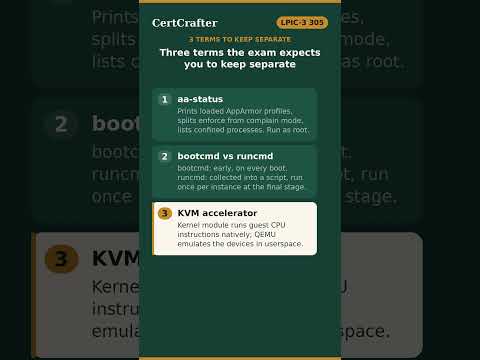 LPIC-3 305 — Three virtualization terms the exam expects you to keep separate. Watch on YouTube · CertCrafter
The channel has a short clip on the same problem: three virtualization terms the exam expects you to keep separate.
Which layer owns which term?
Sort every word into one of three layers before you answer anything. Management is libvirt. The hypervisor and its guests are Xen, QEMU and the kernel. The disk image is the file the guest boots from.
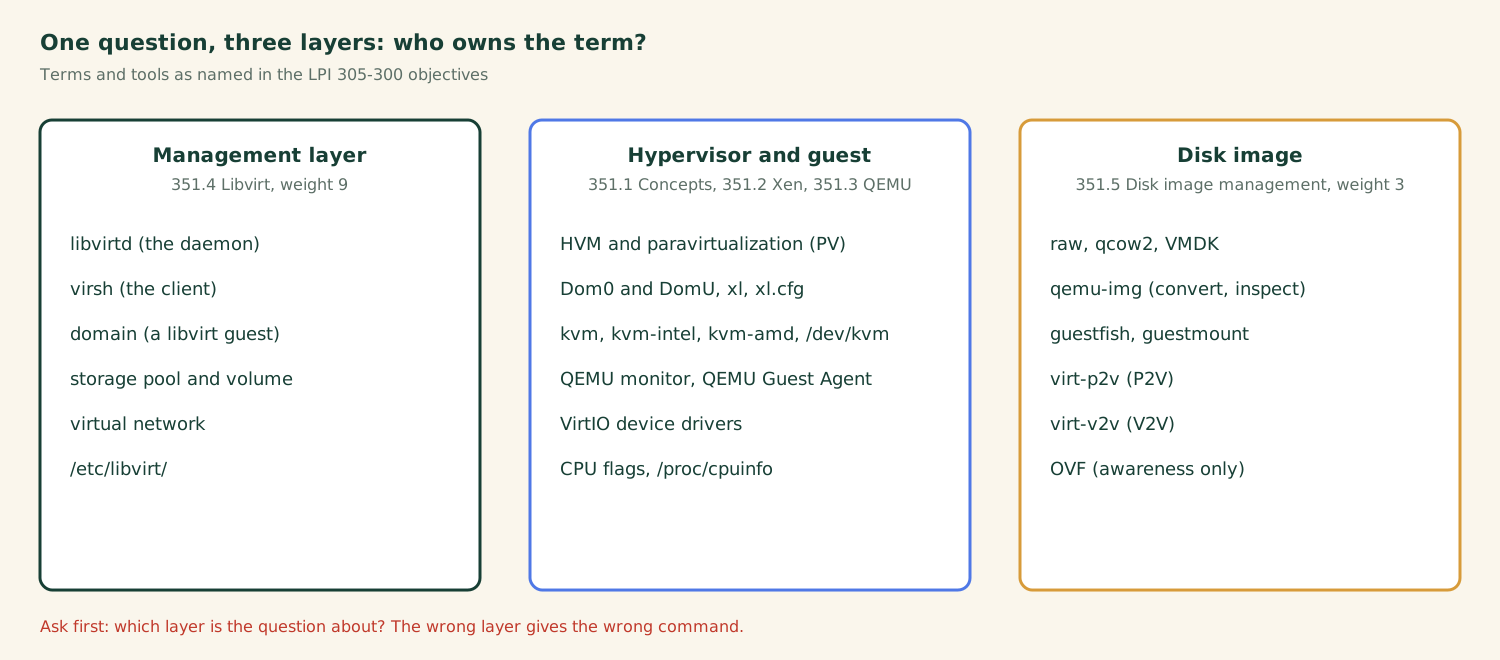
The table picks the pairs that cause the most trouble. It is a sample of the confusion, not the full term list; the objectives page has the rest.
| Looks like | Is not | The difference |
|---|---|---|
| libvirtd | virsh | The daemon does the work. virsh is the command line client you type. |
| libvirt domain | Xen domain | A libvirt domain is what libvirt manages. Dom0 and DomU are Xen’s own terms. |
| HVM guest | PV guest | Hardware Virtual Machine versus Paravirtualization, two ways a guest runs. |
| QEMU | KVM | QEMU is the program. kvm, kvm-intel and kvm-amd are kernel modules behind /dev/kvm. |
| Emulation | Simulation | LPI lists them as separate terms. Know which one you can define in a sentence. |
| P2V | V2V | Physical to virtual versus virtual to virtual. |
| qemu-img | guestfish | One converts and manages image files. The other reaches inside the image. |
What do HVM, PV, Dom0 and DomU really describe?
HVM and PV describe how a guest runs. LPI lists both under the concepts objective and again for Xen, where the guest types are PV-DomU and HVM-DomU. Dom0 is the privileged domain that manages the host, and DomU is an unprivileged guest. The objective gives the focus as Xen version 4.x, the tool as xl, and the files as /etc/xen/, xl.cfg and xl.conf, with xentop for watching resource use.
A common slip is writing Dom0 where the question means the hypervisor. Dom0 is a domain. It is not the layer under every domain. Another is calling every guest a DomU, including a guest that libvirt starts under QEMU. DomU is Xen vocabulary only.
Where do QEMU, KVM and libvirt meet?
QEMU is the program that runs the guest. KVM is the kernel part: the objective lists the modules kvm, kvm-intel and kvm-amd and the device /dev/kvm. Libvirt sits above both and also manages Xen. LPI says candidates should understand how libvirt interacts with Xen and QEMU.
On a real host, the first check is the CPU. The objective names CPU flags and /proc/cpuinfo, because hardware support decides whether the kvm modules are useful at all. After that, a guest agent matters more than people expect. LPI lists installing the QEMU Guest Agent and the VirtIO device drivers as key knowledge for QEMU, so treat both as setup steps, not extras.

Worked example: one word, three layers
Take the word snapshot. LPI lists snapshotting under the effects of virtualization on a guest in 351.1, snapshots in the QEMU monitor in 351.3, and snapshots of domains in 351.4. One word, three objectives. A question that says “snapshot” is asking you to choose the layer.
- Read the verb and the object. “Manage snapshots using the QEMU monitor” names the QEMU layer, so the tool is the monitor.
- If the sentence says “domain”, the layer is libvirt, and the tool is virsh talking to libvirtd.
- If the sentence talks about copying or converting a file, the layer is the disk image, and the tool is qemu-img.
- Only then recall the command or option itself.
Three seconds spent on steps 1 to 3 beats thirty spent guessing a flag. The exam gives you 90 seconds a question on average.
The LPIC-3 305-300 practice tests work more of these layer decisions under timed conditions, with every answer explained.
How do administrators keep these terms straight on the job?
They name things in one place. A team that runs KVM hosts typically defines every guest through libvirt, so everyone says domain, pool and network. Mixing in raw qemu commands or Xen terms on the same hosts is where the confusion starts, and where tickets get misrouted.
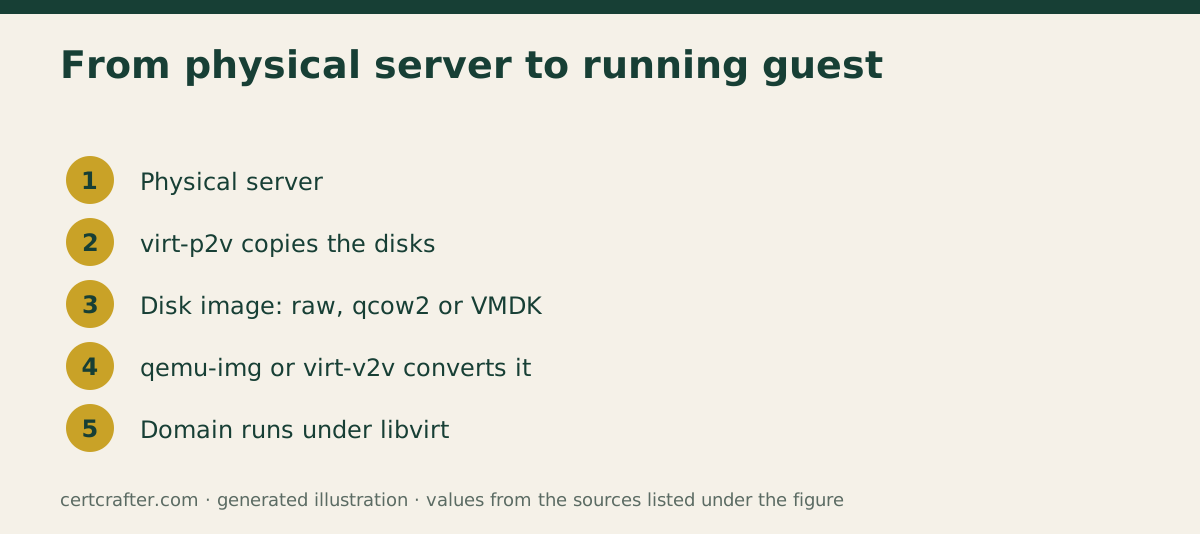
Migration is the other source of wrong words. A physical server turned into a guest is P2V, and LPI lists virt-p2v and virt-p2v-make-disk for it. A guest converted between formats or hypervisors is V2V, with virt-v2v. Domains that move between nodes are a libvirt task in 351.4 and a third thing again. Using one word for all three is how a change request gets scoped for the wrong job.
Where do these terms trip candidates in the exam?
Question writers use the overlap on purpose. Three patterns come up.
The first is the layer swap: a symptom is described and the choices name a tool from the wrong layer. The second is the format swap, where raw, qcow2 and VMDK are the image formats and OVF is only listed for awareness. LPI marks several items as awareness items, and an awareness item is rarely the answer to a detailed question. The third is the typed answer, where you must write the command yourself. The overview page says the exam mixes multiple-choice and fill-in-the-blank questions, so recognizing a name is not enough.
Learn the term, its layer and one command for each. That is a smaller job than it sounds.
What should you do next?
Take the table above and add the missing terms from the objectives page, one layer at a time. Then say each term aloud with its layer in front: “libvirt layer, domain”.
The certification guide covers the exam format, the free sample shows how questions are framed, and the LPIC-3 305 hub lists every topic post. Read the full virtualization topic post for the weights, and the common mistakes post for the rest of the traps.
Comments
Comments are read by a person before they appear. How we moderate.