
Most 305-300 candidates can name the right tool for a task. They stall when the exam hands them a blank line and asks for the command itself.
Why do commands matter so much on LPIC-3 305-300?
LPI’s overview page says the exam is 60 questions in 90 minutes, a mix of multiple choice and fill-in-the-blank. That is an average of 90 seconds a question. A typed answer cannot be guessed from a list, so a command you only half remember costs the whole item.
The objectives help. Each one ends with a list of files, terms and utilities, and that list is the nearest thing to a syllabus for commands. If a tool is on that list, expect to need it. If it appears only as “awareness”, you need the name and the idea, not the flags.
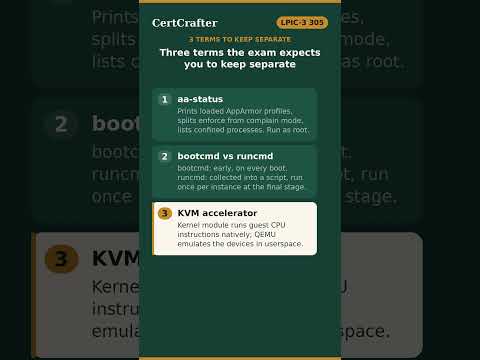 LPIC-3 305 — Three virtualization terms the exam expects you to keep separate. Watch on YouTube · CertCrafter
The channel has a short clip on three virtualization terms the exam expects you to keep separate. It pairs well with this post, because the wrong layer gives the wrong command.
Which tool belongs to which objective?
Learn the pairing first and the syntax second. The table picks a few pairs from the objectives page; the page has the full lists.
| Task | Objective | Tool LPI names |
|---|---|---|
| Manage a libvirt domain, pool or network | 351.4, weight 9 | virsh |
| Convert or inspect a disk image | 351.5, weight 3 | qemu-img |
| Manage Xen domains | 351.2, weight 3 | xl |
| Run and limit a system container | 352.2, weight 6 | lxc |
| Build, run and log containers | 352.3, weight 9 | docker |
| Configure a VM at first boot | 353.3, weight 3 | cloud-init |
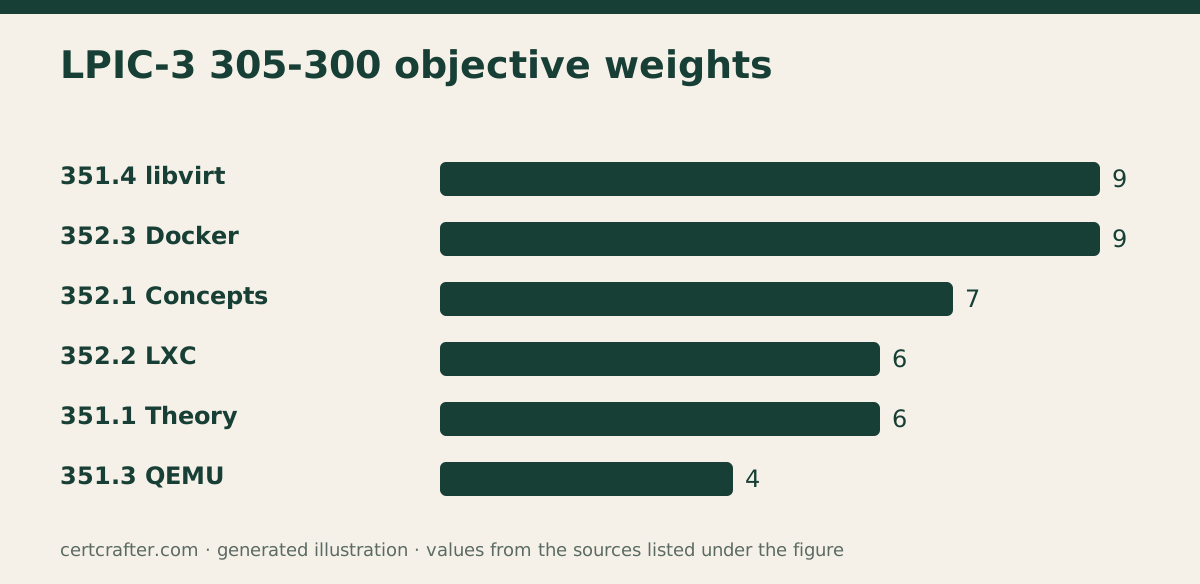
Libvirt and Docker carry the top weight, 9 each. The commands you type most in a lab are the same ones the exam weights most. That is convenient, so use it.
How should you approach a command question?
Use the same four steps every time. Read the task, name the objective, pick the tool, then write the command. The first three take seconds. Only the fourth needs recall.
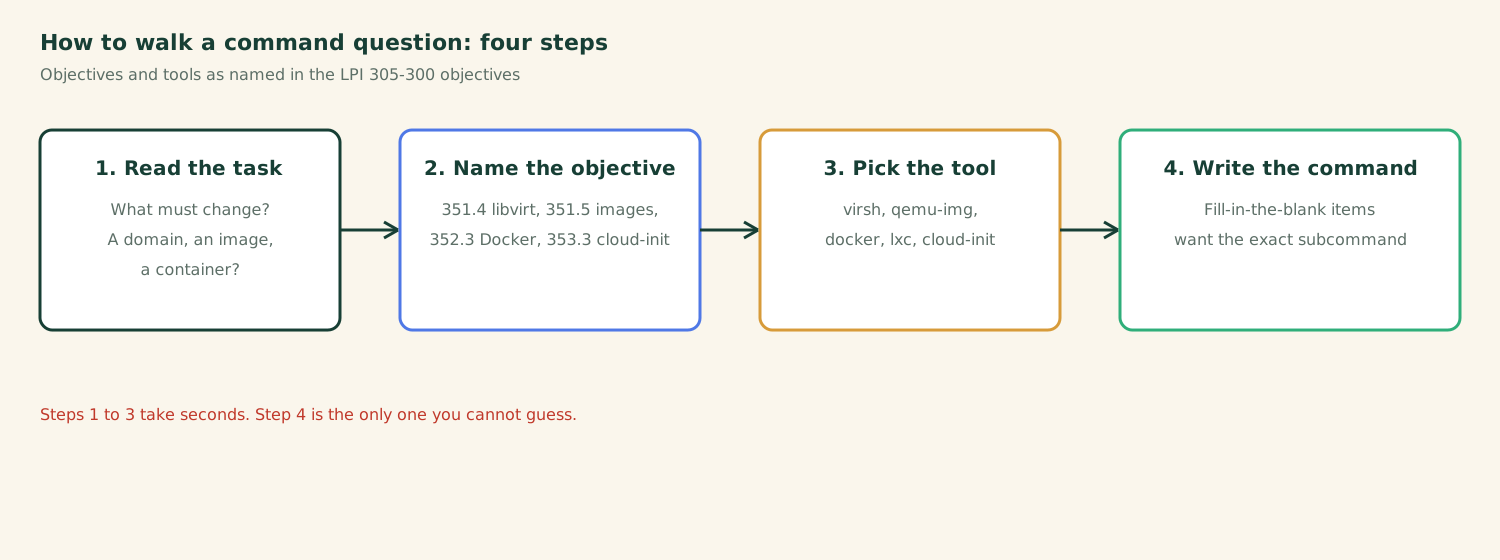
The method also protects you from lookalike answers. A question that says “domain” is about libvirt. One that says “image file” is about qemu-img. One that says “namespaces and cgroups” is about the container concepts in 352.1, not about Docker itself.
Worked example: converting a raw disk image to qcow2
Objective 351.5 says candidates should manage disk images with qemu-img and migrate disk content between formats such as raw, qcow2 and VMDK. Here is the walk.
- Read the task. A raw image has to become qcow2 so the host can use features of that format.
- Name the objective. Disk image management, 351.5, weight 3.
- Pick the tool. qemu-img, which LPI lists first among the utilities for that objective.
- Write the command. The shape is
qemu-img convert -f raw -O qcow2 source.img target.qcow2, where the source format is stated with the lower case flag and the output format with the upper case one. - Check the result with
qemu-img info target.qcow2, which reports the format and the virtual size.
On a real host you would also stop the guest first, or work on a copy, so you never convert a file a running domain is writing to. The exam rarely asks about that habit, but a change review will.
The LPIC-3 305-300 practice tests work more commands like this under timed conditions, with every answer explained.
How do administrators use these commands on the job?
They rarely type them once. A team that runs KVM hosts keeps the commands in a runbook, usually with a check after each step. Create a domain, list it, read its XML, then change one thing on purpose. Libvirt XML configuration files are named in 351.4, and reading what libvirt generated teaches more than any cheat sheet.
Container work follows the same habit. The objectives for Docker list dockerd, /etc/docker/daemon.json and /var/lib/docker/, which tells you where the daemon is configured and where it keeps its state. When something misbehaves on a host, those paths are where you look first.

Where do candidates lose marks on commands?
Three patterns show up again and again.
The first is recognizing a command but not its subcommand. LPI writes “virsh (including relevant subcommands)” and “lxc (including relevant subcommands)”, which is a direct hint that the subcommand is what gets tested.
The second is mixing layers. Putting a qemu-img option on a virsh line, or a Docker idea into an LXC question, is a classic slip. LPI treats LXC and Docker as separate objectives, 352.2 and 352.3, with their own tools.
The third is skipping the quieter objectives. cloud-init, Packer and Vagrant sit in Topic 353 with weights of 3, 2 and 3. They look small, but the objectives list user-data and /var/lib/cloud/ for cloud-init, and a Vagrantfile for Vagrant, so a typed answer there is plausible. The kit’s own study plan flags these as under-prepared.
Learn the pairing, then the subcommand, then one real run of each. Candidates who only read about tools tend to know the name and lose the syntax, and the typed items expose that gap quickly.
Time matters as well. At 90 seconds an item, a command you must reconstruct by trial in your head is a command you will skip. Mark it, move on, and come back with the minutes you saved on the items you knew cold.
What should you do next?
Take the table above and add one row for every tool named in the objectives. Next to each, write one command you have run yourself, then type it from memory with the page closed.
The certification guide covers the exam format, the free sample shows how questions are framed, and the LPIC-3 305 hub lists every topic post. Read the full virtualization topic post for the weights, and the common mistakes post for the rest of the traps.
Comments
Comments are read by a person before they appear. How we moderate.