
Most 305-300 candidates know what a hypervisor is and still drop marks in Topic 351, because the exam asks for the exact tool, file or option an administrator would type.
What is in the Full Virtualization topic?
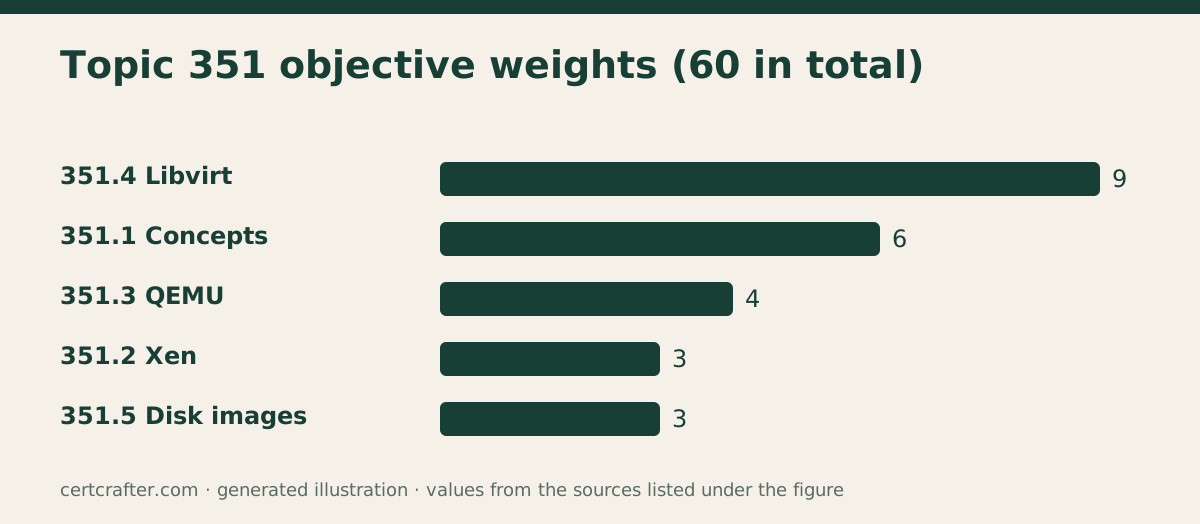
LPI groups the exam into three topics: Full Virtualization, Container Virtualization and VM Deployment and Provisioning. Full Virtualization is Topic 351, and it has five objectives.
| Objective | Weight |
|---|---|
| 351.1 Virtualization Concepts and Theory | 6 |
| 351.2 Xen | 3 |
| 351.3 QEMU | 4 |
| 351.4 Libvirt Virtual Machine Management | 9 |
| 351.5 Virtual Machine Disk Image Management | 3 |
Add them up and you get 25. The other two topics hold 25 and 10, so the three weights total 60, the same number as the questions on the paper. LPI states that objectives with higher weights are covered with more questions. It does not give a question count per objective, so treat the weights as a guide to proportion, not a promise.
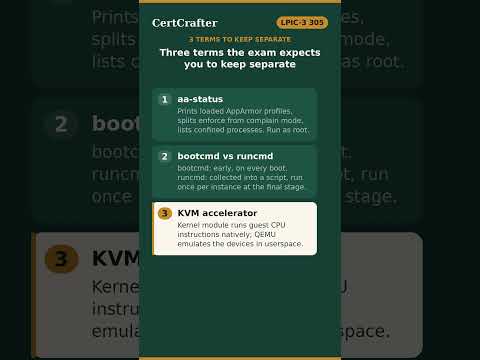 LPIC-3 305 — Three virtualization terms the exam expects you to keep separate. Watch on YouTube · CertCrafter
The channel has a short clip on the terms the exam expects you to keep apart: LPIC-3 305, three virtualization terms.
How do the five objectives fit together?
Think of it as a stack. At the top, an administrator uses virsh. Under it, libvirtd manages connections, domains, storage pools and virtual networks. Under that, a domain is either a QEMU guest, which can use the kvm kernel modules and /dev/kvm, or a Xen guest, which runs beside Dom0 and is managed with xl.
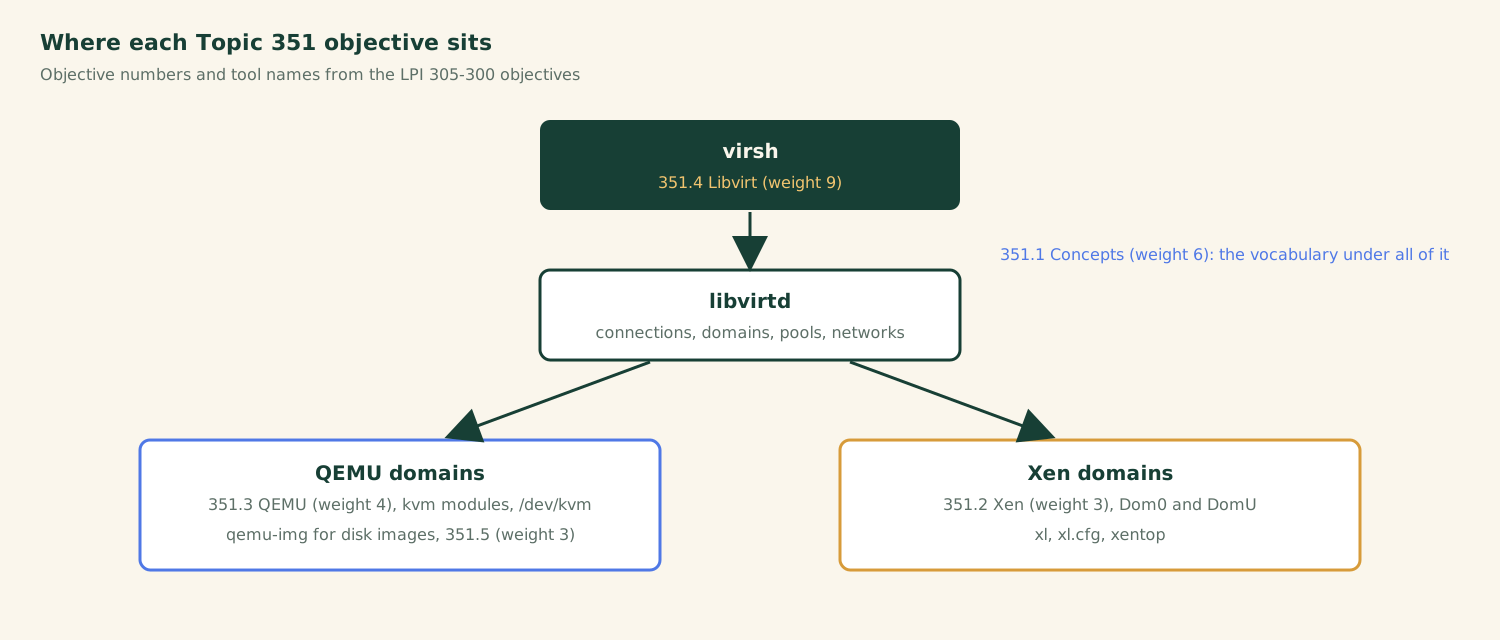
That picture explains the weights. Libvirt sits on top of both hypervisors, so a candidate who understands it can answer questions about QEMU and Xen domains through one tool. LPI’s key knowledge for 351.4 even says to understand how libvirt interacts with Xen and QEMU, and with services such as dnsmasq and radvd.
Why does libvirt carry the most weight?
Because it is where the daily work happens. The objective expects you to manage libvirt connections and nodes, create and manage domains including snapshots, build storage pools and volumes, create virtual networks, migrate domains between nodes and read the libvirt XML configuration files.
The XML is the part people skip. A graphical tool hides it, and an exam question about a domain definition does not.
How do administrators use these skills on a real host?
A team that runs a handful of KVM hosts rarely launches guests by hand with a long qemu command. They define domains through libvirt, keep the XML under version control, and use pools so that disk images land where the storage team expects them. When a host needs maintenance, they migrate domains to another node.
Disk images are the quiet workhorse. Objective 351.5 names raw, qcow2 and VMDK, and the tools qemu-img, guestfish and the virt-v2v family. In practice that is how a physical server becomes a guest, how a guest moves between formats, and how you read a file out of an image that will not boot.
Xen has the smallest weight here, 3, but it brings its own vocabulary: Domain0 and DomainU, PV and HVM guests, the xl tool and the xl.cfg file. The objective says the focus is Xen version 4.x. Expect fewer questions on it, and expect them to be specific. Learn which files configure a node and which configure a domain, because that split is easy to blur under time pressure.
Worked example: turning weights into a practice budget
The exam is 90 minutes for 60 questions, an average of 90 seconds each. Use that to plan hands-on time, not just reading time.
- Take the weight of the objective, 9 for libvirt.
- Treat it as roughly 9 questions out of 60, each worth 90 seconds of your time.
- Compare it with Xen at 3 questions, a third of that.
- Give libvirt about three times as many lab hours as Xen, and then add extra for the fill-in-the-blank items, because those need exact syntax.
The number is an estimate from the weights, not an LPI figure. Its use is to stop you spending a weekend on Xen boot parameters while storage pools stay untouched.
The LPIC-3 305-300 practice tests work through this topic and the others under a timed 90-minute limit, with every answer explained.
Where do candidates lose marks in Topic 351?
The exam mixes multiple choice with fill-in-the-blank items, where you type a command or an option. Recognizing a command is not the same as reproducing it. Candidates who learned virtualization from a web console often cannot recall the exact subcommand.
Another slip is confusing the layers. A question may describe a symptom and ask which component is responsible, the hypervisor, libvirt or the disk image format. Know what each layer owns.
A third is treating 351.1 as soft theory. It carries a weight of 6, and LPI lists hypervisor variations, HVM and paravirtualization, emulation versus simulation, CPU flags, /proc/cpuinfo and migration, both P2V and V2V. The CPU flag check is a real task before you enable hardware virtualization on a host.
The fourth is ignoring snapshots, pausing, cloning and resource limits. LPI names them as implications of virtualization for a virtual machine, and they come up in both concept and tool questions.
What should you do next?
Build one KVM host, define a domain through libvirt, read its XML, then change a setting and see what moves. Do the same with a disk image and qemu-img.
Then read the certification guide. The free sample shows how questions are framed, and the LPIC-3 305 hub lists every topic post. LPI’s own objectives page has the full key knowledge list.
Comments
Comments are read by a person before they appear. How we moderate.