
Most LPIC-3 305 candidates can run a hypervisor. Fewer can say how many of their 60 questions sit on libvirt, and that gap decides where the study hours go.
What does the LPIC-3 305-300 exam look like?
One exam. 60 questions, 90 minutes, multiple choice and fill in the blank. That is 90 seconds a question on average, which sounds generous until you hit a blank where you must type a virsh subcommand or a qemu-img option from memory.
LPI lists the exam as version 3.0 of the objectives, code 305-300. It came from a split of the older 304 exam, version 2.0, and LPI says the previous 304-200 stayed available until June 20th, 2022. If a study guide mentions 304, it is describing the wrong exam.
The exam is offered in English and Japanese, at VUE test centers and online through OnVUE. The LPIC-3 305 video clip on the channel covers three virtualization terms the exam expects you to keep apart, a good warm-up for the format.
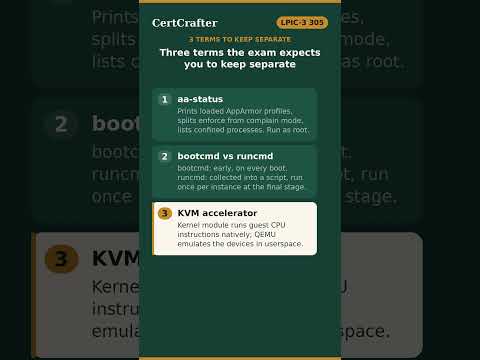 LPIC-3 305 — Three virtualization terms the exam expects you to keep separate. Watch on YouTube · CertCrafter
How is the exam scored?
The score is scaled from 200 to 800, and the pass is 500. Scaled means the number you see is not a count of correct answers. LPI notes that question difficulty varies from one set to another, so the raw number of right answers behind a 500 changes with the set you are given.
A forum claim of a fixed percentage needed to pass is somebody’s guess, and LPI publishes no such figure. Think of a capacity number that changes with the workload on a host: you would not quote it as a constant, and neither should you here.
The practical rule is simple. Treat every question as worth the same, and do not gamble a fill-in-the-blank item for a hard multiple-choice one.
Which objectives carry the most questions?
LPI gives each of the thirteen objectives a weight and says higher weights get more questions. Add them up and you reach 60, the number of questions on the paper, so the weights work as a very close map of the exam.
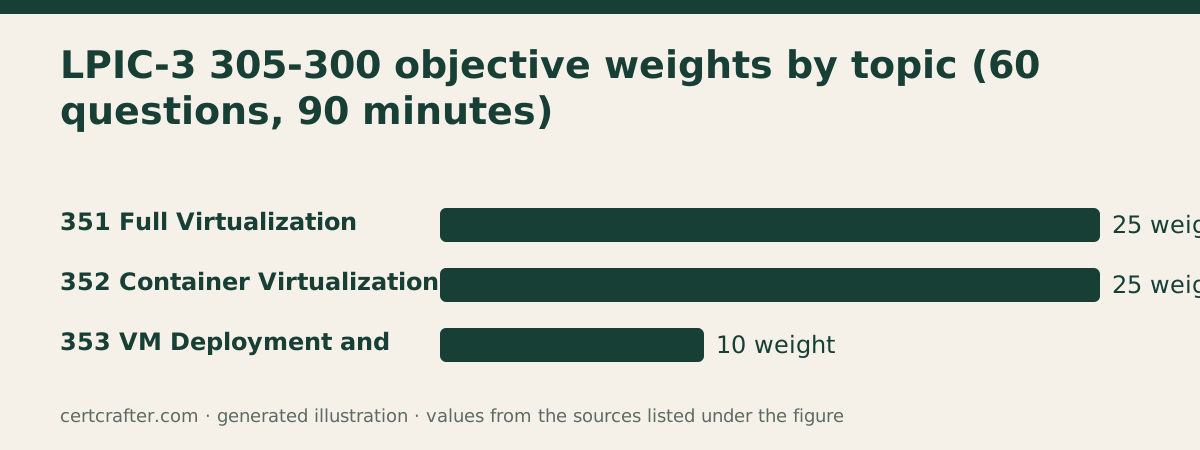
Full Virtualization (Topic 351) adds up to 25: concepts and theory 6, Xen 3, QEMU 4, libvirt 9 and disk images 3. The container topic, 352, is also 25: concepts 7, LXC 6, Docker 9 and orchestration 3. What is left is VM Deployment and Provisioning, Topic 353, at 10 with weights of 2, 2, 3 and 3.
Two single objectives stand out. Libvirt VM management and Docker are weighted 9 each, so those two alone make up nearly a third of the exam weight.

Worked example: where should 90 minutes go?
Take the weights as the plan, then add a time budget.
- Start from 60 questions in 90 minutes, which is 90 seconds each.
- Full Virtualization and Container Virtualization are 25 each, so expect about 25 questions apiece, and at 90 seconds each that is a little over half an hour per topic.
- Provisioning is 10, so about 10 questions and a quarter of an hour.
- Fill-in-the-blank items cost more time to type and check, so give yourself a margin by moving fast on recognition items.
The weights say how many questions to expect, not how hard they are. Use the split to decide where your lab hours go, then test the pace under a hard limit. The LPIC-3 305-300 practice tests are built for that kind of timed pass, with every answer explained.
How do the two requirements fit together?
LPI describes LPIC-3 as the highest level of its professional, distribution-neutral Linux certification, with four specialty certifications. Passing any one of the four exams grants LPIC-3 for that specialty, so a 305 pass covers virtualization and containerization only.
What do you need before LPIC-3 is awarded?
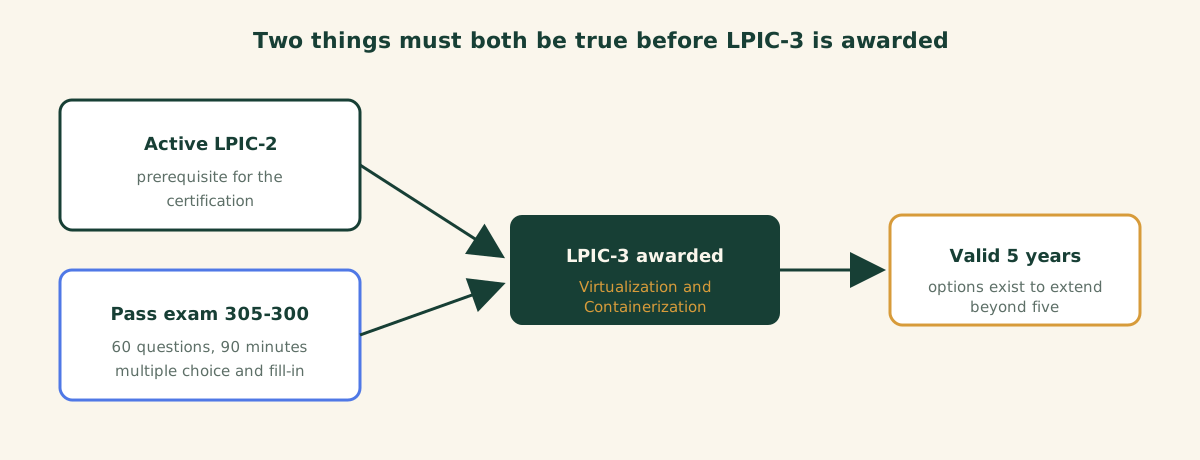
Two things. Passing the 305 exam, and holding an active LPIC-2. LPI says the candidate must have an active LPIC-2 certification to receive the LPIC-3 certification.
This trips up experienced administrators more than any command. Someone who took LPIC-2 years ago, let it lapse, then passes 305 has the score but not the certificate. Look up your LPIC-2 status in your LPI account. Do it before you pay.
Once awarded, LPIC-3 is valid for 5 years. LPI points to options for extending beyond that, which you would read on its renewal pages when the time comes.
What does the exam cost and when can you sit it?
LPI states that cost depends on your country and sends candidates to its exam pricing page for a figure. No price appears on the pages used for this post, so none is given here.
There is no fixed exam date to wait for. You buy a voucher, then choose a test center slot or an online session. Book only after your LPIC-2 status is confirmed and a practice run under a 90-minute limit has gone well.
Where do candidates lose marks on the format?
Three places cost marks again and again, on the job and in the exam room.
First, the blanks. A recognized command is not enough. A host admin knows virsh from daily use, but the exam wants the exact subcommand typed out. Practice by typing, with no history to scroll.
Second, Topic 353. At 10 of 60 it is about one question in six, and cloud-init, Packer and Vagrant get the least study time.
Third, the prerequisite. A pass is not the finish line when the LPIC-2 has lapsed, and nobody tells you until the certificate fails to arrive.
What should you do next?
Check your LPIC-2 status today, then write the three topic weights on a card and plan your lab weeks around them. The certification guide, the 305 guides hub and the free sample are the places to go next, and the common mistakes post shows what goes wrong in practice.
Comments
Comments are read by a person before they appear. How we moderate.