
My 4 engineering books go FREE on Kindle Fri 6 – Tue 10 Nov (PT). See the books → FREE on Kindle now: all 4 engineering books, until Tue 10 Nov 11:59 pm PT. Ends in . Grab yours → My 4 books: FREE on Kindle Fri 6 – Tue 10 Nov (PT). See → FREE on Kindle now: 4 books, left Grab yours →

MB-330 Practice Questions, Set 2 (Free)

By Sandeep Bandyopadhyay, Senior aerospace engineer · PMP, MBA, Six Sigma

TL;DR

This second free MB-330 set holds three more questions with full explanations, on master planning, warehouse putaway and purchase requisitions. Each gives a business requirement and asks which Dynamics 365 setup delivers it. The exam runs 100 minutes and passing is a score of 700 on a 1 to 1000 scale, which is not 70%. Master planning carries 10-15% of the skills measured.

Original questions, not exam dumps. Every CertCrafter question is written from the published body of knowledge and the referenced codes. None is copied from a live exam, and CertCrafter is independent: not affiliated with or endorsed by any awarding body.

A logistics warehouse with a long loading frontage and a company sign above the bay doors
Photo: XPO Logistics, Nab Lane Industrial Estate - geograph.org.uk - 5275458 by Mark Anderson (Wikimedia Commons), CC BY-SA 2.0, via Wikimedia Commons.

Master planning is the smallest MB-330 area, so candidates skim it, and then a single stem about coverage or margins costs them a mark they could have had. This second set pulls three more free questions from three different areas.

Video: MB-330 — What MB-330 changes on a D365 consultant's CV. MB-330 — What MB-330 changes on a D365 consultant's CV. Watch on YouTube · CertCrafter
Image: video thumbnail, source: CertCrafter on YouTube (@certcrafters).

What do these three free MB-330 questions test?

One sits in master planning, one in the purchasing process and one in how coverage turns demand into supply. If you worked through the first free set, you have seen the format: a business wants something, and you name the setting that delivers it.

They come from the free sample behind the MB-330 quiz. None is copied from a live exam. The short clip on what MB-330 changes on a consultant’s CV is on our channel if you want the career angle before you start.

Why does master planning trip up experienced consultants?

Because the settings are cheap to configure and easy to confuse. A coverage group holds margins and a coverage code, and each one acts at a different point in the plan. Two of them sound alike and do opposite jobs.

Take the receipt margin and the issue margin. The receipt margin schedules a planned receipt a number of days before the requirement, which is how you buy an inspection window on arrival. The issue margin works on the outbound side. Mix them up and you build a plan that looks tidy and leaves the goods arriving the same day they are consumed.

The first free question here hangs on exactly that distinction. Read the stem for the direction of the gap: is the buffer between arrival and use, or between issue and demand?

What does coverage code Period actually do?

It groups. Under coverage code Period, master planning consolidates requirements into time buckets as long as the coverage period. A bucket opens with the first unmet demand and runs for the coverage period. The planned order for that bucket is dated on its first day, so the earliest demand inside it is still met on time, and it is sized to the net requirement of the whole bucket.
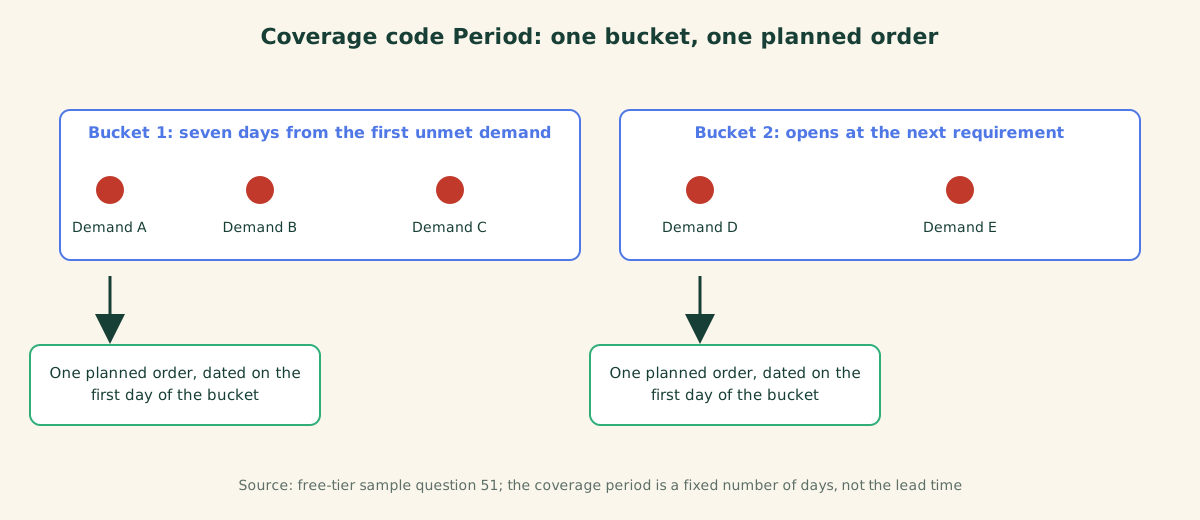
Five demands in two seven day buckets: three demands in the first bucket are covered by one planned order on the first day of that bucket, and two demands in the second bucket by another
Illustration: CertCrafter, from the free-tier sample question on coverage code Period. Illustration: CertCrafter, from Study guide for Exam MB-330: Microsoft Dynamics 365 Supply Chain Management Functional Consultant.

On a site, planners use this to stop a buyer raising twelve small orders for one vendor in a fortnight. The trade-off is stock held a little longer, because material arrives at the start of the bucket and is consumed across it.

The exam tests the opposite readings. Requirement coverage gives every demand its own supply. Minimum and maximum coverage sizes orders by a maximum quantity. Period is neither. When a stem names a coverage period in days, expect the answer to talk about grouping.

Worked example: reading a coverage stem

Here is the method on the second free question.

  1. Write down the coverage code and the period: Period, seven days.
  2. Ask what the code does to demand. It consolidates demand inside each seven day bucket.
  3. Ask where the planned order sits. On the first day of the bucket.
  4. Test each option. An option with one order per demand date describes requirement coverage. An option that sizes orders by a maximum quantity describes min/max. An option that ties the period to lead time invents a link the setup does not have.

Two options survive, and it is a two-answer question, so confirm both before you commit. The MB-330 Complete Exam Kit works more of these under timed conditions, with every answer explained.
A large logistics centre with a long concrete frontage and loading doors
Photo: Daiwa Logistics Tosu Logistics Center by Peka (Wikimedia Commons), CC BY-SA 4.0, via Wikimedia Commons.

How do requisition lines reach a buyer?

Through purchasing policy, not through workflow. That is the trap in the third free question. A department raises a requisition, it clears approval, and by default the line can become a purchase order without a person touching it.

A business that wants a buyer to source one category by hand has to change what happens after approval. Changing who approves, or who can pick the category, does not do that. On projects this shows up when procurement says it wants control over certain spend, and the consultant builds an approval step that routes to the buyer. The approval works. The purchase order is still created before the buyer looks at it.

Ask of every option whether it acts before approval or after. A requirement about what happens next belongs to the object that acts next.

What do warehouse questions add in this set?

The set leans on planning and procurement, because those are the areas candidates revise last. Warehouse still carries weight: the skills list puts warehouse and transportation management at 20-25%, and the study guide now includes the Warehouse Management mobile app subsection. Our worked examples post takes a location profile question apart if you want that area next.
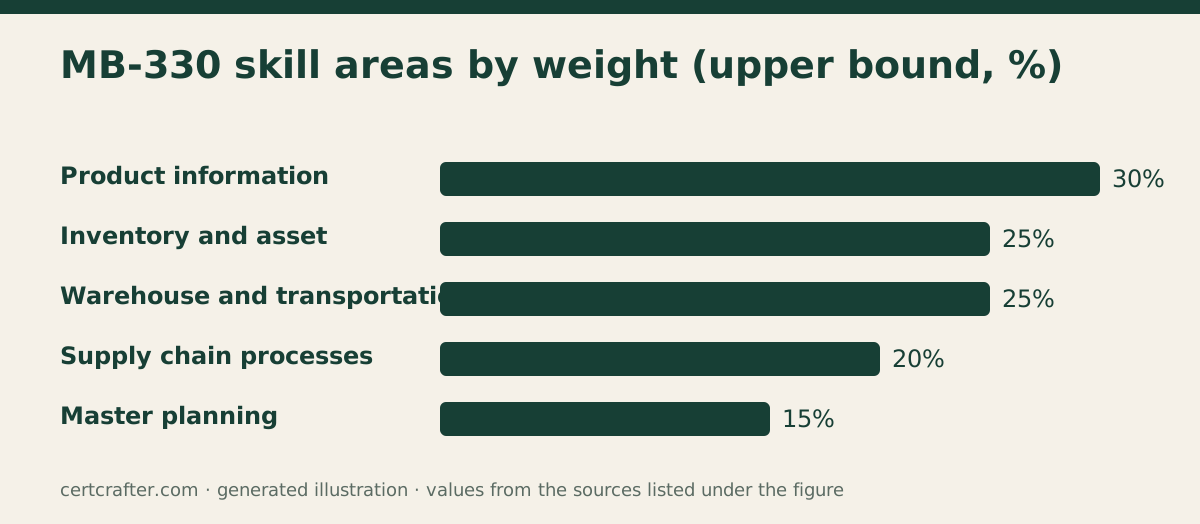
The five MB-330 skill areas with the top of each weight range: product information management 30, inventory and asset management 25, warehouse and transportation 25, supply chain processes 20, master planning 15
Illustration: CertCrafter, from the study guide. Bars show the top of each published range. Illustration: CertCrafter, from Study guide for Exam MB-330: Microsoft Dynamics 365 Supply Chain Management Functional Consultant.

How is MB-330 timed and scored?

The exam runs for 100 minutes. A score of 700 or greater passes, on a scale of 1 to 1000. It is scaled, so you cannot turn it into a number of questions you may miss. Microsoft does not publish the exact question count and says most of its certification exams contain 40 to 60.

If you fail, Microsoft says you can retake 24 hours after the first attempt, and later retakes wait longer. The exam is offered in English and Japanese.

What should you do with these questions?

Commit to an answer before you open the explanation, then say why each wrong option is wrong and name the setting it really controls. A right answer reached for the wrong reason teaches you nothing.

Next step: run all three, then read the MB-330 guide for the full fact sheet. The MB-330 hub lists every post on the exam, and the common mistakes post covers what to fix before exam day.

Try these free questions

  1. A planner requires every planned purchase receipt to be scheduled three days before the demand date so that goods can be inspected on arrival. Which setting achieves this?

    1. The issue margin, which inserts days between the planned issue and the actual demand.
    2. The reorder margin, which extends the lead time applied whenever supply is reordered.
    3. The receipt margin, which schedules receipts a number of days before the requirement.
    4. The delivery date control setting, which validates dates entered manually on order lines.
    Show the answer and explanation

    Answer: C. Safety margins on the coverage group buy time at three distinct points in the plan, and the requirement here concerns the gap between arrival and use, which is what the receipt margin covers. Adding three days moves the planned receipt date earlier so the inspection window exists before the material is consumed. The issue margin in option 1 protects the outbound side by scheduling the issue earlier than the demand, which would compress rather than create the inspection window. The reorder margin in option 2 lengthens the calculated lead time and therefore shifts the order date backwards, so the receipt would still land on the demand date and no buffer would appear. Option 4 belongs to order entry, where delivery date control checks or proposes dates on sales lines using available to promise or capable to promise logic, and it has no influence on how master planning schedules a planned purchase order receipt.

  2. An item is assigned a coverage group with coverage code Period and a coverage period of seven days. Master planning runs. Which two outcomes are expected?

    1. One separate planned order is created for every individual demand date in the horizon.
    2. Demand falling inside the same seven day bucket is grouped onto one planned order.
    3. The coverage period is recalculated automatically from the lead time of each planned order.
    4. Every planned order is sized to the maximum quantity defined on the item coverage record.
    5. The planned order is dated to cover the earliest demand inside its period.
    Show the answer and explanation

    Answer: B, E. Coverage code Period tells master planning to consolidate requirements into time buckets whose length is the coverage period, so option 2 follows directly; a bucket opens with the first unmet demand for the item and runs for seven days, and the next bucket starts with the next requirement after that. Option 5 completes the picture, because the single planned order that covers a bucket is placed on the first day of the period so that the earliest demand inside it is still met on time, and its quantity is the net requirement for the whole bucket. Option 1 describes requirement coverage, where every demand line gets its own supply, and that is precisely what period coverage avoids. Option 3 invents a link between lead time and bucket length, but the coverage period is a fixed number of days entered on the coverage group or the item coverage record. Option 4 belongs to minimum and maximum coverage, where a maximum quantity sizes the order instead of accumulated demand.

  3. Fabrikam wants approved purchase requisition lines in one procurement category to be sourced manually by a buyer instead of becoming purchase orders automatically. Which approach best meets this requirement?

    1. Remove the category from the requester category access policy so buyers add the lines.
    2. Use a purchasing policy rule that disables automatic purchase order creation for those lines.
    3. Add a workflow approval step that assigns the requisition line to the category buyer.
    4. Set the requisition purpose to Replenishment so master planning generates the supply instead.
    Show the answer and explanation

    Answer: B. Whether an approved requisition line turns straight into a purchase order or waits for a buyer is governed by purchasing policy, and the purchase order creation and demand consolidation rule is the mechanism that matches the requirement, because its manual creation criteria can name a procurement category so that those lines are held back for a buyer while everything else still converts automatically. Option 1 would stop requesters from selecting the category at all, which defeats the purpose, since the requirement is that requesters still raise the demand and a buyer sources it afterwards. Option 3 changes who approves the line but not what happens after approval; once workflow completes, automatic purchase order creation still fires, so the buyer would receive a document that has already been committed. Option 4 misuses the requisition purpose field, since replenishment requisitions feed master planning as demand for stocked items and never produce the manual sourcing step described, and it also changes the accounting treatment of the line.

Take the full free 10-question sample with scoring →

Frequently asked questions

How is this set different from the first free MB-330 set?

It uses three different questions from the free sample, covering master planning, warehouse management and supply chain processes. The first set covered warehouse mobile work, vendor bids and quality orders.

Does a score of 700 on MB-330 mean 70%?

No. Microsoft states that a score of 700 or greater is required to pass, on a scale of 1 to 1000. It is a scaled score, so it does not correspond to a fixed share of correct answers.

How long is the MB-330 exam?

Microsoft's exam page says you have 100 minutes. Microsoft does not publish the exact question count and says most of its certification exams contain 40 to 60.

Official sources

  1. Study guide for Exam MB-330: Microsoft Dynamics 365 Supply Chain Management Functional Consultant — accessed 8 November 2026
  2. Microsoft Certified: Dynamics 365 Supply Chain Management Functional Consultant Associate — accessed 8 November 2026

Exam rules change. Check the awarding body's official page before you apply. CertCrafter is independent and is not affiliated with or endorsed by any awarding body.

Was this helpful?

Comments

    Comments are read by a person before they appear. How we moderate.