
Most MB-330 candidates know the settings and still miss the question, because the stem describes a business need and never names the object that meets it. The three free questions below are written that way, each with an explanation you can open once you have committed to an answer.
 MB-330 — What MB-330 changes on a D365 consultant's CV. Watch on YouTube · CertCrafter
What do these free MB-330 questions test?
Take them cold. One sits in warehouse management, one in procurement and one in quality management, three areas that consultants meet very unevenly on real projects. They come from the free sample behind the MB-330 quiz, and none is copied from a live exam.
Microsoft’s study guide describes a candidate who maps requirements to system capabilities and applies industry-recommended practices. That sentence is the whole exam in miniature. You are handed a requirement and asked which capability delivers it, so the reasoning counts for more than knowing where a menu sits. Our short clip on what MB-330 changes on a consultant’s CV covers why that matters in the job market.
How do you read a requirement-to-setup question?
Split the stem in two. First, the requirement: what must be true when the setup is finished? Second, the clue to the object: which part of the system has authority over that outcome?
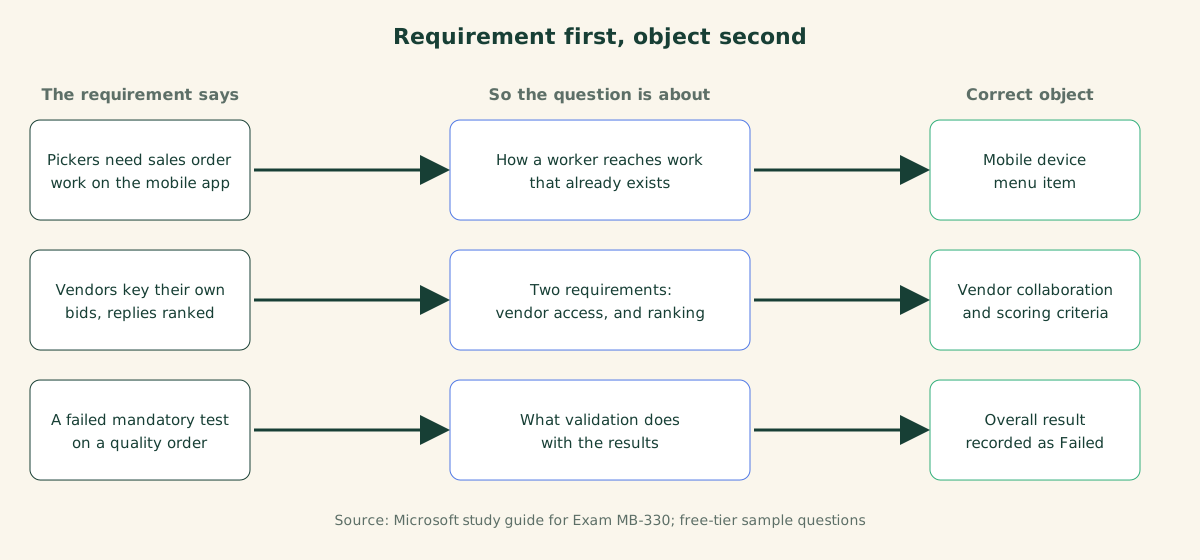
Take a picker who needs sales order work on a handheld. Wave processing creates the work long before a worker touches a device. So the real question is how a worker reaches work that already exists, and that points at the mobile device configuration, not at templates that create work. The first free question hangs on exactly that distinction.
Why does procurement use two-answer questions?
Because real requests arrive bundled. A buyer asks that vendors enter their own bids and that replies be ranked automatically. On a project you would hear that as one request and build both halves without noticing the seam.
The exam makes you notice. Each half has its own owner in the system, and a distractor will fit one half and ignore the other. Count the verbs in the stem. Two verbs usually mean two settings, and an option that covers only one is a trap.
Worked example: splitting a stem into requirements
Here is the method applied to the second free question.
- Underline every thing the stem asks the system to do: vendors enter their own bids, and replies are ranked automatically.
- Ask what each one needs. A vendor can only key a reply if it can reach the collaboration interface. Ranking needs criteria and a method to turn them into a score.
- Match each need to the setup that carries it: vendor collaboration activated for the invited vendors, and scoring criteria on the request for quotation.
- Test every other option against the two needs. An option that describes a later step, such as the contract signed after sourcing, fails both.
Do the same with the other two questions in your head before you open the explanations. The MB-330 Complete Exam Kit works more of these under timed conditions, with every answer explained.

What does this look like on a real project?
Quality management is where the gap between exam and site shows. In practice, an operator records a failing result and the follow-up is a conversation: rework, return or scrap. On the exam the stem asks what the system does at validation, and the answer is a recorded verdict, not a reversal of anything already posted.
Consultants who have only configured procurement and sales for years are exposed here. The skills list also covers asset management, quality management and transportation management, so the exam rewards the consultant who has read about the modules they have never switched on. The third free question tests that reading.
Warehouse work shows the same pattern. On a go-live, the first complaint is rarely a missing feature. It is a worker who cannot see the work on the handheld, because the creating side was configured and the exposing side was not. The exam compresses that site story into one stem, so ask yourself on every question whether the setup creates something, exposes something or checks something. Most wrong options do one of the other two jobs.
How much does each area weigh?
Microsoft publishes a range for each of the five areas in the skills list as of October 21, 2026.
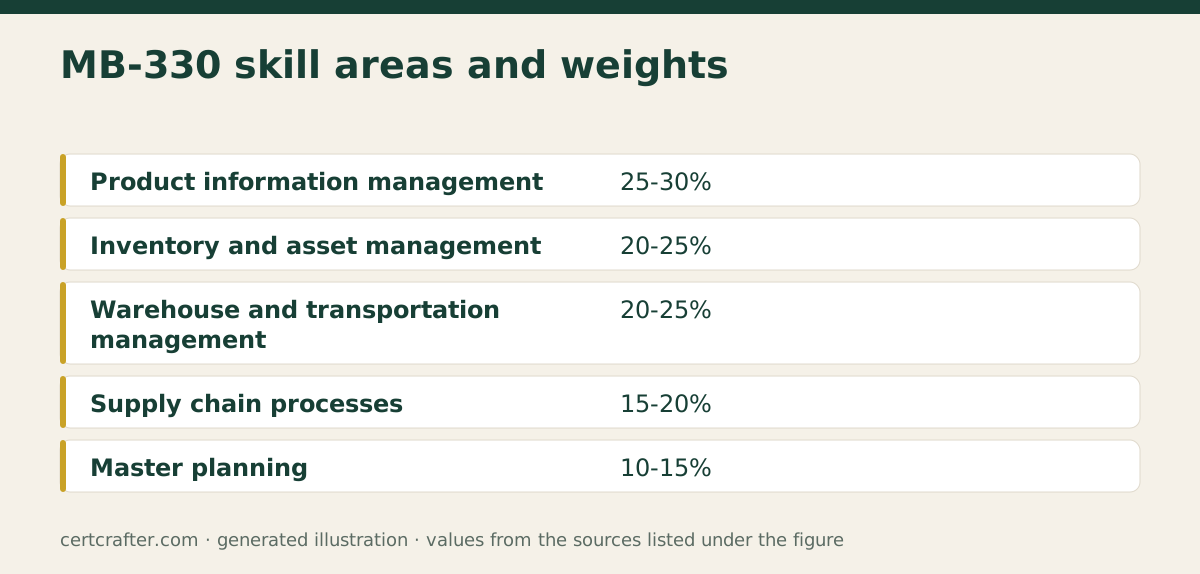
Three free questions cannot mirror those weights. Our product information management post takes the largest area apart, and the skills update post shows what changed on October 21, 2026.
How is MB-330 timed and scored?
The exam runs for 100 minutes and is proctored. A score of 700 or greater passes, on a scale of 1 to 1000. It is a scaled score, so you cannot turn it into a number of questions you may miss. Microsoft does not publish the exact question count and says most of its certification exams contain 40 to 60.
The exam is offered in English and Japanese. If you fail, Microsoft’s exam page says you can retake after 24 hours, and later retakes wait longer. Register with a personal Microsoft account rather than a work or school one, because records tied to an organizational account can be lost if you leave that organization.
What these questions will not do
They will not tell you whether you are ready. They show whether a habit is sound. For each one, say why every wrong option is wrong and name the setting it actually controls. A question answered correctly for the wrong reason teaches nothing.
Next step: open the first question, commit to an answer, then read the explanation. The MB-330 guide holds the full fact sheet and the MB-330 hub lists every post on the exam. Our common mistakes post covers what to fix before exam day.
Comments
Comments are read by a person before they appear. How we moderate.