
Most MB-330 candidates do not fail on a hard configuration question. They fail on a decision made weeks earlier: what to study, how much of it, and what the score means.
Which MB-330 mistakes happen before you start studying?
Three of them, and they are the most expensive.
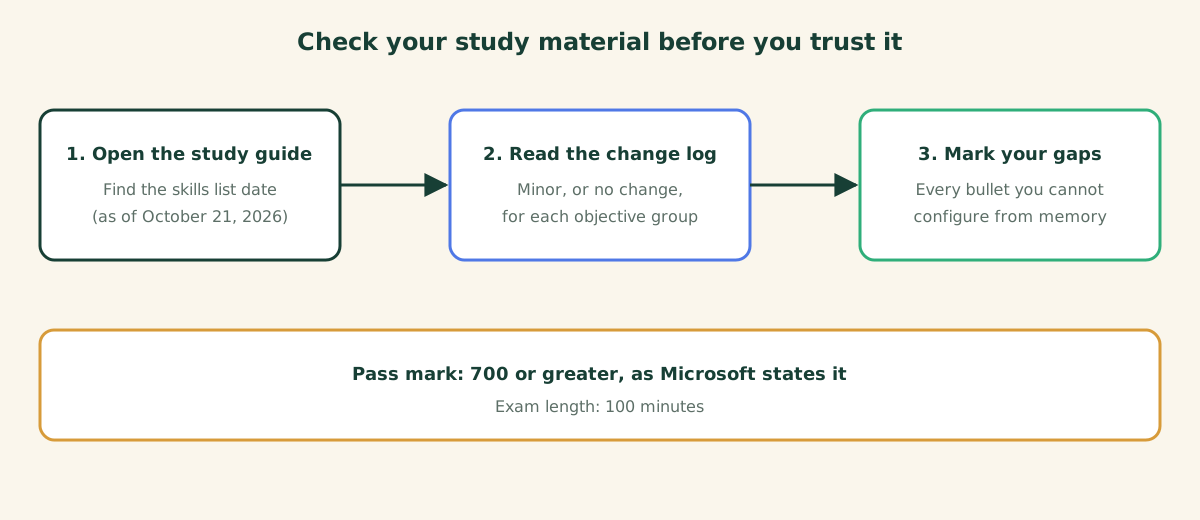
The first is studying from notes that predate the current skills list. Microsoft dates its skills measured, and the study guide now carries the list as of October 21, 2026. Blog posts, course slides and forum threads written earlier may describe an objective that has since been reworded. Open the guide first, note the date, and judge everything else against it.
The second is skipping the change log. It sits at the bottom of the study guide and marks each objective group as no change or minor change. Reading it takes two minutes and tells you whether your older notes still hold. Our skills update post walks through which groups were flagged.
The third is treating the five areas as equal. They are not.
 MB-330 — What MB-330 changes on a D365 consultant's CV. Watch on YouTube · CertCrafter
If you want a short reminder of why the effort pays off, our channel has a clip on what MB-330 changes on a consultant’s CV.
Why does spreading your time evenly across the five areas fail?
Microsoft publishes a weight range for each area, and the ranges differ by a factor of two. Product information management carries 25-30%. Inventory and asset management and warehouse and transportation management each carry 20-25%. Supply chain processes carry 15-20% and master planning 10-15%.
On a project this is familiar. A team that gets item setup wrong pays for it in every module that reads the item, so consultants put their care there first. The exam rewards the same instinct. Our product information management post takes the largest area apart.
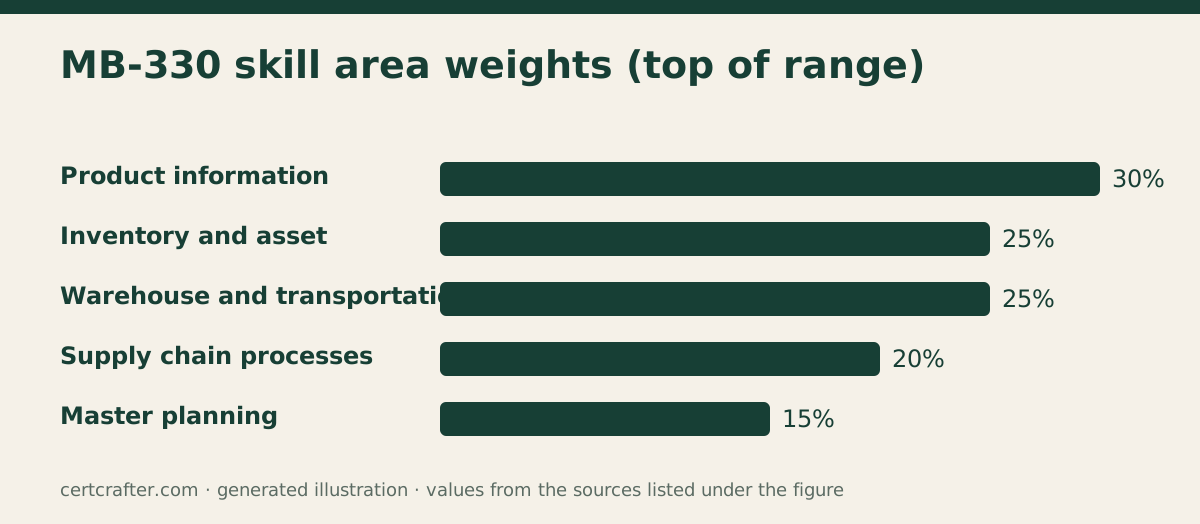
The weights are ranges, so treat them as a guide to emphasis. A candidate who ignores master planning because it is the smallest area still faces 10-15% of the exam there.
What mistakes do consultants bring from real projects?
Projects teach habits that the exam punishes.
The study guide describes a candidate who maps requirements to system capabilities and applies industry-recommended practices. That is a design role, not a clicking role. A common mistake is to memorize where a setting lives and never ask what requirement it satisfies. Questions describe a business need and ask which setup delivers it, so the reasoning matters more than the menu path.
Another is to know only the modules you have used. A consultant from a distribution business may have configured procurement and sales for years and never touched asset management, quality management or transportation management. All three appear in the skills list. The exam covers the whole role, so the gaps in your own project history are exactly where to look.
A third is to assume the system behaves the way your last client configured it. One client’s workaround is not a feature. Study the standard behavior in the documentation, then compare.

How do candidates misread the exam itself?
Four mistakes, all avoidable with facts from Microsoft’s pages.
Reading 700 as 70%. Microsoft states that a score of 700 or greater is required to pass, on a scale of 1 to 1000. It is a scaled score, so you cannot work out the number of questions you can afford to miss.
Planning around a question count. Microsoft does not publish the exact number for this exam and says most of its certification exams contain 40 to 60. Some questions are case studies, drag and drop, hot area, build list or labs, so the time per question varies. The exam runs for 100 minutes.
Leaving questions blank. There is no penalty for a wrong answer, and a few unscored items are included that you cannot identify. Answer everything.
Ignoring the exam rules. The exam is proctored, and Microsoft recommends registering with a personal Microsoft account rather than a work or school account, because exam records tied to an organizational account can be lost if you leave that organization. It is offered in English and Japanese. If it is not offered in your preferred language, Microsoft notes you can request an additional 30 minutes.
Worked example: turning the change log into a study plan
This is a method, so follow the steps.
- Open the study guide and find the heading with the date, skills measured as of October 21, 2026.
- Scroll to the change log and list the groups marked minor. For this exam Microsoft marks the audience profile, manage and process inventory activities, landed cost, common sales and marketing features, perform warehouse management processes and manage master plans as minor.
- Read those bullets in the current list first, because they are the ones most likely to differ from older notes.
- Compare the bullets against your own notes and mark each one you cannot configure from memory.
- Rank the gaps by area weight, largest first.
The MB-330 practice tests work more of these scenarios under timed conditions, with every answer explained.
What does practice get wrong when you use it badly?
Two mistakes here.
Using practice only to check recall. A question you answer correctly for the wrong reason teaches you nothing. After each one, say why every wrong option is wrong, and name the setting it actually controls.
Never practicing in exam conditions. Microsoft offers a free practice assessment and an exam sandbox, which lets you explore the exam environment before the day. Use both, so the interface is not a surprise and the clock is not new to you.
Microsoft also notes that most questions cover generally available features, and the exam may include Preview features if those are commonly used. Read the documentation for newer features, not only the ones your client has switched on.
What should you do next?
Open the study guide, do the five steps above, and book your first timed session once you have your ranked gap list. The MB-330 guide sets out the full plan, the free sample quiz shows how configuration questions read, and the MB-330 hub lists every post on the exam.
Comments
Comments are read by a person before they appear. How we moderate.