
My 4 engineering books go FREE on Kindle Fri 6 – Tue 10 Nov (PT). See the books → FREE on Kindle now: all 4 engineering books, until Tue 10 Nov 11:59 pm PT. Ends in . Grab yours → My 4 books: FREE on Kindle Fri 6 – Tue 10 Nov (PT). See → FREE on Kindle now: 4 books, left Grab yours →

MB-330 Configuration Walkthroughs With Examples

By Sandeep Bandyopadhyay, Senior aerospace engineer · PMP, MBA, Six Sigma

TL;DR

MB-330 configuration questions describe a business need and ask which setting delivers it. The method that works is the same one a consultant uses on a project: state what the system must do or stop doing, place it in one of the five skill areas, pick the single object that controls that behavior, then test whether the result matches the stem. Wrong options are real objects that control something nearby.

Original questions, not exam dumps. Every CertCrafter question is written from the published body of knowledge and the referenced codes. None is copied from a live exam, and CertCrafter is independent: not affiliated with or endorsed by any awarding body.

A cargo truck backed up to the loading bays of a large distribution warehouse
Photo: Vos Logistics cargo truck warehouse Oss by Joyce Roosenhart (Wikimedia Commons), CC BY-SA 4.0, via Wikimedia Commons.

Most MB-330 candidates know what the settings are called. They lose marks because they cannot say which one a requirement is actually asking for.

How do you turn a requirement into a configuration?

Start with the behavior, not the screen. A stem says a warehouse must stop something, or a planner needs something to happen earlier. Write that as one sentence: the system must prevent X, or produce Y.

Then place it. Microsoft’s study guide splits the exam into five areas: product information management at 25-30%, inventory and asset management at 20-25%, supply chain processes at 15-20%, warehouse and transportation management at 20-25%, and master planning at 10-15%. Naming the area narrows the candidate objects fast.
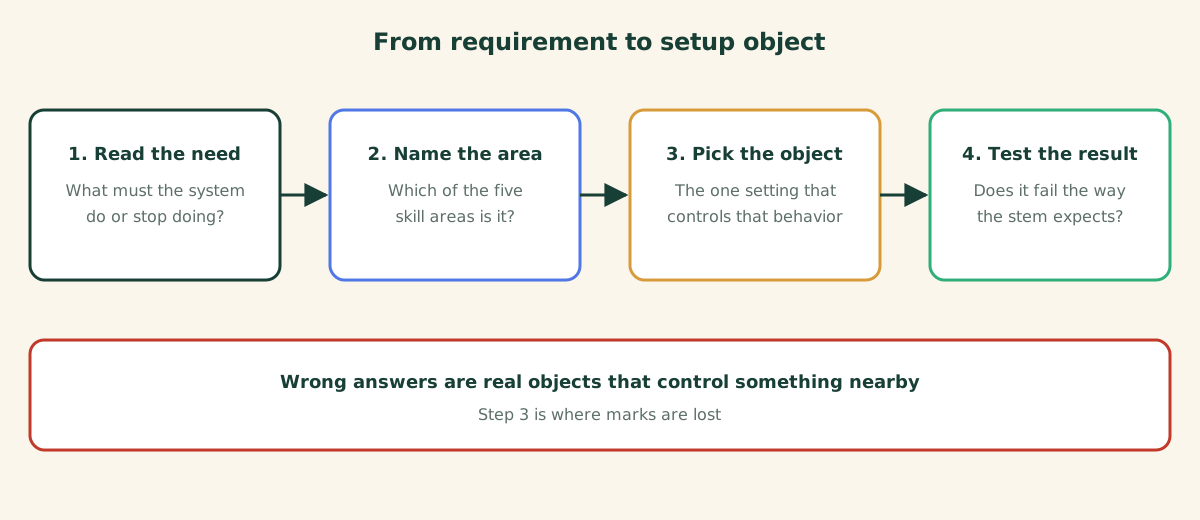
Four boxes in a row: read the need, name the area, pick the object, test the result, with a note that wrong answers are real objects that control something nearby
The four steps used in every walkthrough below. Illustration: CertCrafter, from Study guide for Exam MB-330: Microsoft Dynamics 365 Supply Chain Management Functional Consultant.

The third step is where the work is. Each option in a good question is a real object. One of them controls the behavior you wrote down. The others control the thing next to it.

Worked example: stopping mixed items in a bulk location

Take a requirement a warehouse lead might hand you: pallets must not be put away into a bulk location that already holds a different item. Follow the steps.

  1. Behavior: putaway must reject an occupied bulk location when the item differs.
  2. Area: warehouse management, specifically location setup.
  3. Candidates: the location type, license plate tracking, a location directive line with a quantity restriction, and the location profile.
  4. Decide: whether two items may share one physical location is a property of the location profile. The option that allows mixed items is cleared for those locations.
  5. Test: putaway logic now skips occupied locations and drives work to an empty or matching one.

Notice what each wrong option really does. A location type classifies the location. License plate tracking changes how stock is identified. A directive quantity restriction limits how much, not which item. Every distractor is a real feature, and none answers the stem.

The MB-330 practice tests work many more scenarios like this under timed conditions, with every answer explained.

Video: MB-330 — What MB-330 changes on a D365 consultant's CV. MB-330 — What MB-330 changes on a D365 consultant's CV. Watch on YouTube · CertCrafter
Image: video thumbnail, source: CertCrafter on YouTube (@certcrafters).

Our channel has a short on what MB-330 changes on a consultant’s CV, if you want the career case before the configuration work.

Which requirement points to which object?

Here are a few pairings from the study guide’s own objectives, written the way a stem would put them.

The requirement says Think about
Workers must see larger units break down automatically A unit sequence group on the product
Receipts must land earlier than the demand date The receipt margin in safety margins
Stock value must not follow the document price The standard cost in the costing version
Vendors must key their own bids Vendor collaboration for the invited vendor
Pickers must reach sales order work on a device A mobile device menu item using existing work

Five rows, four different areas. The pattern is the useful part: each need maps to one object, and the wrong answers are neighbors.
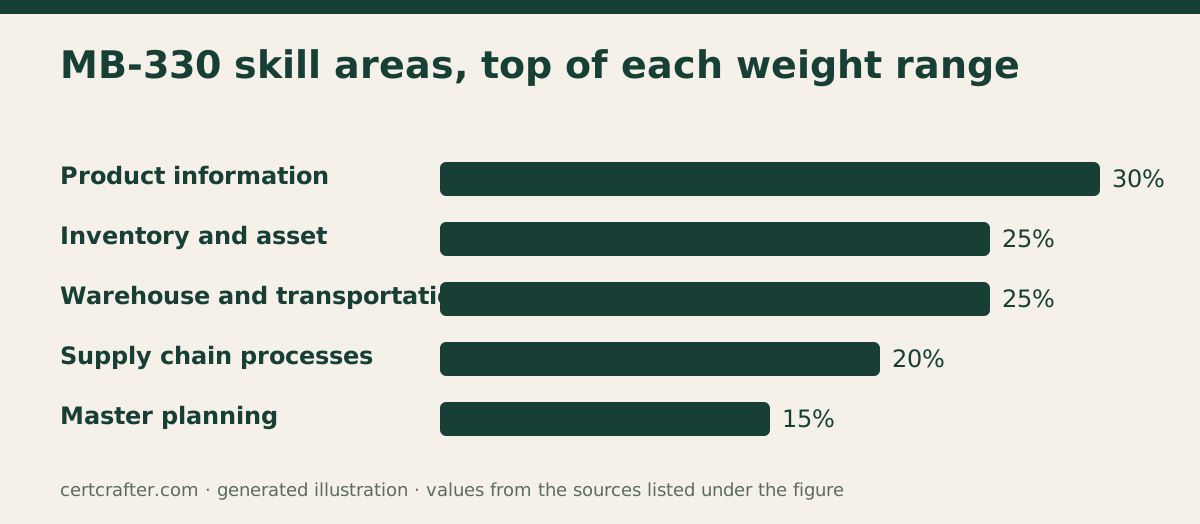
Bar chart of the five MB-330 skill areas at the top of each weight range: product information management 30 percent, inventory and asset management 25, warehouse and transportation 25, supply chain processes 20, master planning 15
Where the requirements come from: the five skill areas by weight. Illustration: CertCrafter, from Study guide for Exam MB-330: Microsoft Dynamics 365 Supply Chain Management Functional Consultant.

The weights tell you where to practice first. Product information management is the largest area, so a wrong habit there costs the most. Master planning is the smallest, but its questions often carry two requirements in one stem, which makes the method matter more, not less.

A large white logistics warehouse building with loading docks along its long side
Photo: Autodoc Logistics Warehouse in Stettin by Autodoc GmbH (Wikimedia Commons), CC BY-SA 4.0, via Wikimedia Commons.

What does this look like on a real project?

On site, the same discipline saves rework. A business user says the system should “not let people mix stock.” That is not a configuration yet. Is it about putaway, about reservation, about quality? A consultant who asks that question before opening a screen builds the right thing the first time.

The mistakes are predictable. Someone changes a costing setting because a variance looks odd, when the real cause was an adjustment journal entered at a different price. Someone adds a planning rule when the actual need was a margin. Setup knowledge helps, but the habit of naming the behavior first is what prevents these.

How are these questions framed in the exam?

As a short scenario with a named company, a requirement, and four or five plausible options. Some ask for one answer, some for two. Microsoft notes that most questions cover generally available features, and Preview features can appear if they are commonly used. The guide also says its bullets illustrate how a skill is assessed, so related topics may come up.

Here are three free-tier questions in that style. Before you open each answer, write the behavior in one sentence.

Why do the two-answer questions cost marks?

They split a stem into two requirements. Treat each as its own run through the four steps. In the planning question above, the coverage code decides how demand is grouped, and a separate setting decides the date of the planned order. Getting one right and the other wrong leaves you short, so give each half its own check.

Check each pair against the stem separately, and cross out any option that answers a different question than the one asked. Then reread the stem once more. If an option you kept needs an assumption the question never gave you, it is probably a neighbor, not the answer. Clients do the same thing in workshops, adding requirements nobody stated, and the fix is identical: go back to the written need.

What should you do next?

Take one objective group from the study guide and write five requirements in plain language, then name the object for each. The MB-330 product information management post covers the biggest area, and MB-330 common mistakes covers how candidates misread the exam. The MB-330 guide, the free sample quiz and the MB-330 hub hold the rest.

Try these free questions

  1. A warehouse must stop workers from putting a pallet away into a bulk location that already holds a different item. Which setup satisfies this requirement?

    1. Set the location type on the affected bulk locations to a dedicated bulk value.
    2. Enable license plate tracking on the location profile used by the bulk locations.
    3. Add a location directive line with a quantity restriction covering the bulk zone.
    4. Clear the option that allows mixed items on the location profile for those locations.
    Show the answer and explanation

    Answer: D. Whether two different items may share the same physical bin is a property of the location profile, so clearing the mixed items option makes the putaway logic reject any location that is already occupied by another item and drive work to an empty or matching location instead. Option 1 confuses location types with behaviour; location types are descriptive groupings used for filtering and reporting and impose no occupancy rule of their own. Option 2 changes how inventory is tracked inside the location by requiring license plates, which affects how quantity is identified but still permits several items to sit in the same bin. Option 3 addresses how much can be directed to a location through directive restrictions and can control volume or quantity, yet it cannot express the condition that the occupying item must be the same one. Only the location profile carries the mixed items and mixed statuses controls that enforce this requirement.

  2. A clerk posts an inventory adjustment journal for five units of an item that uses standard cost. The entered cost price differs from the active standard cost. What is posted?

    1. The journal is rejected because the entered price must match the active standard cost.
    2. Inventory is valued at the active standard cost and the difference posts to a variance.
    3. The active standard cost is updated to the entered price for all future transactions.
    4. The receipt is valued at the entered price and the standard cost is simply ignored.
    Show the answer and explanation

    Answer: B. Under a standard cost inventory model the value of on hand stock is fixed by the activated cost record in the costing version, and every receipt or issue is booked at that value no matter what price appears on the source document. When a journal line carries a different amount, the system still increases inventory at standard and routes the difference to a variance account defined in the inventory posting setup, which keeps the balance sheet aligned with the standard while making the deviation visible. Option 1 assumes a hard validation that does not exist, since the whole point of variance accounting is to accept the difference. Option 3 confuses transactional entry with costing version maintenance, because standards change only through a new cost record that is activated, usually in a new costing version. Option 4 describes moving average or FIFO behaviour, where the receipt price genuinely drives valuation, which is precisely the misconception being tested.

  3. An item is assigned a coverage group with coverage code Period and a coverage period of seven days. Master planning runs. Which two outcomes are expected?

    1. One separate planned order is created for every individual demand date in the horizon.
    2. Demand falling inside the same seven day bucket is grouped onto one planned order.
    3. The coverage period is recalculated automatically from the lead time of each planned order.
    4. Every planned order is sized to the maximum quantity defined on the item coverage record.
    5. The planned order is dated to cover the earliest demand inside its period.
    Show the answer and explanation

    Answer: B, E. Coverage code Period tells master planning to consolidate requirements into time buckets whose length is the coverage period, so option 2 follows directly; a bucket opens with the first unmet demand for the item and runs for seven days, and the next bucket starts with the next requirement after that. Option 5 completes the picture, because the single planned order that covers a bucket is placed on the first day of the period so that the earliest demand inside it is still met on time, and its quantity is the net requirement for the whole bucket. Option 1 describes requirement coverage, where every demand line gets its own supply, and that is precisely what period coverage avoids. Option 3 invents a link between lead time and bucket length, but the coverage period is a fixed number of days entered on the coverage group or the item coverage record. Option 4 belongs to minimum and maximum coverage, where a maximum quantity sizes the order instead of accumulated demand.

Take the full free 10-question sample with scoring →

Frequently asked questions

How do I answer an MB-330 configuration scenario?

Restate the requirement as one behavior the system must produce or prevent, place it in a skill area from Microsoft's study guide, then choose the one object that controls that behavior. Wrong options usually control something close by, so check the result against the wording of the stem.

Does the exam ask me to click through screens?

Microsoft states that the bullets in the study guide illustrate how each skill is assessed, and that related topics may be covered. Scenario questions in this style ask which object or setting meets a requirement, so you need to know what each one controls.

How many questions are on MB-330?

Microsoft does not publish the exact number for this exam, stating only that most of its certification exams contain between 40 and 60 questions. The exam runs for 100 minutes, and the pass mark is a scaled 700 on a 1 to 1000 scale.

Official sources

  1. Study guide for Exam MB-330: Microsoft Dynamics 365 Supply Chain Management Functional Consultant — accessed 1 November 2026
  2. Microsoft Certified: Dynamics 365 Supply Chain Management Functional Consultant Associate — accessed 1 November 2026

Exam rules change. Check the awarding body's official page before you apply. CertCrafter is independent and is not affiliated with or endorsed by any awarding body.

Was this helpful?

Comments

    Comments are read by a person before they appear. How we moderate.