
Most MB-330 candidates study warehouse work first because it feels hands-on. Then the largest domain turns out to be the item setup that every warehouse screen depends on.
What does product information management cover on MB-330?
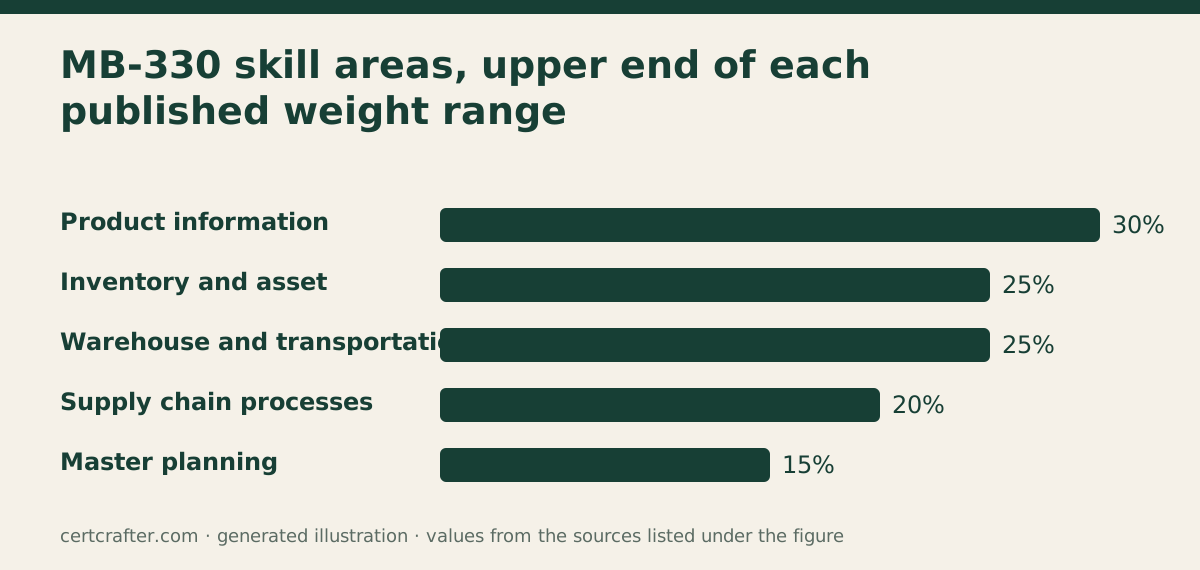
It is the first of five areas and the biggest, at 25-30% of the skills measured. Microsoft’s study guide breaks it into three objective groups, and each one maps to a stage of a real implementation.
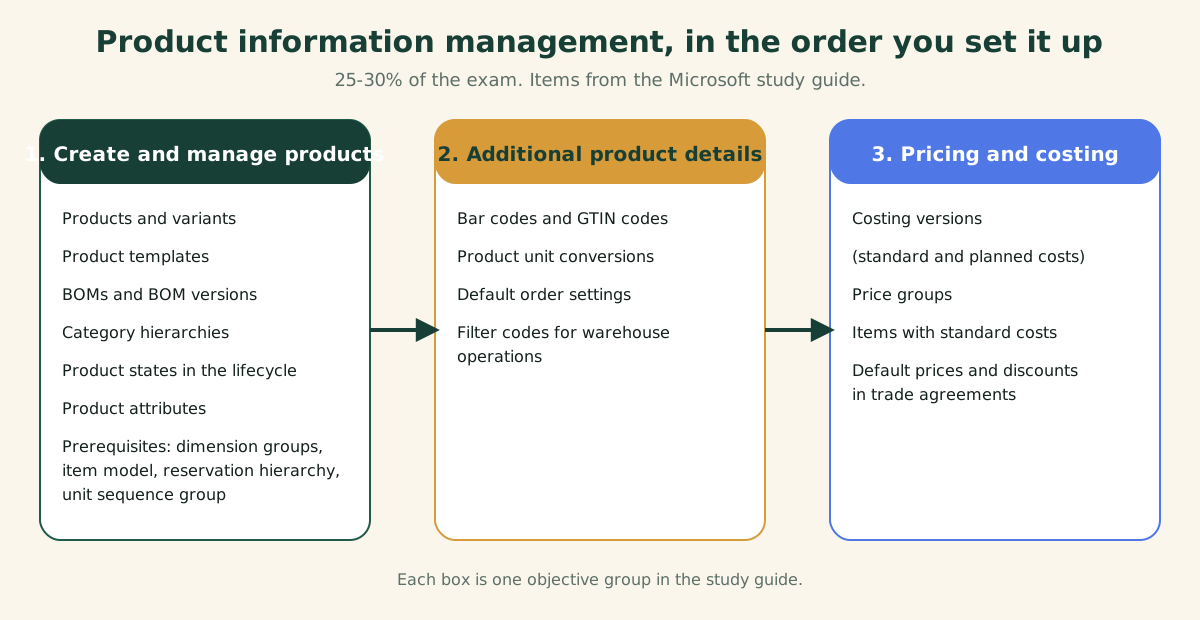
The first group is creating and managing products: products and variants, templates, bills of materials and their versions, category hierarchies, lifecycle states and attributes. It also holds the prerequisites that decide how an item behaves later: inventory dimensions, item model groups, reservation hierarchies and unit sequence groups.
The second is the extra detail an item needs before it can move through a warehouse: bar codes and GTIN codes, unit conversions, default order settings and filter codes for warehouse operations.
The third is inventory pricing and costing: costing versions for standard and planned costs, price groups, items with standard costs, and default prices and discounts in trade agreements.
Why do consultants spend so much time on item setup?
Because everything downstream reads it. A sales line, a planned order and a pick all look at the item’s dimension groups, units and costing before they do anything else.
On a project, the item master is where scope arguments start. The business wants every attribute it has ever used. The consultant has to decide which belong on the product, which belong on a category, and which stay in the legacy system. A short list that people trust beats a long list that nobody maintains.
Teams usually settle the tracking and costing decisions before stock is loaded. Changing how an item is tracked or costed once transactions exist is slow, and nobody enjoys explaining that to a finance controller. The exam reflects this. It rarely asks you to click through a screen. It describes a requirement and asks which setup object satisfies it.
 MB-330 — What MB-330 changes on a D365 consultant's CV. Watch on YouTube · CertCrafter
Our channel has a short on what MB-330 changes on a consultant’s CV, which helps explain why the certification is worth the effort.
How do questions on this domain get framed?
Almost always as a scenario. A company wants X, so which setting, group or object delivers X? The wrong answers are real objects that control something nearby.
Take the dimension groups. A storage dimension group decides which dimensions are tracked and whether the item uses warehouse management processes. A reservation hierarchy orders the dimensions for reservation. Neither holds units of measure. A unit sequence group does, and it sits beside unit conversions: the conversions supply the ratios, the sequence group supplies the order in which handling units break down. The sample questions below sit in exactly this territory.
Costing works the same way. Under standard cost, the activated cost record in the costing version fixes the value of stock, and a differing price on a journal line posts the difference to a variance. Candidates who think receipt price drives valuation everywhere give away that mark.

Worked example: setting up a new item in a sensible order
This is a method, not a calculation, so follow the sequence.
- Create the product from a product template, so the defaults arrive with it.
- Decide the item’s behaviour groups: storage and tracking dimensions, item model group, reservation hierarchy and unit sequence group.
- Add the units the business really handles, with the unit conversions between them.
- Add the bar codes or GTIN codes and the default order settings.
- Assign the costing: a standard cost in the right costing version, or the price groups and trade agreements the item needs.
The sequence matters because a later step often depends on an earlier choice. The MB-330 practice tests work more of these setup scenarios under timed conditions, with every answer explained.
What goes wrong on real projects?
The same three things, project after project. Units are set up for how purchasing buys, not how the warehouse picks, so a pallet cannot be broken down at the shelf. Dimension groups are copied from an old item without anyone asking whether the new item is traced the same way. And costing is left until the first invoice, when the variance report is already full.
None of these is exotic. Each one maps to a bullet in the study guide, which is why the exam keeps returning to them. A consultant who has been burned by one of them reads the question stem differently and spots the distractor faster.
Which topics are most often confused?
Pairs that sound alike but control different things:
- Storage dimension group and tracking dimension group: where an item is held against how it is traced.
- Reservation hierarchy and unit sequence group: the order of dimensions against the order of units.
- Standard cost and planned cost: what stock is valued at against what a future version expects.
- Product and released product: the shared definition against what a legal entity actually uses.
For each pair, ask which exam requirement would force the choice. That question beats memorising definitions.
What should you do before moving on?
Read the three objective groups in the current study guide and mark every bullet you could not configure from memory. Microsoft also notes that most questions cover generally available features, and the exam may include Preview features if they are commonly used.
The October 2026 skills update post shows which objective groups changed and which did not. Product information management is not on that change list. The MB-330 guide sets out the full plan, the free sample quiz shows how configuration questions read, and the MB-330 hub lists every post on the exam.
Comments
Comments are read by a person before they appear. How we moderate.