
Two consultants read the same MB-330 item setup scenario and name different objects, and both can defend their pick. The split is usually vocabulary: one filed the requirement under tracking, the other under storage.
Why do product setup terms get mixed up?
Product information management is the largest area of MB-330, at 25-30% of the skills measured. Microsoft lists three groups of objectives inside it, and the names of the objects inside those groups sound alike. Dimension groups, item model groups, reservation hierarchies and unit sequence groups all “group” something about an item, and the labels do not say what.
On a project this never bites, because the consultant has the screen in front of them and the item behaves or it doesn’t. The exam takes the screen away. It gives you a requirement in words and asks which object delivers it, so you need to know what each one is for before you meet the wording.
 MB-330 — What MB-330 changes on a D365 consultant's CV. Watch on YouTube · CertCrafter
The channel has a short on what MB-330 changes on a consultant’s CV, which is a fair reason to learn the vocabulary properly.
Storage or tracking: what is the difference between the dimension groups?
Microsoft’s study guide has one bullet that reads “Configure inventory dimensions, including storage, tracking, and product dimension groups”. Three groups, three questions.
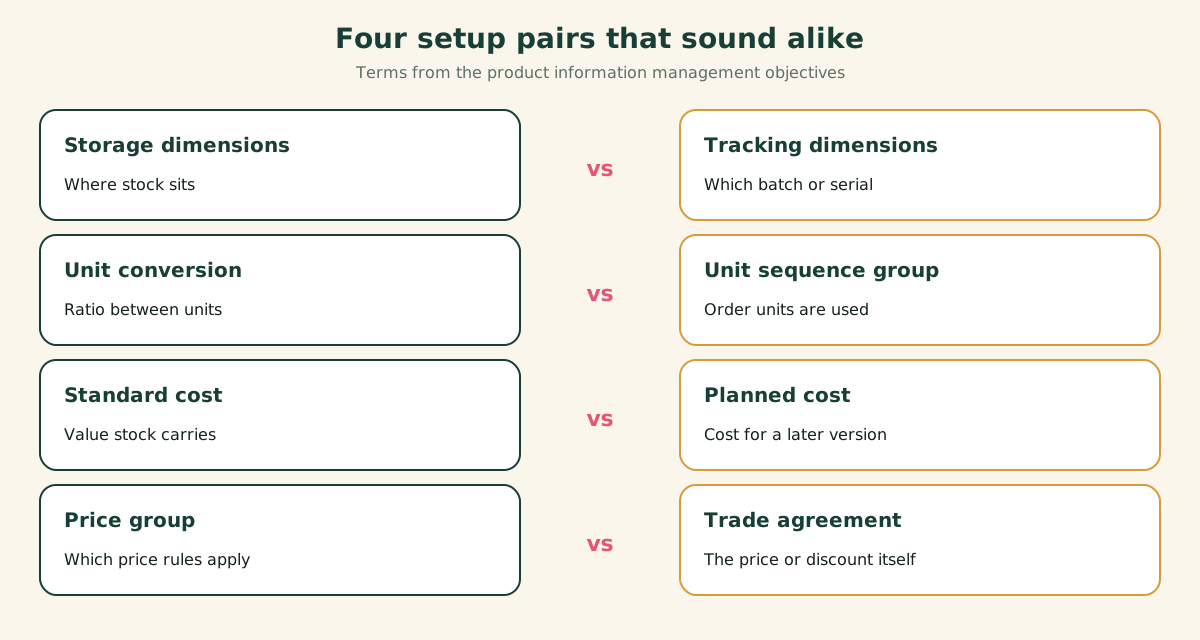
A storage dimension group answers where stock sits: site, warehouse, location. A tracking dimension group answers how a unit is traced, which on most projects means batch or serial numbers. A product dimension group answers which variations of a product exist, such as size or color.
In the field the confusion comes from timing. A client says they must recall a faulty lot, so the consultant reaches for tracking. A client says they need stock counted by shelf, so the consultant reaches for storage. A requirement about both needs both, and a stem that mentions only one almost always wants only one.
Which other setup pairs cause trouble?
Five pairs cause most of the damage. The study guide’s wording is the tie-breaker, because each side is its own bullet.
| Pair | What separates them |
|---|---|
| Product vs product variant | The shared definition against the version a customer actually buys. |
| Product template vs product | The template supplies defaults. The product is the item. |
| BOM vs BOM version | The structure against a dated revision of it. |
| Category hierarchy vs attribute | Where an item sits in a tree against a property it carries. |
| Unit conversion vs unit sequence group | The ratio between two units against the order units are handled in. |
Look at the last row. A conversion says one case holds twelve pieces. It does not say whether a picker is offered cases first or pieces first. Candidates who treat the two as one object lose that mark every time.

Standard cost or planned cost: what does a costing version hold?
The pricing and costing objectives name “costing versions for standard and planned costs” in a single bullet. A costing version is a container, and it holds two kinds of cost.
Standard cost is what an item is valued at while it sits in stock. Planned cost is a price you prepare for a later version, so finance can review it before it takes effect. In practice a team loads next year’s planned costs while this year’s standards still run, and the activation date is the decision that matters.
The trap is reading “cost” as “the price on the purchase order”. A receipt price and a standard cost can differ, and the exam likes stems that make you decide which one the question is about.
Price group or trade agreement: who decides the price?
The study guide separates “configure price groups” from “configure default item prices, purchase and sales prices, and discounts in trade agreements”.
A price group is a label you attach to customers, vendors or both. It says which price rules apply to them. A trade agreement holds the price or the discount itself. So “give wholesale customers a lower price” needs both: the group to identify wholesale customers, and the agreement to carry the number.
When a stem asks who gets a price, think group. When it asks what the price is, think agreement.
Worked example: which object does the requirement name?
Say a stem describes a client that stocks one item in pieces, cases and pallets, wants pickers on the mobile app to be offered cases before pieces, and wants every pallet to carry a lot number.
- Split the sentence into three requirements: units, order of units, tracing.
- Match each one. Units and ratios are unit conversions. The order pickers see is the unit sequence group. A lot number is a tracking dimension.
- Check what the options offer. A storage dimension group is a real object, but nothing in the stem asks where the stock sits, so it is bait.
- Choose the option that covers all three, or the one the stem is actually asking about if it only asks for one.
Step 1 is the whole skill. Most wrong answers come from reading the stem as one requirement when it holds three. The MB-330 practice tests work more of these under timed conditions, with every answer explained.
What do the numbers say about how much this matters?
Microsoft’s figures put the stakes plainly. The area is the biggest on the paper, and the paper is short on time.
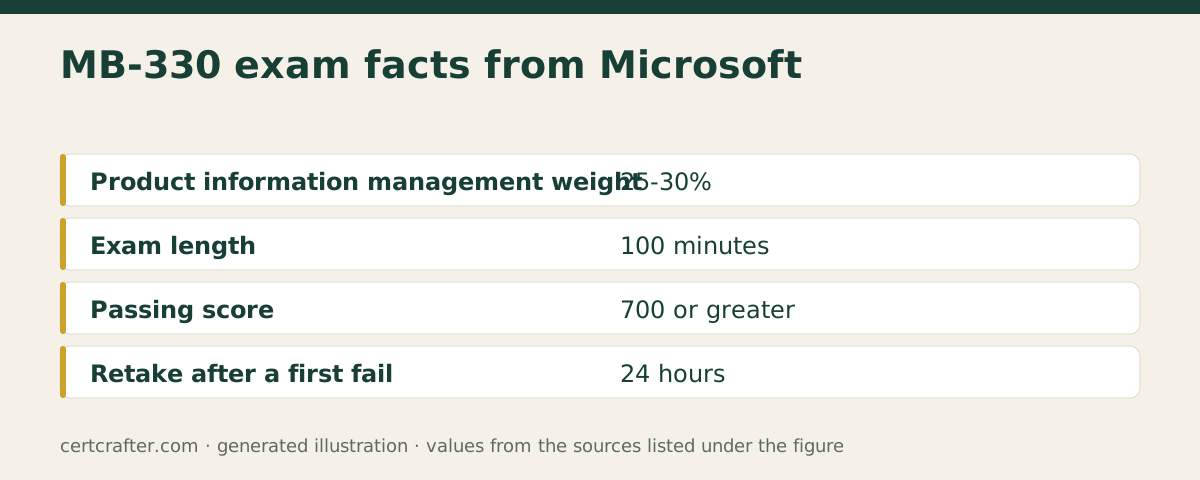
A score of 700 or greater passes, and Microsoft’s page says a candidate who fails can retake it 24 hours after the first attempt. Neither fact helps you if a quarter of the paper keeps tripping you on vocabulary.
What do candidates get wrong on these terms in the exam?
They answer from the nearest familiar word. “Cost” sounds like price, so they pick the purchase price. “Group” sounds like dimension, so they pick a dimension group when the stem is about units.
They also treat paired objects as alternatives. Group and agreement work together. Conversion and sequence work together. A stem that asks for a result needs the one that produces it, and the other option is a real object that does something nearby.
Last, they stop at the first match. The right option often covers two of the three requirements, and the one that looks perfect covers only one.
Before you choose, name the question the stem is asking: where, how traced, how much, in what order. Then name the object that answers it.
What should you do next?
Open the product information management section of the study guide and write each pair above on one line, with the question it answers. Then read the full tour of the area in what product information management tests, and the field mistakes in MB-330 common mistakes. The MB-330 guide, the free sample quiz and the MB-330 hub have the rest.
Comments
Comments are read by a person before they appear. How we moderate.