Databricks Data Engineer Associate Exam Guide 2026
Databricks Data Engineer Associate exam guide: 45 scored questions, 90 minutes, seven weighted domains and a 4-week plan. Then check readiness with mocks.
Quick answer
The Databricks Certified Data Engineer Associate exam has 45 scored multiple-choice questions and a 90-minute time limit. The registration fee is $200 and the certification is valid for 2 years. Seven domains are weighted, and Data Transformation and Modeling is the largest at 22%, just ahead of Data Ingestion and Loading at 21%.
Disclosure: Links to Udemy in this article are referral links. If you enroll through them, CertCrafter earns a share of the sale at no extra cost to you.
Key facts
- Exam code
- Not published; the exam is listed as Databricks Certified Data Engineer Associate source: databricks.com
- Full name
- Databricks Certified Data Engineer Associate source: databricks.com
- Questions
- 45 scored multiple-choice questions; unscored items may also appear source: databricks.com
- Duration
- 90 minutes source: databricks.com
- Passing score
- Not published on the certification page source: databricks.com
- Cost
- $200 registration fee source: databricks.com
- Delivery
- Proctored, online or at a test center, in English, Japanese, Portuguese (Brazil) and Korean; no test aides allowed source: databricks.com
- Validity
- 2 years; recertification means taking the current version of the exam source: databricks.com
Last reviewed: · Exam facts verified against: databricks.com
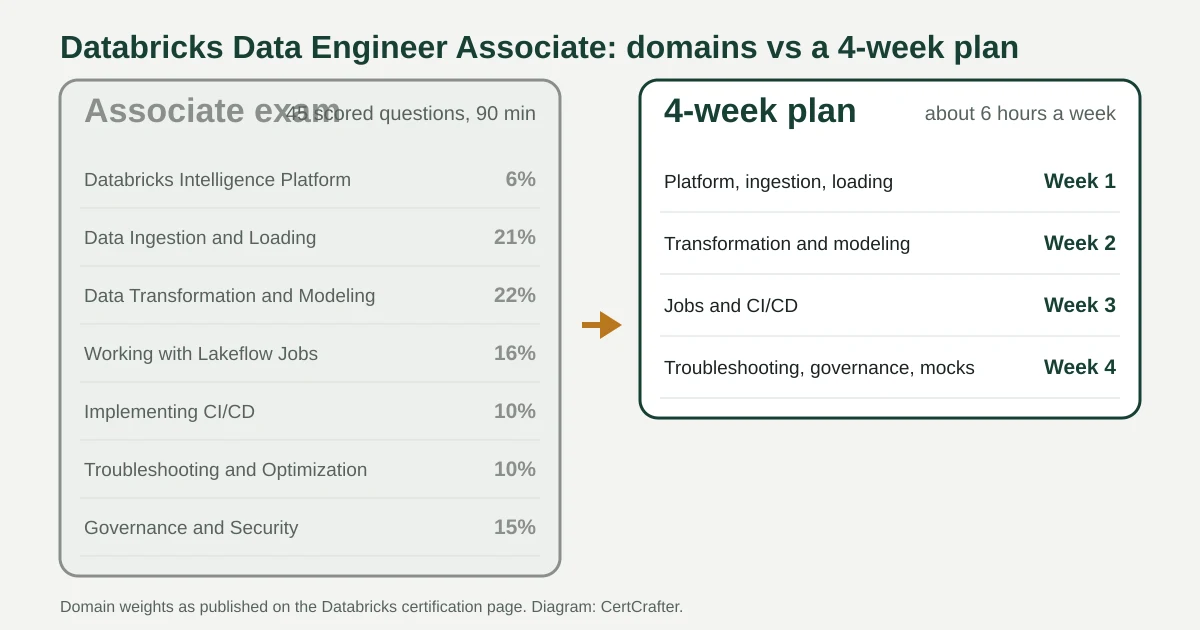
This Databricks Data Engineer Associate exam guide covers the entry-level credential for the Databricks Data + AI Platform. According to the Databricks certification page, the exam has 45 scored questions and a 90-minute limit.
The exam tests foundational, practical data engineering tasks. This guide covers what it measures, who it suits, and how to plan four weeks of preparation.
What is the Databricks Data Engineer Associate exam?
It is the Databricks Certified Data Engineer Associate exam. According to Databricks, it assesses your ability to use the Databricks Data + AI Platform to execute foundational data engineering tasks.
A data engineer builds the pipelines that move raw data into reliable tables for analysis. The exam covers the platform, its workspace and architecture, and tasks such as ingesting, loading, transforming and modeling data.
It is a proctored exam with multiple-choice questions. Databricks lists no prerequisites, but it highly recommends related training.
What does the Databricks Data Engineer Associate exam guide cover?
The exam covers seven domains, and Data Transformation and Modeling carries the most weight at 22%. Databricks publishes these percentages on the certification page.
| Domain | Weight |
|---|---|
| Databricks Intelligence Platform | 6% |
| Data Ingestion and Loading | 21% |
| Data Transformation and Modeling | 22% |
| Working with Lakeflow Jobs | 16% |
| Implementing CI/CD | 10% |
| Troubleshooting, Monitoring, and Optimization | 10% |
| Governance and Security | 15% |
Ingestion and transformation are the two largest domains, so most of your hands-on time belongs there. Governance and security, at 15%, is still large enough that skipping it is risky, and it is easy to underestimate because it feels like administration rather than engineering.
Which language does the code use?
Databricks says data manipulation code in the exam is provided in SQL when possible. In all other cases, code is in Python.
Practise reading short queries and scripts and predicting their result. Test aides are not allowed, so you cannot look anything up.
Who is the Databricks Data Engineer Associate exam for, and who is it not for?
It suits people who already work with data on the Databricks platform, or are about to. Databricks recommends hands-on experience performing the data engineering tasks outlined in the exam guide.
It is a good fit for:
- analysts and developers moving into data engineering on Databricks;
- engineers from other platforms who want to prove they can work in the Databricks workspace;
- team members who build ingestion, transformation and scheduling workflows.
It is a weaker fit for:
- people looking for a purely conceptual overview with no hands-on work;
- readers who first want to judge whether credentials are worth the time, who can start with our post on whether AI and data certifications are worth taking.
How should you use this exam guide? A 4-week plan
Plan around the weights: ingestion, transformation and jobs are over half of the exam. This plan assumes about six hours a week.
- Week 1: platform, ingestion and loading. Learn the workspace and architecture, then load files and tables in several ways. Practise handling semi-structured data.
- Week 2: transformation and modeling. Write joins, aggregations and deduplication in SQL, then repeat the main ones in Python. Read about pipelines that declare how tables should be built.
- Week 3: jobs and CI/CD. Build a multi-task job with dependencies, conditions and retries. Then work through version control integration and the command line, and deploy a job from code.
- Week 4: troubleshooting, governance and timed practice. Read run metrics and find what slows a job, then practise grants and access controls. Finish with full timed practice tests, review every miss by domain, and repeat.
Spaced, mixed review beats rereading; our post on how to study for a technical exam explains why.
How are the questions delivered?
The exam is a proctored certification with multiple-choice questions. Databricks says you can take it online or at a test center, and that no test aides are allowed.
For an online exam, the certification page asks you to review the technical requirements and run a system check first. Registration happens on Databricks’ exam delivery platform.
It is offered in English, Japanese, Portuguese (Brazil) and Korean. The registration fee is $200.
How long is the certification valid, and how do you renew it?
The validity period is 2 years, according to Databricks. To recertify, you take the current version of the exam.
That means the exam you sit in two years may not match today’s outline. Databricks tells you to review the exam guide again to find gaps before you prepare for a recertification exam.
Is the Databricks Data Engineer Associate exam hard?
It is manageable if you have built things on the platform, and difficult if you have only read about it. The questions are multiple choice, but the code-reading and scenario items reward hands-on experience.
Two things raise the difficulty. Product names change, so a study source from a year ago may use outdated terms. And with a 90-minute limit for 45 scored questions, you need to read code quickly.
How do you know you are ready to book?
You are ready when you can walk through each domain without notes and explain why you would choose one approach over another. Use Databricks’ AI Prep Guide first to learn the question style.
Then sit at least two full timed Databricks Data Engineer Associate practice tests and look at your score by domain, not only the total. If one domain trails, spend another week building before you book.
Before you schedule, recheck the Databricks certification page for the current domains, price and any update.
Related reading
Frequently asked questions
How many questions are on the Databricks Data Engineer Associate exam?
Databricks lists 45 scored questions, all multiple choice, with a 90-minute time limit. The certification page adds that exams may include unscored items used to gather statistics for future use. They are not identified on the form and do not affect your score, and extra time is factored in to account for them.
How much does the Databricks Data Engineer Associate exam cost?
Databricks lists a registration fee of $200 on its certification page. The exam is a proctored certification that you can take online or at a test center. Test aides are not allowed. You register through Databricks' exam delivery platform, and the page asks you to run a system check before an online exam.
How long is the certification valid?
Databricks gives the certification a validity period of 2 years. To recertify, you must take the current version of the exam, which can differ from the one you first passed. Databricks recommends reviewing the exam guide again before a recertification attempt, since the domains and product names may have changed.
What programming languages does the exam use?
Databricks says data manipulation code in the exam is provided in SQL when possible. In all other cases, the code is in Python. You should therefore be comfortable reading SQL and Python snippets and predicting what they do, without access to documentation, since no test aides are allowed during the exam.
Do I need a prerequisite for this exam?
No. Databricks lists no prerequisites, but it says related training is highly recommended. The recommended experience is hands-on practice with the data engineering tasks in the exam guide. Plan to build ingestion, transformation and job workflows yourself, because the exam is aimed at foundational but practical tasks.
What is the best way to practice for the Databricks Data Engineer Associate exam?
Read the exam guide, then build each task once in a Databricks workspace. Databricks also points to an AI Prep Guide. In the final week, sit full timed mock tests of 45 questions and review every miss by domain, so your last study hours go to the domains where you lose points. Timed Databricks Data Engineer Associate mock tests on Udemy.
What is the passing score?
The Databricks certification page does not publish a passing score. It lists the number of scored questions, the time limit and the domain weights. Because the score is not published, aim for strong results in every domain rather than a narrow target, and recheck the certification page before you book.
References
- Databricks Certified Data Engineer Associate — Databricks
- Databricks Certified Data Engineer Associate exam guide (PDF) — Databricks
CertCrafter is independent and is not affiliated with or endorsed by the certification bodies named above.
- #Databricks
- #Data Engineer Associate
- #Lakeflow
- #Unity Catalog
- #Practice Test
Get new articles by email
New exam guides, changes to exam dates and fees, and new practice-test certifications. One short email a day at most, only when there is something new.
Was this helpful?
Related articles
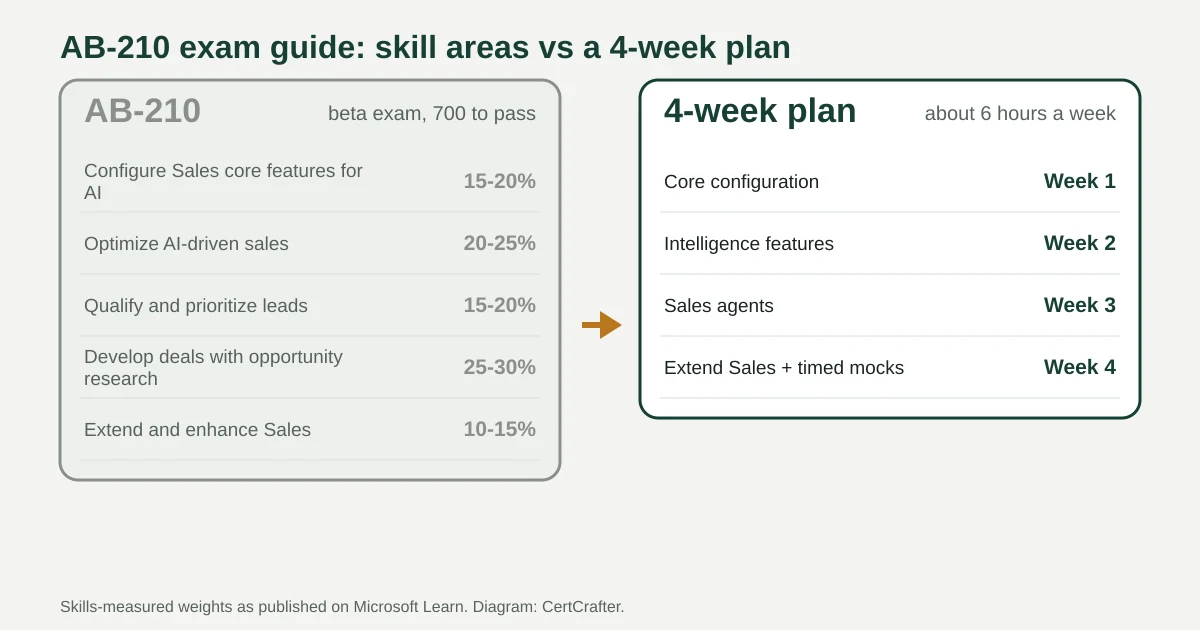
AB-210 Exam Guide 2026: Dynamics 365 Sales AI Skills
AB-210 is a beta Microsoft exam on Dynamics 365 Sales AI. See the five skill areas, weights and a 4-week study plan, then test your readiness with mocks.
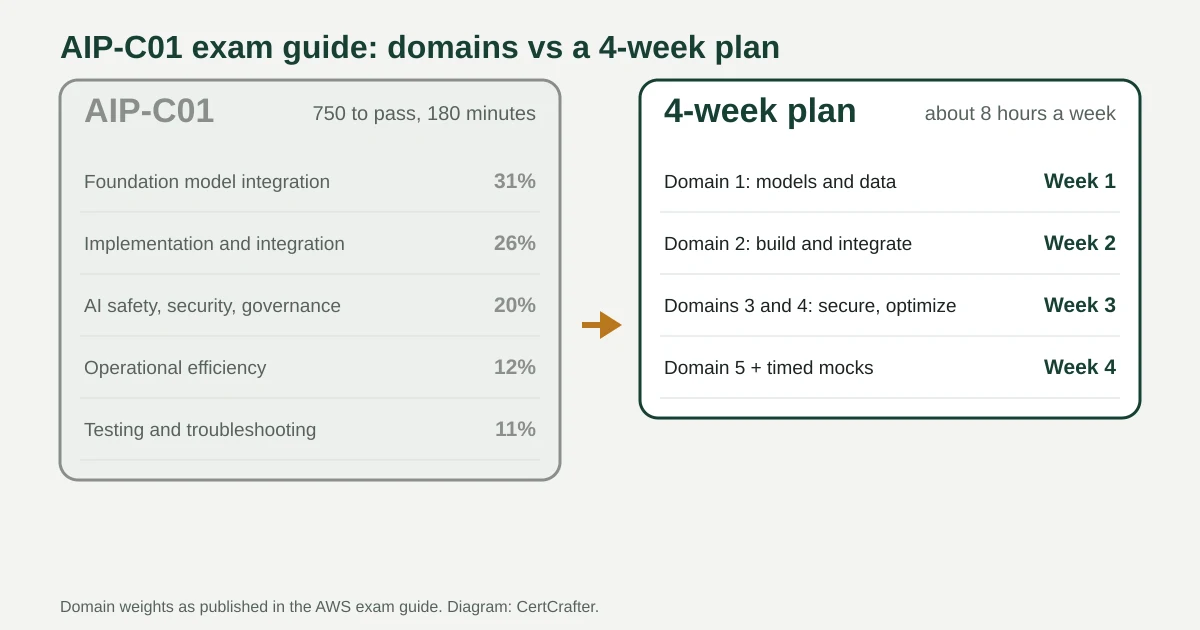
AIP-C01 Exam Guide 2026: AWS GenAI Developer Pro
AIP-C01 tests production generative AI on AWS: 75 questions, 180 minutes, five weighted domains. See the outline and a 4-week plan, then check readiness.
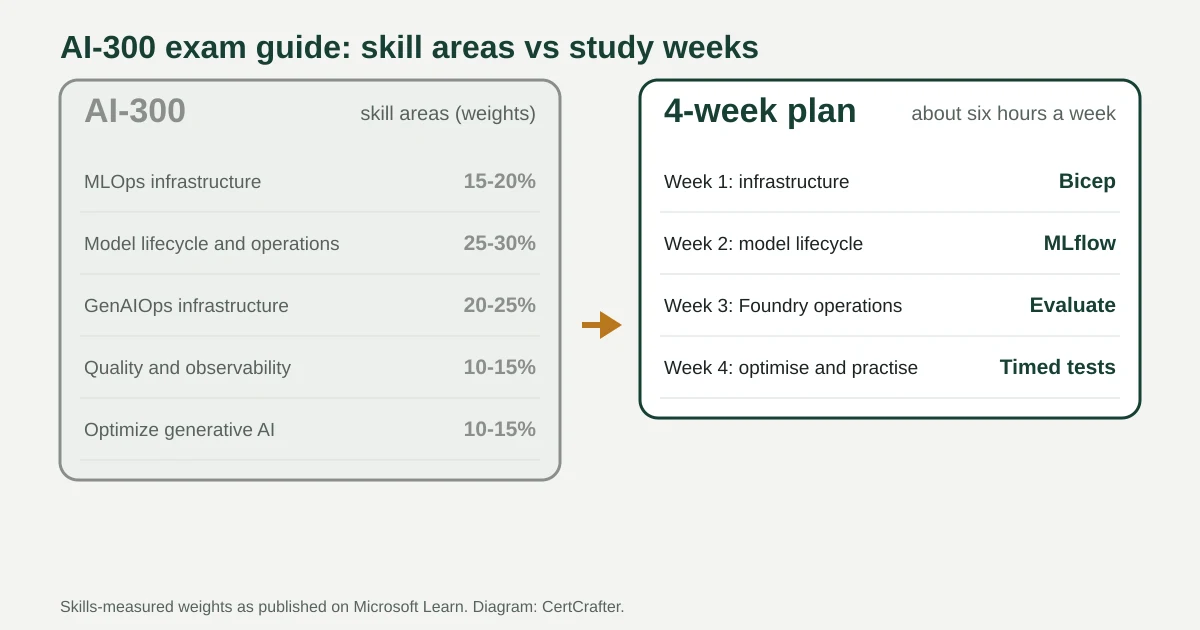
AI-300 Exam Guide 2026: MLOps and GenAIOps Skills
AI-300 tests MLOps and generative AI operations on Azure. See the five skill areas, weights and a 4-week study plan, then test your readiness with mocks.
Comments
Comments are read by a person before they appear. How we moderate.