AI-300 Exam Guide 2026: MLOps and GenAIOps Skills
AI-300 tests MLOps and generative AI operations on Azure. See the five skill areas, weights and a 4-week study plan, then test your readiness with mocks.
Quick answer
AI-300 is the exam for Microsoft Certified: Machine Learning Operations Engineer Associate. It lasts 120 minutes, needs a score of 700, and is offered in English. Five skill areas cover MLOps infrastructure, the model lifecycle, GenAIOps infrastructure, generative AI quality and observability, and optimising generative AI systems.
Disclosure: Links to Udemy in this article are referral links. If you enroll through them, CertCrafter earns a share of the sale at no extra cost to you.
Key facts
- Exam code
- AI-300 source: learn.microsoft.com
- Full name
- Operationalizing Machine Learning and Generative AI Solutions source: learn.microsoft.com
- Questions
- Not published on the Microsoft pages source: learn.microsoft.com
- Duration
- 120 minutes source: learn.microsoft.com
- Passing score
- 700 source: learn.microsoft.com
- Cost
- Set by the country or region where the exam is proctored; shown when you schedule source: learn.microsoft.com
- Delivery
- Proctored through Pearson VUE, English only source: learn.microsoft.com
- Validity
- Associate certifications expire annually and renew through a free online assessment on Microsoft Learn source: learn.microsoft.com
Last reviewed: · Exam facts verified against: learn.microsoft.com
This AI-300 exam guide covers the Microsoft exam for MLOps and generative AI operations on Azure. According to Microsoft Learn, the study guide was last updated on 15 October 2026.
The exam is about running models in production, not training them for the first time. This guide covers what it measures, who it suits, and how to plan four weeks of preparation.
What is the AI-300 exam?
AI-300 is Exam AI-300: Operationalizing Machine Learning and Generative AI Solutions. According to Microsoft Learn, passing it earns the Microsoft Certified: Machine Learning Operations Engineer Associate certification.
MLOps means applying DevOps practices to machine learning, so models are trained, deployed and monitored in a repeatable way. GenAIOps applies the same discipline to generative AI applications and agents. Microsoft groups the two together as AI operations.
The audience profile asks for experience with Azure Machine Learning and Microsoft Foundry. It also names GitHub Actions and infrastructure as code with Bicep and Azure CLI.
What skills does AI-300 measure?
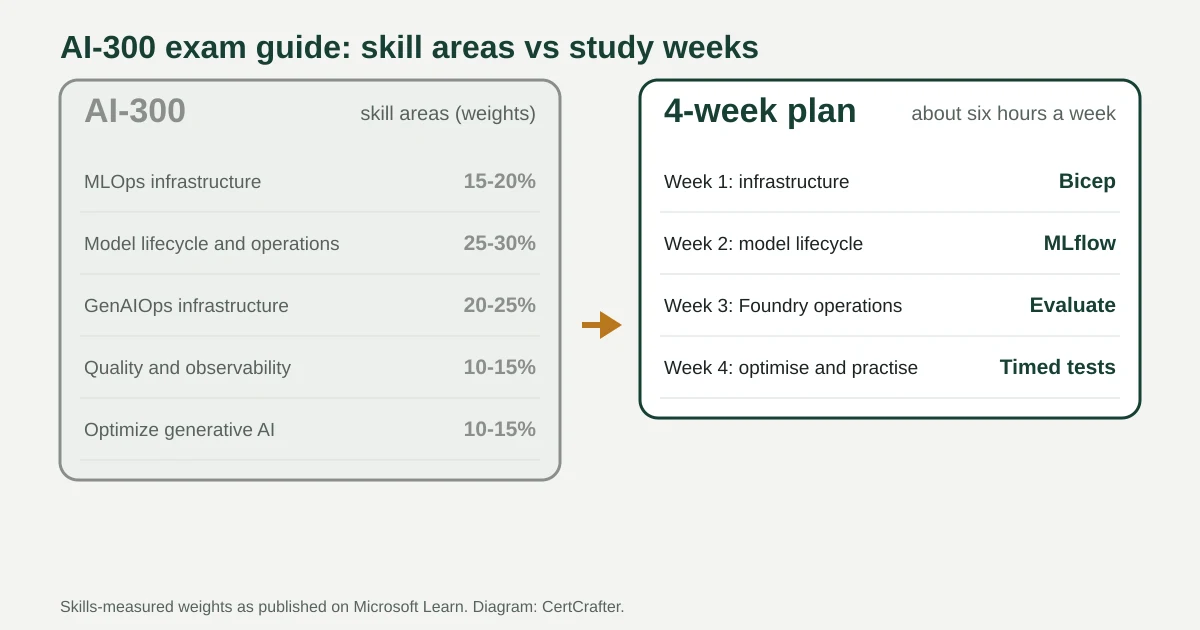
The exam measures five skill areas, and the model lifecycle carries the most weight at 25-30%. The study guide publishes these ranges.
| Skill area | Weight |
|---|---|
| Design and implement an MLOps infrastructure | 15-20% |
| Implement machine learning model lifecycle and operations | 25-30% |
| Design and implement a GenAIOps infrastructure | 20-25% |
| Implement generative AI quality assurance and observability | 10-15% |
| Optimize generative AI systems and model performance | 10-15% |
Classic machine learning operations fill the first two areas, and generative AI operations fill the last three, so neither half can be skipped.
What is in the MLOps infrastructure area?
This area covers workspaces, datastores, compute targets, data assets, environments and components. According to the study guide, it also covers sharing assets through registries.
Infrastructure as code is part of it too. You are expected to deploy workspaces with Bicep and Azure CLI, automate provisioning with GitHub Actions workflows, and restrict network access.
What is in the model lifecycle area?
This is the largest area, covering training orchestration, registration, deployment and monitoring. The study guide lists MLflow experiment tracking, hyperparameter tuning, distributed training and training pipelines.
On the deployment side, it lists real-time and batch endpoints, progressive rollout and safe rollback. Monitoring covers data drift, performance metrics and retraining or alert triggers.
What is in the GenAIOps areas?
Three areas cover generative AI. The infrastructure area covers Foundry resources, managed identities, role-based access control, private networking, model deployment and provisioned throughput units.
The quality area covers evaluation datasets and metrics such as groundedness, relevance, coherence and fluency. The optimisation area covers retrieval-augmented generation tuning, hybrid search, fine-tuning and synthetic data.
Who is AI-300 for, and who is it not for?
AI-300 suits people who already run machine learning or generative AI workloads and want to prove they can operate them on Azure. Microsoft describes the candidate as having a data science background with Python experience.
It is a good fit for:
- machine learning engineers who deploy and monitor models on Azure Machine Learning;
- DevOps or platform engineers who support data science teams and want to learn Foundry;
- data scientists moving from notebooks toward production pipelines.
It is a weaker fit for:
- beginners who want a conceptual overview of AI, who may prefer our guide on how AI-901 replaces AI-900;
- developers focused on application code rather than operations, who may prefer the AI-103 exam changes.
How should you use this AI-300 exam guide? A 4-week plan
Plan around the weights: spend the most hands-on time on the model lifecycle and GenAIOps infrastructure. This plan assumes about six hours a week.
- Week 1: infrastructure. Create a workspace, datastores and a compute cluster. Deploy the same workspace again with Bicep, then trigger it from a GitHub Actions workflow.
- Week 2: the model lifecycle. Run a training job with MLflow tracking, build a pipeline from components, register the model, and deploy it to a managed online endpoint. Practise a rollout and a rollback.
- Week 3: Foundry operations. Create a Foundry project, deploy a model, compare prompt variants and keep prompts in Git. Run a built-in evaluation and read the metrics.
- Week 4: optimisation and timed practice. Tune chunk sizes and similarity thresholds for retrieval. Then sit full timed practice tests and review every miss by skill area.
Mixed, spaced review beats rereading, as our post on studying smarter explains.
Do you need to read code for AI-300?
Yes. The audience profile names Python, command-line interfaces, Bicep and GitHub Actions. Expect to read short snippets and judge what they do rather than write programs from scratch.
The practical habit is to read every script and template you create in the plan aloud. If you cannot explain a line, you cannot answer a question about it.
How is AI-300 delivered?
The exam is proctored and offered through Pearson VUE. Microsoft’s certification page says you have 120 minutes, and that the exam may include interactive components.
It is offered in English only. Price depends on the country or region where the exam is proctored, and Microsoft shows it when you schedule.
If you fail, Microsoft says you can retake the exam 24 hours after a failed attempt. The wait for later retakes varies, so read the retake policy before you plan.
Is AI-300 hard?
It is demanding because it mixes two disciplines. A strong machine learning engineer may be weaker on Foundry, and a strong Foundry developer may be weaker on MLflow, pipelines and endpoints.
Microsoft also notes that most questions cover generally available features, though the exam may include preview features if they are commonly used. Check the study guide’s skills list rather than relying on memory of older exams.
How do you know you are ready to book?
You are ready when you can walk through each skill area without notes and explain why you would choose one option over another. Use Microsoft’s free practice assessment first for the question style.
Then sit at least two full timed AI-300 practice tests and look at your score by skill area, not only the total. If one area trails, spend another week building before you book.
Before you schedule, recheck the AI-300 study guide for the current skills list and any update.
Related reading
Frequently asked questions
What is the AI-300 exam?
AI-300 is Microsoft's Exam AI-300: Operationalizing Machine Learning and Generative AI Solutions. Passing it earns Microsoft Certified: Machine Learning Operations Engineer Associate. It targets people who set up infrastructure for MLOps and GenAIOps on Azure, using Azure Machine Learning and Microsoft Foundry.
How long is the AI-300 exam?
Microsoft's certification page says you have 120 minutes to complete the assessment. The exam is proctored, and it may include interactive components. Microsoft does not publish a question count for AI-300, so practise pacing by skill area rather than by an assumed number of questions.
What is the passing score for AI-300?
A score of 700 or greater is required to pass, according to the AI-300 study guide. Microsoft reports scores on a scaled basis, so 700 is not a fixed percentage of questions answered correctly. Treat practice-test percentages as a study signal rather than a prediction of your result.
Is AI-300 available in languages other than English?
No. The AI-300 certification page lists English as the only language. The study guide adds that if an exam is not available in your preferred language, you can request an additional 30 minutes, but check the current language list on the exam page before you schedule.
Do I need to know Python and DevOps for AI-300?
Yes, at a practical level. Microsoft's audience profile expects a data science background with Python experience, an entry-level understanding of DevOps practices such as GitHub Actions, and comfort with command-line interfaces. Infrastructure as code with Bicep and Azure CLI is also named.
What is the best way to practice for AI-300?
Start with Microsoft's practice assessment on AI Skills Navigator to see the question style. Then build one Azure Machine Learning pipeline and one Foundry project yourself. In the final week, sit full timed mock tests and review every miss by skill area. Timed AI-300 mock tests on Udemy.
Is there a free practice assessment for AI-300?
Yes. Microsoft says the practice assessment is available on AI Skills Navigator, and you must be signed in to launch it. Use it early for the question style, and use the exam sandbox to see the interface before exam day.
References
- Study guide for Exam AI-300: Operationalizing Machine Learning and Generative AI Solutions — Microsoft Learn
- Microsoft Certified: Machine Learning Operations Engineer Associate — Microsoft Learn
CertCrafter is independent and is not affiliated with or endorsed by the certification bodies named above.
- #AI-300
- #Machine Learning Operations Engineer
- #MLOps
- #GenAIOps
- #Microsoft Foundry
- #Practice Test
Get new articles by email
New exam guides, changes to exam dates and fees, and new practice-test certifications. One short email a day at most, only when there is something new.
Was this helpful?
Related articles
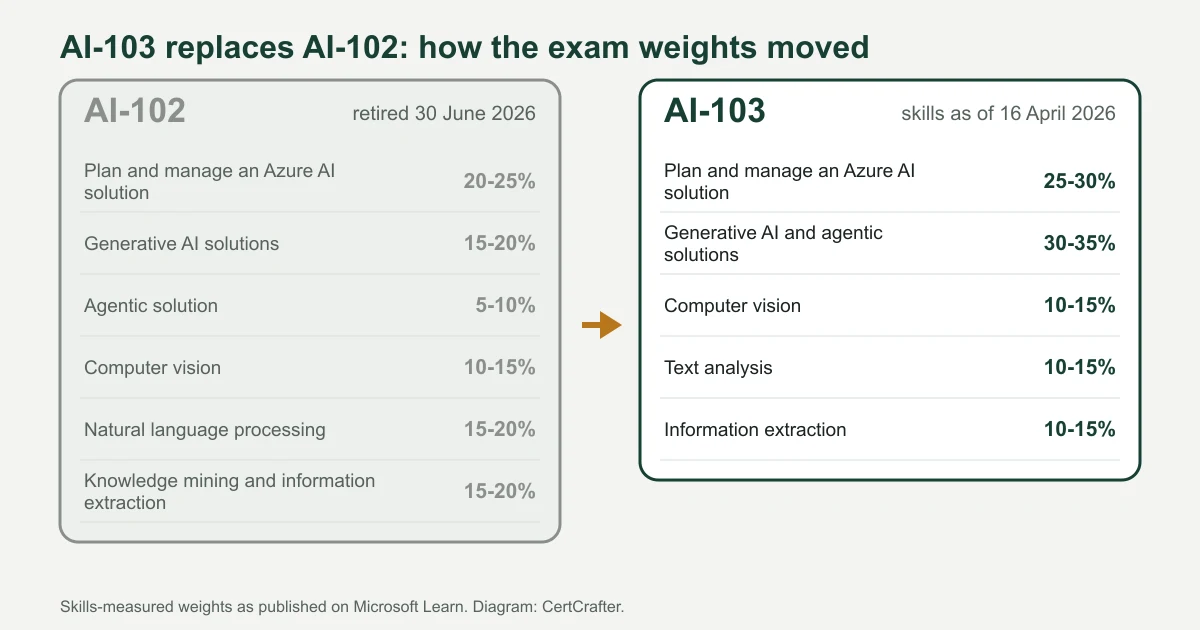
AI-103 Replaces AI-102: What Changed for AI Engineers
AI-102 retired in June 2026 and AI-103 now covers the Azure AI engineer role. Compare the domains, the new agent skills, and a 6-week plan to prepare well.
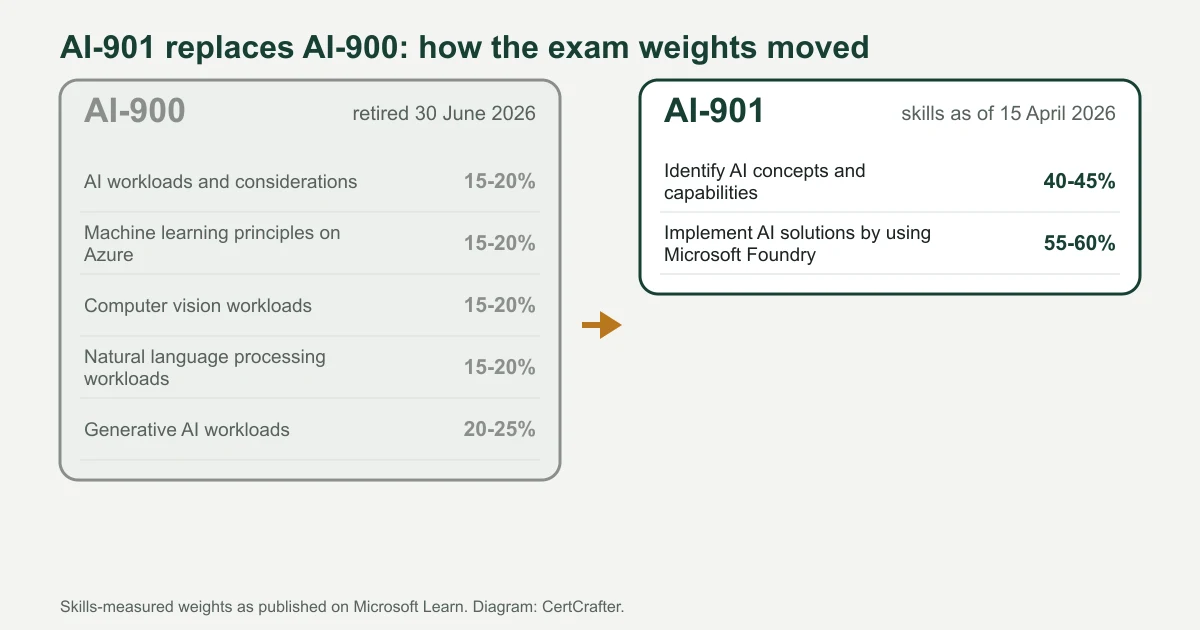
AI-901 Replaces AI-900: What Changed in 2026
AI-901 replaces AI-900 with a Foundry-heavy, Python-aware exam. See the new domains, what was dropped, and a 4-week plan to prepare with confidence.

Are AI and data certifications worth taking in 2026?
AI credentials multiplied faster than the standards behind them. How to tell a rigorous data certification from a badge with a marketing budget.
Comments
Comments are read by a person before they appear. How we moderate.