AI-103 Replaces AI-102: What Changed for AI Engineers
AI-102 retired in June 2026 and AI-103 now covers the Azure AI engineer role. Compare the domains, the new agent skills, and a 6-week plan to prepare well.
Quick answer
In practice, yes. Microsoft retired AI-102 on June 30, 2026, along with the Azure AI Engineer Associate certification. AI-103, Developing AI Apps and Agents on Azure, now covers the Azure AI engineer role and earns a new credential. It centres on Microsoft Foundry, with 30-35% on generative AI and agentic solutions and 120 minutes of exam time.
Disclosure: Links to Udemy in this article are referral links. If you enroll through them, CertCrafter earns a share of the sale at no extra cost to you.
Key facts
- Exam code
- AI-103 source: learn.microsoft.com
- Full name
- Developing AI Apps and Agents on Azure source: learn.microsoft.com
- Certification
- Microsoft Certified: Azure AI Apps and Agents Developer Associate source: learn.microsoft.com
- Questions
- Not published for AI-103; Microsoft says most of its exams have 40-60 questions source: learn.microsoft.com
- Duration
- 120 minutes source: learn.microsoft.com
- Passing score
- 700 source: learn.microsoft.com
- Cost
- Set by the country or region where you take the exam; shown when you schedule source: learn.microsoft.com
- Delivery
- Proctored through Pearson VUE, in 10 languages; may include interactive components source: learn.microsoft.com
- Validity
- Associate certifications expire annually; renew with a free online assessment source: learn.microsoft.com
Last reviewed: · Exam facts verified against: learn.microsoft.com
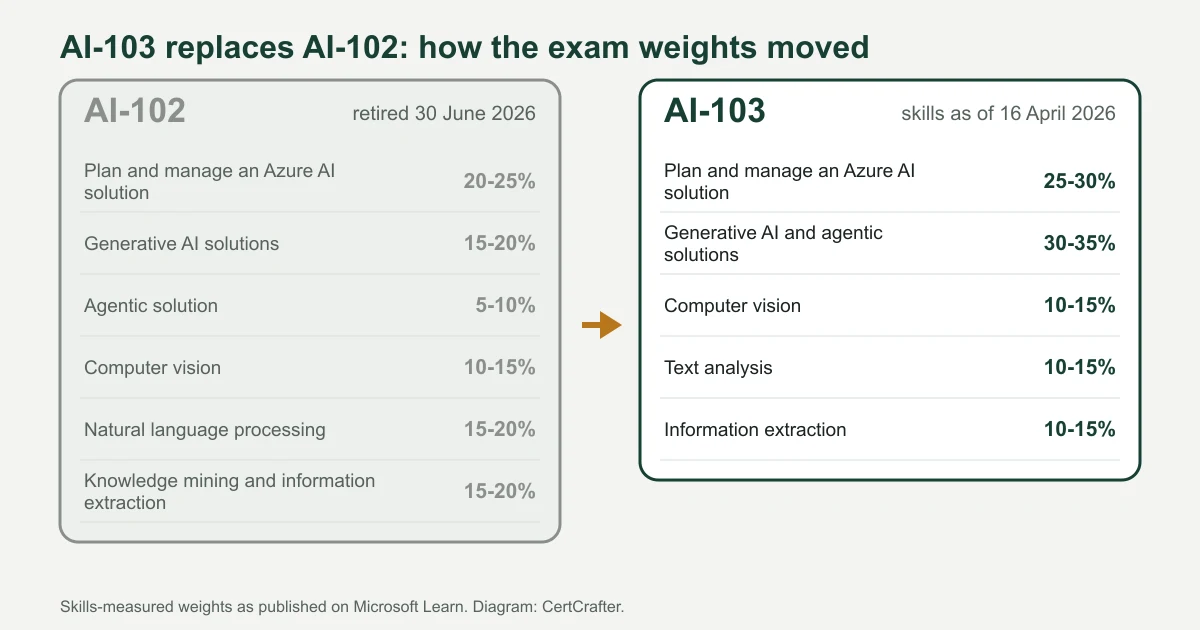
AI-103 replaces AI-102 as the Microsoft exam for Azure AI engineers, and it is a rewrite, not a refresh. According to Microsoft Learn, AI-102 retired on June 30, 2026, and the AI-103 skills outline is dated April 16, 2026.
AI-103 is called Developing AI Apps and Agents on Azure. It earns a new credential, Microsoft Certified: Azure AI Apps and Agents Developer Associate. This guide compares the two outlines and shows where your study time should go.
Does AI-103 replace AI-102?
For the job it measures, yes. Microsoft retired AI-102 and the Azure AI Engineer Associate certification on June 30, 2026, and AI-103 now describes its candidate as “an Azure AI engineer who builds, manages, and deploys agents and AI solutions”.
The credential is different, though. Passing AI-103 earns the Azure AI Apps and Agents Developer Associate, not the old Azure AI Engineer Associate.
That matters on a CV. If you hold the old certification, keep it, and name the new one separately once you pass AI-103.
What changed between AI-102 and AI-103?
The outline moved from six domains to five, and agents moved from a side topic to the centre. In AI-102, agentic work was a separate 5-10% domain. In AI-103 it shares a 30-35% domain with generative AI.
Microsoft Foundry is Microsoft’s Azure platform for deploying models and building AI apps and agents. Both outlines use it, but AI-103 builds almost every objective around it.
| AI-102 (retired June 30, 2026) | Weight | AI-103 (skills as of April 16, 2026) | Weight |
|---|---|---|---|
| Plan and manage an Azure AI solution | 20-25% | Plan and manage an Azure AI solution | 25-30% |
| Implement generative AI solutions | 15-20% | Implement generative AI and agentic solutions | 30-35% |
| Implement an agentic solution | 5-10% | (merged into the domain above) | |
| Implement computer vision solutions | 10-15% | Implement computer vision solutions | 10-15% |
| Implement natural language processing solutions | 15-20% | Implement text analysis solutions | 10-15% |
| Implement knowledge mining and information extraction solutions | 15-20% | Implement information extraction solutions | 10-15% |
Planning and managing grew to 25-30%. It now includes monitoring drift and grounding quality, managing quotas and cost, and security through managed identity, private networking and keyless credentials.
Which AI-102 topics are not in the AI-103 outline?
Several build-and-train tasks from AI-102 do not appear in the AI-103 skills list. These include training and publishing custom vision models, creating intents and utterances for language understanding, and building custom question answering knowledge bases.
Custom Document Intelligence models, Speech Synthesis Markup Language, Azure AI Video Indexer, prompt flow and fine-tuning a generative model are also absent. Microsoft notes that related topics may still appear, so treat this as a shift in emphasis.
What is new in AI-103?
The new material is agents, multimodal generation and operations. According to the AI-103 study guide, candidates should be able to:
- build agents that integrate retrieval, function calling and conversation memory;
- implement orchestrated multi-agent solutions with safeguards and approval flow controls;
- generate and edit images and videos from prompts, including inpainting and mask-based edits;
- detect and mitigate indirect prompt injection carried by text embedded in images;
- set up tracing, token analytics, safety signals and latency breakdowns;
- integrate Foundry projects with CI/CD pipelines.
Retrieval-augmented generation (RAG) means grounding a model’s answer in documents you retrieve at query time, usually from a search index. AI-103 tests it in both the generative domain and the information extraction domain.
How long is the AI-103 exam, and how many questions does it have?
Microsoft gives AI-103 120 minutes. The retired AI-102 had 100 minutes, so the sitting is longer.
Microsoft does not publish a question count for AI-103. Its exam-experience page says most exams have 40-60 questions and that associate exams which may contain labs run 120 minutes, with 140 minutes of seat time.
A score of 700 or greater is required to pass. You can retake 24 hours after a first failed attempt, and later retakes have longer waits. Practise the pacing with timed AI-103 practice tests before the day.
Which skills carry the most weight on AI-103?
Generative AI and agentic solutions carry the most, at 30-35%. Together with planning and managing at 25-30%, those two domains make up more than half of the exam.
Vision, text analysis and information extraction share the rest at 10-15% each. Do not skip them: content safety for images and Content Understanding pipelines appear there, and they are easy points if you have built one.
Who is AI-103 for, and who is it not for?
AI-103 is for developers who build AI features with Python on Azure. Microsoft’s profile asks for experience developing apps by using Python and familiarity with generative AI and Azure services.
It suits:
- AI-102 holders who need a current, renewable associate credential;
- application developers moving into agent and RAG work on Microsoft Foundry;
- engineers responsible for monitoring, securing and costing AI workloads in production.
It is a weaker fit for:
- beginners with no Python, who should start with AI-901 (see how AI-901 replaces AI-900);
- back-end developers whose work is containers, databases and messaging rather than models, for whom AI-200 maps more closely.
How should you study for AI-103? A 6-week plan
Study in the order of the weights, and build each piece once in Foundry before you practise questions on it. The plan assumes six to eight hours a week.
- Week 1: plan and secure. Choose models and services for sample scenarios, configure a deployment, and set up managed identity and keyless access.
- Week 2: generative apps and RAG. Build a grounded chat app over an Azure AI Search index with vector and hybrid search, then evaluate it for relevance and fabrications.
- Week 3: agents. Build an agent with tools and memory, add a second agent with orchestration, and add an approval step before a risky action.
- Week 4: operate. Add tracing and token analytics, configure guardrails and content filters, and wire the project into a CI/CD pipeline.
- Week 5: vision, text and extraction. Run image generation and editing, multimodal question answering, speech as an agent modality, and Content Understanding analyzers.
- Week 6: timed practice. Sit full timed tests with a case study, review every miss by domain, and rebuild the weakest task.
The method behind this order is explained in our post on what blueprint-aligned practice tests actually mean.
What happens to your Azure AI Engineer Associate certification?
It stays on your Microsoft Learn transcript but can no longer be renewed. Microsoft’s certification page states that the certification and the renewal assessment are retired.
Microsoft associate certifications normally expire annually and are renewed through a free online assessment. With the renewal assessment gone, AI-103 is the path to a current associate credential in this area.
Should you take AI-103 or wait for the outline to settle?
Take it when you are ready rather than waiting. The current AI-103 study guide lists skills measured as of April 16, 2026, and Microsoft updates English exams first and localised versions about eight weeks later.
Before you book, check the AI-103 study guide for a newer skills date. If you sit in another language, allow for that eight-week lag.
Related reading
Frequently asked questions
Can I still take AI-102?
No. Microsoft retired AI-102 on June 30, 2026, at 11:59 PM Central Standard Time, and retired exams cannot be booked. The Azure AI engineer role is now covered by AI-103, Developing AI Apps and Agents on Azure, which earns the Microsoft Certified: Azure AI Apps and Agents Developer Associate credential.
Does my Azure AI Engineer Associate certification still count?
It stays on your Microsoft Learn transcript, because Microsoft keeps earned certifications there after retirement. The certification and its renewal assessment are retired, though, so it can no longer be renewed. If you need a current associate credential for Azure AI work, AI-103 is the exam that earns one.
How long is the AI-103 exam?
Microsoft lists 120 minutes for AI-103 on its certification page. That matches Microsoft's timing for associate exams that may contain labs or interactive components. The retired AI-102 had 100 minutes, so plan for a longer sitting and practise pacing across long scenario questions and a case study.
Which programming language does AI-103 use?
Python. The AI-103 audience profile asks for experience developing apps by using Python. AI-102 listed Python and C# as example languages. Expect to read Python that calls Foundry SDKs, plus REST requests and configuration such as JSON definitions, rather than C# samples.
Is AI-103 harder than AI-102?
It covers more ground in agents and operations. Generative AI and agentic solutions now carry 30-35% of the exam, against a combined 20-30% across two domains in AI-102. Monitoring, tracing, guardrails and CI/CD also sit inside the 25-30% planning domain, so expect more design judgement questions.
What is the best way to practice for AI-103?
Build each objective once in Microsoft Foundry, then practise under time. Long scenario stems and a case study reward pacing, so sit full timed mock tests and review every miss by domain. Use Microsoft Learn sparingly during practice, because the exam clock keeps running while you search. Timed AI-103 mock tests with case studies.
Can I use Microsoft Learn during AI-103?
Yes. Microsoft allows access to Microsoft Learn during associate and expert role-based exams, in a split screen next to the question. The exam clock keeps running, and Microsoft warns that looking up every answer will run you out of time, so use it only for specific details.
References
- Study guide for Exam AI-103: Developing AI Apps and Agents on Azure — Microsoft Learn
- Microsoft Certified: Azure AI Apps and Agents Developer Associate — Microsoft Learn
- Study guide for Exam AI-102 (retired) — Microsoft Learn
- Exam and assessment lab retirement — Microsoft Learn
CertCrafter is independent and is not affiliated with or endorsed by the certification bodies named above.
- #AI-103
- #Microsoft Foundry
- #Azure AI
- #AI Agents
- #RAG
- #Practice Test
Get new articles by email
New exam guides, changes to exam dates and fees, and new practice-test certifications. One short email a day at most, only when there is something new.
Was this helpful?
Related articles
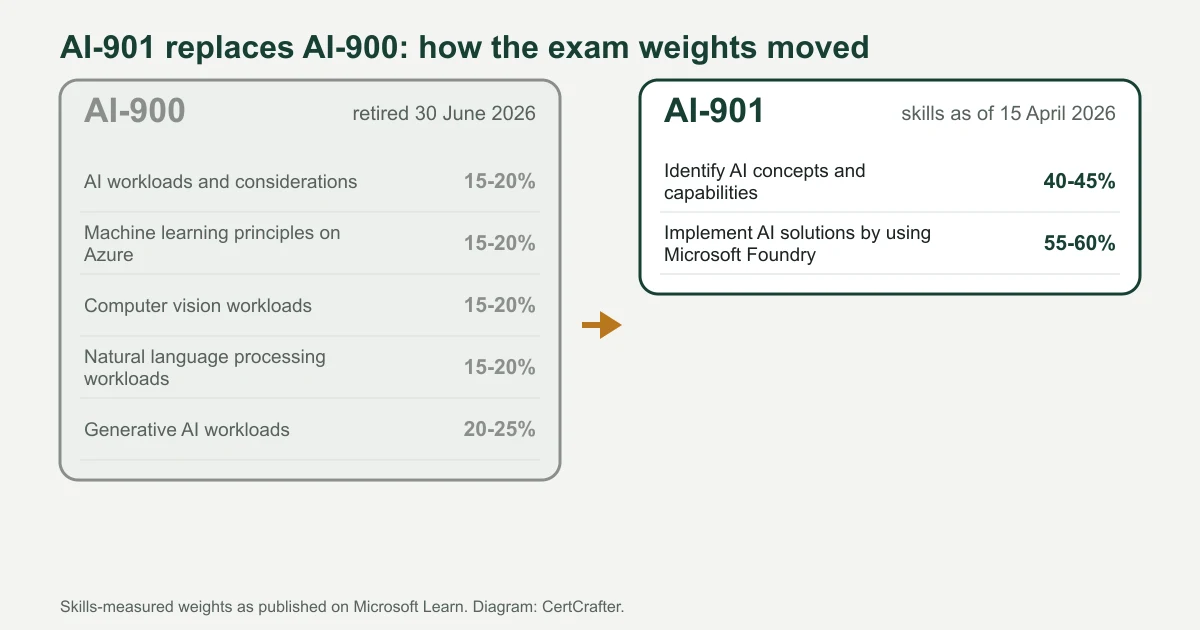
AI-901 Replaces AI-900: What Changed in 2026
AI-901 replaces AI-900 with a Foundry-heavy, Python-aware exam. See the new domains, what was dropped, and a 4-week plan to prepare with confidence.
Are AI and data certifications worth taking in 2026?
AI credentials multiplied faster than the standards behind them. How to tell a rigorous data certification from a badge with a marketing budget.
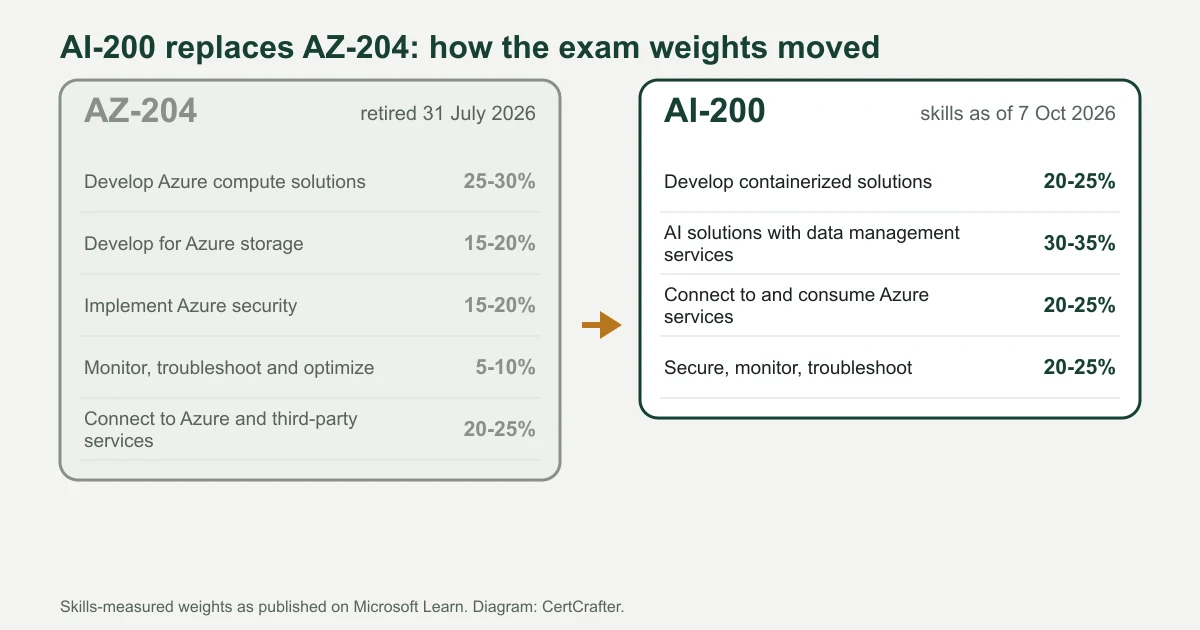
AI-200 Replaces AZ-204: What Changed in 2026
AZ-204 retired in July 2026 and AI-200 now tests Azure back ends for AI apps. Compare the domains, what was dropped, and get a 6-week plan to prepare well.
Comments
Comments are read by a person before they appear. How we moderate.