Most CWI candidates know the bend test exists. Fewer can turn a plunger size and a thickness into a strain number in under a minute.

Why start with a calculation on a CWI exam?
Because Part A has room for them. AWS describes the Fundamentals exam as 150 questions on Destructive Testing, Fabrication Math, Safety, Metallurgy, Nondestructive Testing, Welding Symbols, WPS/PQR and Welding Fundamentals. Fabrication Math sits right next to Destructive Testing on that list, and a bend test question is where the two meet.
Candidates must reach 72% on each part, so a handful of dropped calculation questions in Part A is not a rounding error. Each one is a mark you can win with a method instead of a memory.
What does a guided bend test actually measure?
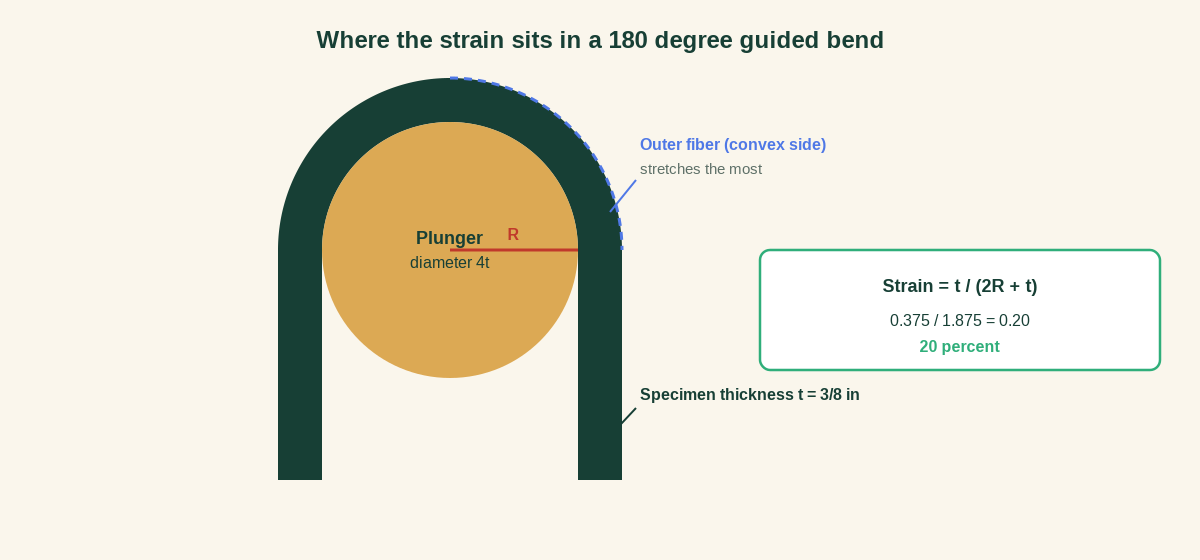
Bending a specimen around a plunger stretches the outside of the bend and compresses the inside. The outer fiber on the convex side takes the most strain. If the weld or the heat-affected zone has a flaw or poor ductility, that surface is where it opens.
In the shop, this is why the plunger size is tied to the material. A smaller plunger gives a tighter bend and more strain on the outer surface. A more ductile material gets a smaller plunger than a less ductile one, because it can stand the strain. Inspectors who read a bend test report should know what strain the specimen saw, not only whether it passed.
The relation for the outer fiber strain of a bend, with the neutral axis at mid-thickness, is:
strain = t / (2R + t)
Here t is the specimen thickness and R is the inside radius, which is the plunger radius. That is the only formula this post needs.
Worked example: a 3/8 in face bend around a 4t plunger
This is a free sample question from the CertCrafter CWI kit. A 3/8 in thick transverse face bend specimen is wrapped right around a plunger whose diameter is 4t. Taking the neutral axis at mid-thickness, approximately what strain does the outer fiber of the convex surface reach? The options are 25%, 20%, 50% and 40%.
Work it in three steps.
- Find the plunger diameter. It is 4t, so
4 x 0.375 = 1.5 in. - Halve it for the radius.
R = 0.75 in. - Put the numbers in.
0.375 / (2 x 0.75 + 0.375) = 0.375 / 1.875 = 0.20, which is 20%.
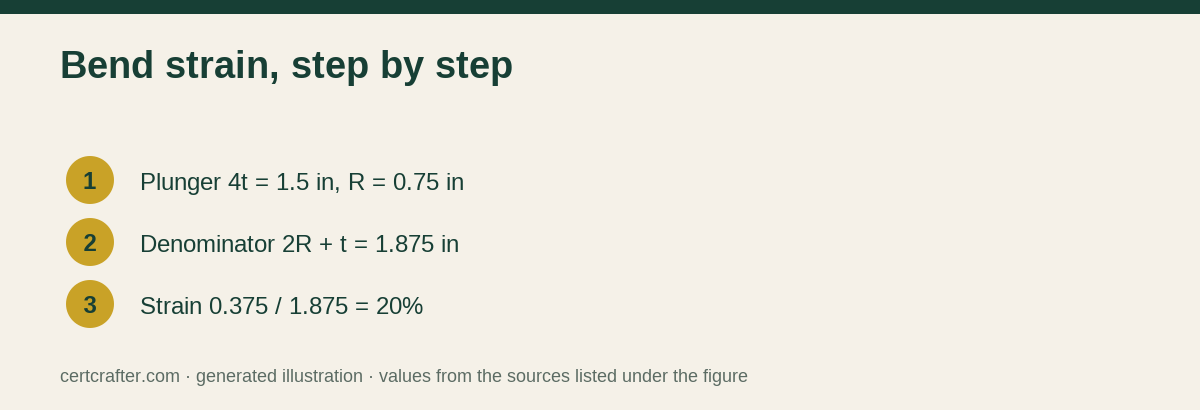
The answer is 20%.
Why is each wrong option wrong?
Every distractor on this question comes from one slip in the same three steps. If you can name the slip, you can spot it on exam day.
- 25% divides
tby the plunger diameter,0.375 / 1.5. It leaves the thickness out of the denominator. - 50% divides
tby the radius alone,0.375 / 0.75. It uses R where 2R plus t belongs. - 40% uses
t / (R + t/2), which gives0.375 / 0.9375. That doubles the true strain.
Notice that none of these is a random number. Question writers build wrong options out of the mistakes a rushed candidate makes, so a number that looks right on the first pass is often the one to double check.

How do inspectors use a number like this on the job?
Mostly as a sanity check. A report that says a specimen was bent around a plunger gives you enough to estimate the strain in seconds, and that tells you how hard the test was. Two procedures that both passed bends are not equally proven if one used a much larger plunger.
Field habits worth building:
- Read the plunger size and the specimen thickness off the record, not from memory.
- Carry units through every step. A radius in millimeters over a thickness in inches gives a confident wrong figure.
- Write the formula before you put numbers in it, so a second reviewer can follow your line.
Look up the acceptance rules in the code you are inspecting to, since they set the plunger size and what counts as a rejectable opening. The strain number explains the test. It does not replace the code.
Where do candidates lose marks on questions like this?
Three places, again and again.
The first is the formula. Candidates recall that strain involves thickness and radius, and then assemble the wrong ratio. Writing t / (2R + t) on the scratch sheet at the start of the question costs five seconds and removes the guess.
The second is the diameter-radius swap. A stem that gives a plunger diameter wants a radius in the formula, so halve first. The plunger here was given as 4t, which is a diameter, and using the diameter as R gives a strain far too small. It matches none of the options, a useful alarm.
The third is time. The Part A exam gives you a fixed number of questions and a clock, so a calculation you cannot set up in a minute should be marked and revisited, not forced. Mark it, move on, return with the time you saved.
The CWI Complete Exam Kit works more calculations like this under timed conditions, with every answer explained.
What should you do next?
Redo the question with a different plunger. Change 4t to 3t and recompute the strain, then predict before you calculate whether it goes up or down. Then try the other free sample questions to see how Part A frames its distractors.
Parts B and C are different skills: AWS describes Part B as hands-on work with equipment it provides, and Part C as an open-book test of locating information in the code book you choose. The same habit helps in both, which is to write down what you are looking for before you look.
The product page is at AWS CWI Parts A, B and C Complete Exam Kit.
The free sample is the CWI practice questions page.
More guides are in the CWI hub.
Comments
Comments are read by a person before they appear. How we moderate.