Replace a Margins Spreadsheet With 20 Lines of Tested Python
A margins workbook rewritten as about 20 lines of Python with a test that proves it. Python for Aerospace Stress Engineers is free on Kindle.
In short
- A margins spreadsheet hides its formulas in cells; a short Python script puts them in one place where they can be read, reviewed and tested.
- One test that reproduces a hand-checked margin turns the script from a convenience into something a checker can trust.
- Python for Aerospace Stress Engineers is free on Kindle for a short time during the promotion, and its bonus files include the code.
Less than two of the free Kindle days are left, so if a margins spreadsheet has ever surprised you, today is a good day to read this one. Below is a typical workbook rewritten as about 20 lines of Python, with the test that proves it.
The spreadsheet problem
Most stress offices have one: a workbook that takes loads from one tab, applies the factors in another, divides by allowables pulled from a third and colours the negative margins red. It works until someone sorts a column without its neighbours, pastes over a formula, or copies a row from an old revision. None of those leave a trace, and the reviewer only sees the numbers.
The same thing in Python
Here is the core of that workbook. It reads a CSV of cases, each with a name, a limit load and an allowable, and reports the critical one.
import csv

ULTIMATE = 1.5   # 14 CFR 25.303
FITTING = 1.15   # 14 CFR 25.625

def margin(allowable, limit, fitting=FITTING):
    design = limit * ULTIMATE * fitting
    return allowable / design - 1.0

def critical_case(path):
    with open(path, newline="") as f:
        rows = list(csv.DictReader(f))
    results = [(r["case"], margin(float(r["allowable"]), float(r["limit"])))
               for r in rows]
    return min(results, key=lambda r: r[1])

def test_margin_matches_hand_check():
    assert round(margin(18562.5, 8000.0), 2) == 0.35

if __name__ == "__main__":
    name, ms = critical_case("cases.csv")
    print(f"Critical case {name}: MS = {ms:+.2f}")
Every formula is on one screen. The factors have names and references instead of living in a cell somewhere. And the last function is a test: it repeats the fitting margin worked by hand in Volume 1 of the stress books, 18,562.5 lb against a limit load of 8,000 lb, and fails loudly if anyone ever changes the method so that number stops coming out at +0.35.
Why the test matters
Run it with pytest and it either passes or tells you exactly what broke. That is the step most spreadsheets never get. A checker can read the method, see the hand check it reproduces, and rerun it on the next revision of the loads in seconds. The book builds from this kind of script to load cases, section properties, buckling and joint checks, plots, and a small reporting tool, always with tests beside the code.
What a reviewer gets from it
A spreadsheet review usually means clicking cell by cell to see which formula feeds which, and hoping nothing was overwritten. With a script the reviewer reads the method once, from top to bottom, in the order it runs. The change history lives in version control, so the question of which revision produced a margin has an answer. And because the input is a plain CSV, the loads team can hand over a new file and the margins are rerun without anyone retyping a number.
None of this needs a software background. The listing above uses only the standard library: no installs, no frameworks, nothing your IT department needs to approve.
How to use the free copy this week
Pick one small workbook you own and rewrite only its core formula first, with one test against a number you already trust. Do not try to replace the whole thing. Once that test passes, the rest of the workbook is just more rows. The early chapters of the book walk through exactly this first step, from reading a CSV to writing the first test, with stress examples rather than generic ones.
All four books in the promotion
-
 GD&T Professional Exam Guide Get it free on Kindle Kindle ebook on Amazon
-
 Practical Airframe Stress Analysis, Vol. 1 Get it free on Kindle Kindle ebook on Amazon
-
 Practical Airframe Stress Analysis, Vol. 2 Get it free on Kindle Kindle ebook on Amazon
-
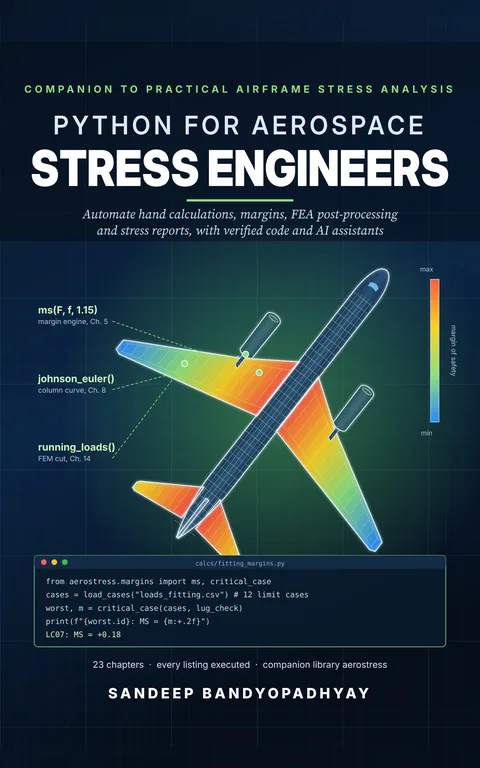 Python for Aerospace Stress Engineers Get it free on Kindle Kindle ebook on Amazon
Read more
The book’s card and paperback are on the books page, and readers’ code, data files and notebooks are in the bonus materials. All the posts of this promotion are on the announcements page.
Frequently asked questions
Do I need to know Python already?
No. The book starts from the basics and builds up with stress problems, so the first chapters are for engineers who have never written a script.
Is the Kindle ebook really free?
Yes, while the promotion runs, in every Amazon store that sells Kindle ebooks. It then returns to its paid price; the paperback keeps its normal price.
Where is the code from the book?
Readers get the scripts, data files and notebooks as bonus materials, linked from the book's short page.
- #Python
- #stress analysis
- #automation
- #testing
- #Kindle
Get new articles by email
New exam guides, changes to exam dates and fees, and new practice-test certifications. One short email a day at most, only when there is something new.
Was this helpful?
Related articles
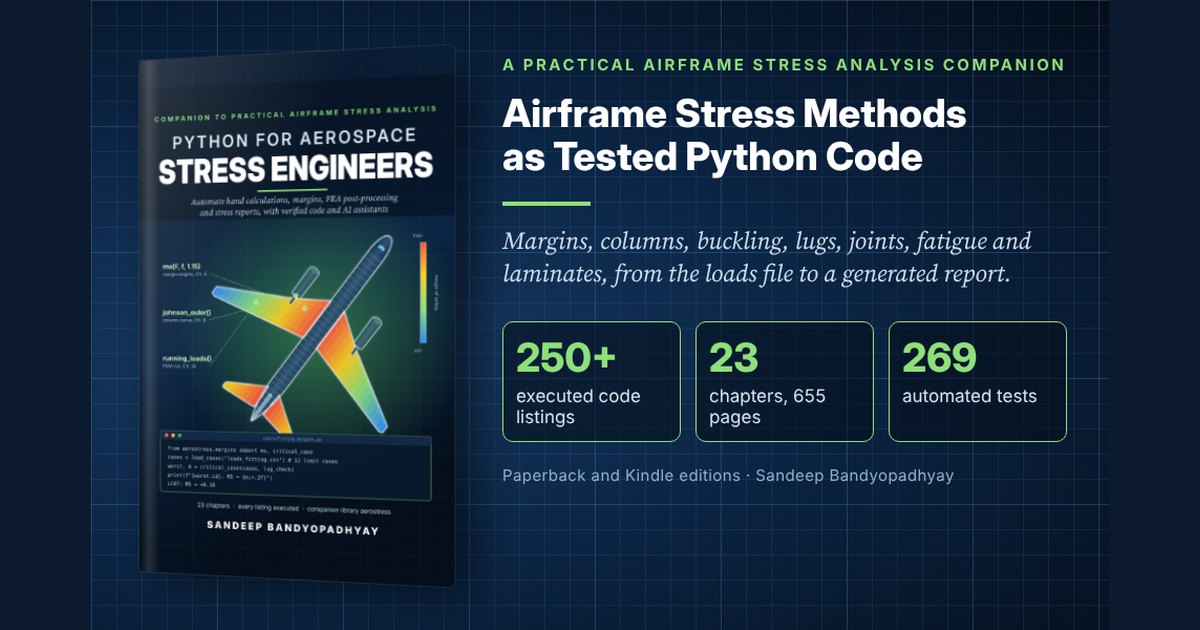
Python for Aerospace Stress Engineers: Free Kindle Promotion
Turn spreadsheet hand calculations into tested Python: Python for Aerospace Stress Engineers is free on Kindle for five days, companion code included.
A Margin of Safety Worked Like a Checker Would Want It
One tension fitting, the Part 25 factors applied in the right order, and the margin a checker accepts. Airframe Stress Analysis Vol. 1 is free on Kindle.
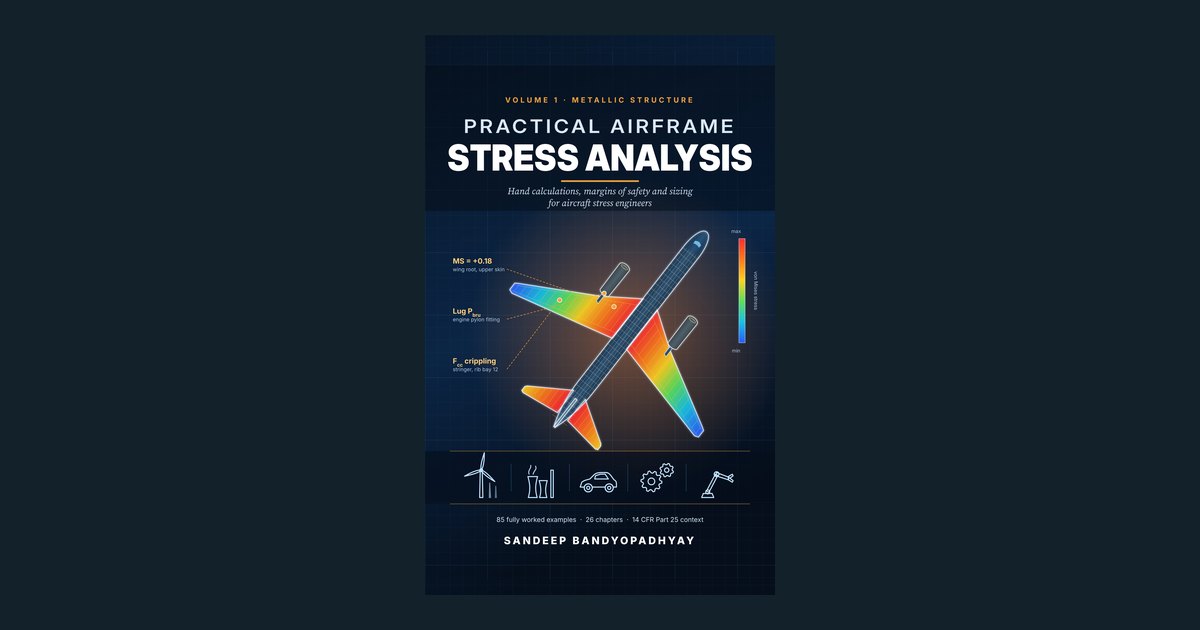
Airframe Stress Analysis Vol. 1: Free Kindle Promotion
Practical Airframe Stress Analysis, Volume 1 is free on Kindle for five days: metallic structure by hand calculation, 26 chapters and 85 worked examples.
Comments
Comments are read by a person before they appear. How we moderate.