API 510, 570 or 653: which should you take first?
Three API inspection certifications, one exam format, three completely different reference lists. How to choose, and why the overlap is smaller than it looks.

In short
- All three exams share one format: 170 questions, 110 closed-book in 2 h 45 min, a 45-minute break, then 60 open-book in 3 h 45 min.
- All three pass at a scaled 400 on a 200-500 scale. API publishes no percentage equivalent for any of them.
- The reference lists barely overlap. API 653's construction standard is API 650, and ASME Section VIII is not a referenced publication for it at all.
- API 653 runs March, July and November, a different calendar from API 510's September, January and May windows.
- The most recent pass rate API has published for API 653 is 60.8%, from 503 candidates in November 2025.
Many candidates pick between API 510, 570 and 653 believing they are “basically the same exam with different codes”, and that belief costs people a sitting. The format claim is true; the rest of it is not.
Do API 510, 570 and 653 use the same exam format?
Yes, and this is the part that genuinely transfers. Each exam is 170 questions, of which 140 are scored and 30 are unscored pretest items that are not identified while you sit it. The sitting splits into 110 closed-book questions in 2 hours 45 minutes, a 45-minute break, then 60 open-book questions in 3 hours 45 minutes. Each is delivered in person at Prometric, with references supplied as on-screen PDFs rather than your own tabbed copies. Each passes at a scaled score of 400 on a 200-500 scale.
If you have sat one, you know how the day works. That is worth something, the rhythm of a two-session exam catches people out the first time, and it is the one thing you never have to learn twice.
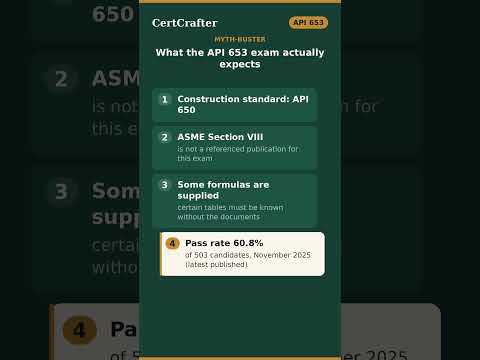 API 653 — Myth: API 653 is only for crude oil storage. Watch on YouTube · CertCrafter
How much do the reference lists actually overlap?
Much less than the shared format implies, and this is where the “same exam” story falls apart.
API 653’s construction standard is API 650. ASME Section VIII is not a referenced publication for API 653 at all. That single fact removes the entire pressure-vessel calculation spine that dominates an API 510 bank. A candidate who prepares for 653 by reworking their 510 material is studying for a different exam.
The direction of travel matters too: the March 2027 effectivity sheet moves API 650 to its 14th Edition and ASME BPVC Sections V and IX to their 2025 editions. The November 2026 window is the last one on the older March 2026 sheet, which still uses API 650 13th Edition and ASME BPVC 2023. Two candidates sitting four months apart can be examined on different editions of the same standard.
| API 510 | API 570 | API 653 | |
|---|---|---|---|
| Equipment | Pressure vessels | In-service piping | Aboveground storage tanks |
| Construction standard | ASME Section VIII | ASME B31.3 | API 650 |
| Format | 170 questions, two sittings | 170 questions, two sittings | 170 questions, two sittings |
| Pass standard | Scaled 400 (200-500) | Scaled 400 (200-500) | Scaled 400 (200-500) |
| Recent windows | September, January, May | , | March, July, November |
Which one should you take first?
The honest answer is the one covering the equipment you actually inspect, because that is where your existing judgement counts for most and where the certification is worth most to your employer.
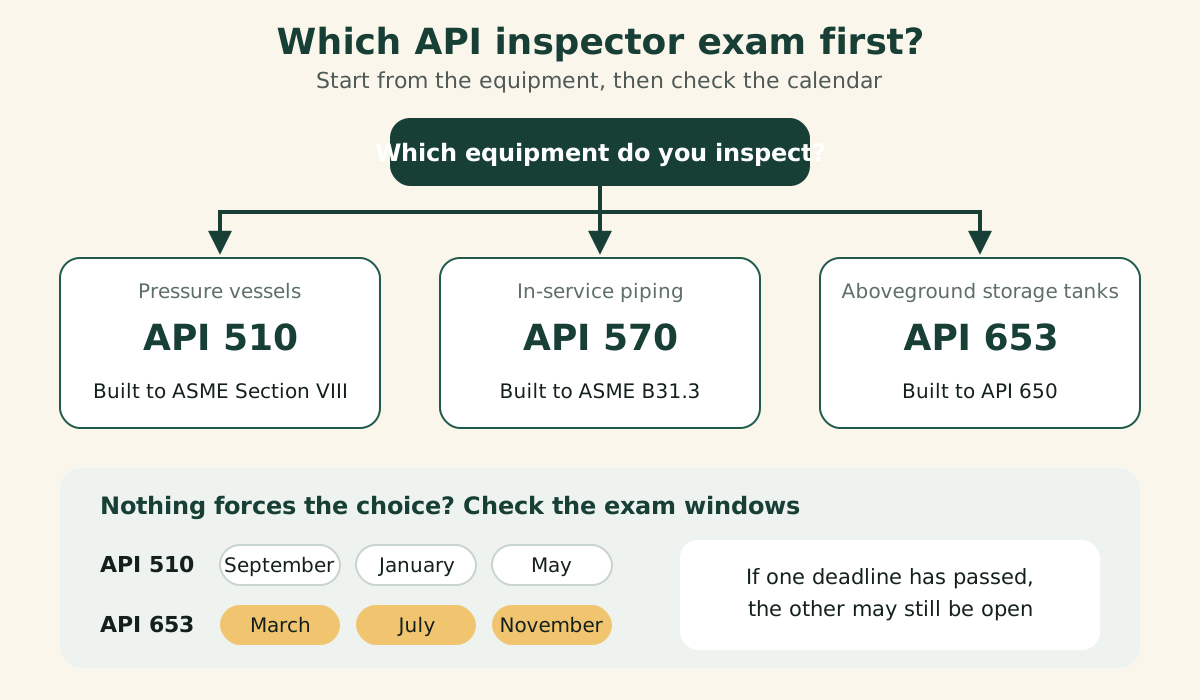
If nothing forces the choice, note the calendar. API 653 windows run March, July and November with deadlines roughly two months earlier, on a different cycle from API 510’s recent September, January and May windows. If a deadline has already passed for one, the other may still be open, and a certification you sit this year beats a better-matched one you sit next year.
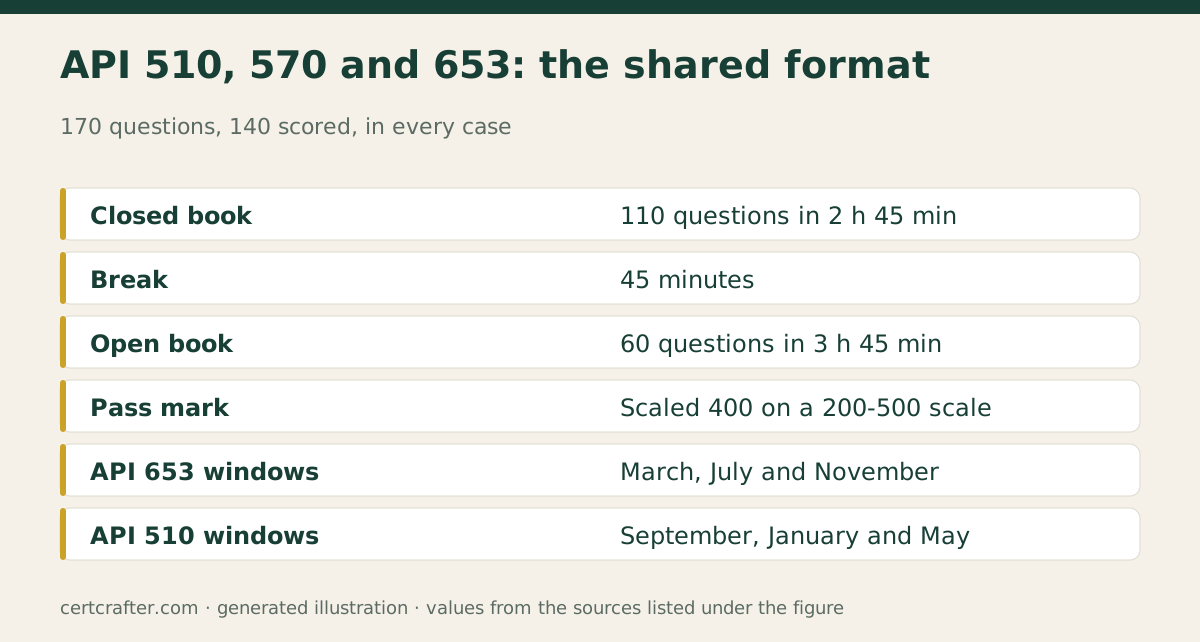
What does the published pass rate tell you?
For API 653, API’s April 2026 ICP status update gives the most recent published rate as the November 2025 administration: 503 candidates at 60.8%.
Resist doing anything with that number beyond noting it. It is one administration of one exam. Without equivalent published figures for 510 and 570 from comparable windows, it supports no ranking of difficulty, and a 60.8% pass rate says as much about who chose to sit that window as about the paper.
What actually transfers between them?
Three things, in descending order of usefulness:
- The exam-day mechanics. Two sittings, a fixed break, no returning to the closed-book section once submitted, unanswered questions scored as incorrect, references on screen only during the open half.
- Reading the effectivity sheet. The skill of checking which editions apply to your window, rather than to the window someone described in a forum post two years ago.
- Nondestructive examination. All three include an NDE domain, and the physics does not change when the equipment does.
What does not transfer is the calculation work, the acceptance criteria, and the reference documents themselves. Budget your time accordingly. Each Complete Exam Kit is written to its own effectivity sheet: the API 510 kit, the API 570 kit and the API 653 kit each run full timed exams with every answer explained.
Start with the free sample
Each of these has a ten-question free sample drawn from the real bank, enough to tell you whether the level is what you expected before you spend anything.
Frequently asked questions
Which API inspection certification is easiest?
API publishes no comparative difficulty data, and the only pass rate here, 60.8% for API 653 in November 2025, cannot be compared against the others without equivalent figures. Choose on the equipment you actually inspect, not on a rumoured difficulty ranking.
Do API 510, 570 and 653 use the same exam format?
Yes. Each is 170 questions, of which 140 are scored and 30 are unscored pretest items. The sitting splits into 110 closed-book questions in 2 hours 45 minutes, a 45-minute break, then 60 open-book questions in 3 hours 45 minutes. Each passes at a scaled 400 on a 200-500 scale.
How much does API 510 overlap with API 653?
Less than the shared format suggests. API 653's construction standard is API 650, not ASME Section VIII, and Section VIII is not a referenced publication for API 653 at all. The whole pressure-vessel calculation spine of a 510 bank is out of scope for 653.
Can I prepare for two API exams at once?
The exam mechanics transfer completely, the timing, the two sittings, the scaled score, the on-screen references. The technical content transfers much less. Treat the format as shared and the reference material as separate.
When are the API 653 exam windows?
March, July and November, with application deadlines roughly two months earlier. That is a different calendar from API 510, whose recent windows have run in September, January and May.
References
- API Individual Certification Programs — American Petroleum Institute
- API ICP Publication Effectivity Sheets — American Petroleum Institute
CertCrafter is independent and is not affiliated with or endorsed by the certification bodies named above.
- #API 510
- #API 570
- #API 653
- #inspection
- #certification
Practise what this article covers
Get new articles by email
New exam guides, changes to exam dates and fees, and new practice-test certifications. One short email a day at most, only when there is something new.
Was this helpful?
Related articles
The API open-book session: what you can look up
Sixty questions, 3 h 45 min, references on screen only. What the open half of an API inspection exam actually asks, and why it is not the easy half.
The API 510 exam structure, explained properly
170 questions, two sessions, a scaled pass mark and a reference set that changes. What the API 510 exam actually asks of you.
GD&T Professional Exam Guide: the ASME Y14.5-2018 GDTP book
A study guide for the ASME GDTP exam on Y14.5-2018: 21 chapters, an original drawing per rule and two 150-question practice exams. On Amazon worldwide.
Comments
Comments are read by a person before they appear. How we moderate.