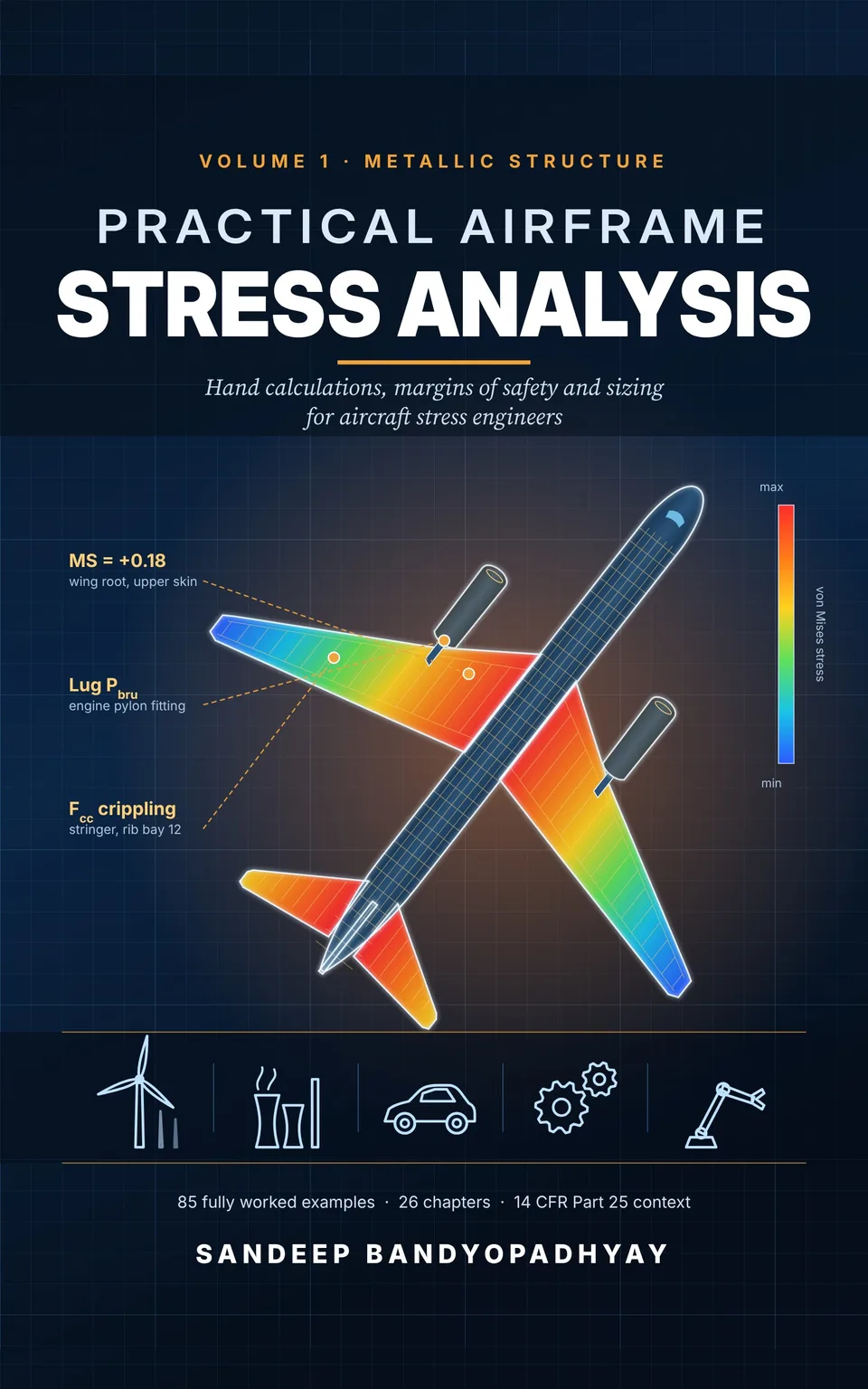
Practical Airframe Stress Analysis, Volume 1: Metallic Structure
A desk handbook for aircraft stress engineers: hand calculations, margins of safety and sizing of metallic airframe structure, 85 worked examples.
New: paperback and kindle on Amazon
Practical Airframe Stress Analysis, Volume 1Metallic Structure. Hand Calculations, Margins of Safety and Sizing for Aircraft Stress Engineers
by Sandeep Bandyopadhyay
- 26 chapters and 85 fully worked examples, each checked numerically
- Margins of safety and the 14 CFR Part 25 factors, and how not to stack them
- Buckling, crippling, stiffened panels, diagonal tension webs and cutouts
- Lugs, fastened joints, fittings, fatigue and damage tolerance for the static analyst
- Writing a stress report that passes review, and where AI helps and fails
Opens your own country's Amazon store. Independent publication. Methods from public sources only; illustrative material values. Not a substitute for approved allowables or company methods.
In short
- Practical Airframe Stress Analysis, Volume 1 is a desk handbook for aircraft stress engineers on sizing and substantiating metallic airframe structure by hand calculation.
- It has 26 chapters and 85 fully worked examples, each solved step by step and closed with what a reviewer would question.
- It covers margins of safety and the 14 CFR Part 25 factors, buckling and crippling, joints and fittings, fatigue and damage tolerance for the static analyst, and the stress report.
- All methods come from public sources: NACA and NASA reports, US Air Force manuals, FAA regulations and advisory circulars, and the published literature.
- It is on Amazon in paperback and Kindle; the button on this page opens your own country's store.
University courses teach the bending formula and the Euler load. A stress group hands a new engineer a loads package with hundreds of cases, a finite element model, a drawing of a machined fitting and a deadline. This book covers the ground in between.
Practical Airframe Stress Analysis, Volume 1 explains how metallic airframe structure is sized and substantiated in practice, by hand calculation, from the loads file to a margin of safety that a checker will accept. It is out now on Amazon in paperback and Kindle.
What does the book cover?
Every method sits inside the real workflow: loads, free-body diagram, finite element cut, hand calculation, margin and report.
- 26 chapters and 85 fully worked examples, each solved step by step, checked numerically and closed with what a reviewer would question.
- Margins of safety and the factors of 14 CFR Part 25: ultimate and yield, fitting, casting, bearing and special factors, and how not to stack them.
- Loads, free-body diagrams and load paths, and how to turn finite element results into hand calculations that balance.
- Material allowables: A- and B-basis, grain direction, Ramberg-Osgood curves and tangent modulus.
- Beams and thin-walled sections, plastic bending, columns and beam-columns.
- Plate buckling, crippling, effective width and stiffened compression panels.
- Diagonal tension webs, curved panels and cylinders, cutouts and reinforcement.
- Lugs and pins, fastened joints, fastener flexibility and load distribution, fittings, clips and brackets.
- Fatigue and damage tolerance for the static analyst.
- Writing a stress report that passes review, and a capstone engine-mount fitting taken from loads to report.
Where does AI fit in the stress workflow?
Two closing chapters look at where AI assistants and machine-learning surrogates save time in everyday stress work, how they fail, and how to verify their output before it reaches a margin or a report. The rule throughout is the one a checker applies to any tool: the engineer signs the number, so the engineer must be able to reproduce it.
Where do the methods come from?
All methods come from public sources: NACA and NASA reports, US Air Force manuals, FAA regulations and advisory circulars, and the published literature. Nothing is taken from any manufacturer’s internal manuals. Material values and examples are illustrative; on a program, the approved allowables and company methods govern.
Who is it for?
Stress engineers in their first years on an airframe program, mechanical engineers moving into aerospace structures, and experienced engineers who want a modern desk reference. I have spent more than twenty years on wing structures, nacelles and composite parts, and the book is written the way I would walk a colleague through a fitting at the desk: what the load path is, which check governs, and where people go wrong.
How do I buy it in my country?
Use the Buy on Amazon button at the top of this page: it opens the book on your own country’s Amazon store. A Kindle book can only be bought from the store your Amazon account belongs to, so it matters which one you land on. If you prefer a particular store, the full list is under the cover.
Reading it chapter by chapter? The free reader’s companion has a short quiz for every chapter, with the reasoning behind each answer, and a tracker of the quizzes you have finished. Volume 2, on composite structure, is listed on the books page.
Independent publication. Methods from public sources only; illustrative material values. Not a substitute for approved allowables or company methods.
Frequently asked questions
Who is the book written for?
Stress engineers in their first years on an airframe program, mechanical engineers moving into aerospace structures, and experienced engineers who want a modern desk reference for hand calculations.
Does it use any manufacturer's internal methods?
No. Every method comes from public sources: NACA and NASA reports, US Air Force manuals, FAA regulations and advisory circulars, and the published literature. Material values and examples are illustrative.
Does Volume 1 cover composites?
Volume 1 covers metallic structure, with one chapter on composite parts in a metallic airframe. Volume 2 covers composite structure in full and can be read on its own.
Where can I buy it outside the United States?
On your own country's Amazon store. The Buy on Amazon button sends you to your country's store, and the full list of stores is on this page.
References
- 14 CFR Part 25, Airworthiness Standards: Transport Category Airplanes — US Government (eCFR)
CertCrafter is independent and is not affiliated with or endorsed by the certification bodies named above.
- #stress analysis
- #airframe
- #aircraft structures
- #margin of safety
- #book
Get new articles by email
New exam guides, changes to exam dates and fees, and new practice-test certifications. One short email a day at most, only when there is something new.
Was this helpful?
Related articles
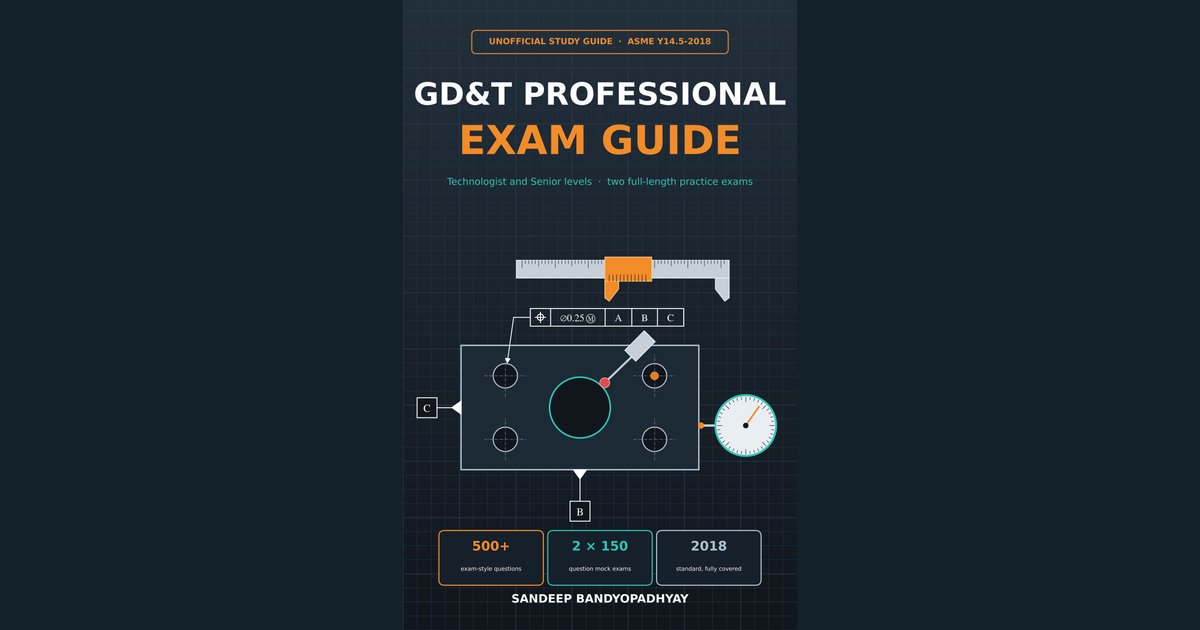
GD&T Professional Exam Guide: the ASME Y14.5-2018 GDTP book
A study guide for the ASME GDTP exam on Y14.5-2018: 21 chapters, an original drawing per rule and two 150-question practice exams. On Amazon worldwide.

API 510, 570 or 653: which should you take first?
Three API inspection certifications, one exam format, three completely different reference lists. How to choose, and why the overlap is smaller than it looks.

The API open-book session: what you can look up
Sixty questions, 3 h 45 min, references on screen only. What the open half of an API inspection exam actually asks, and why it is not the easy half.
Comments
Comments are read by a person before they appear. How we moderate.