LPIC-3 305-300: what the virtualisation exam expects
60 questions in 90 minutes, scaled 200-800 with a pass at 500, covering KVM, Xen, containers and provisioning. What to study and in what order.
In short
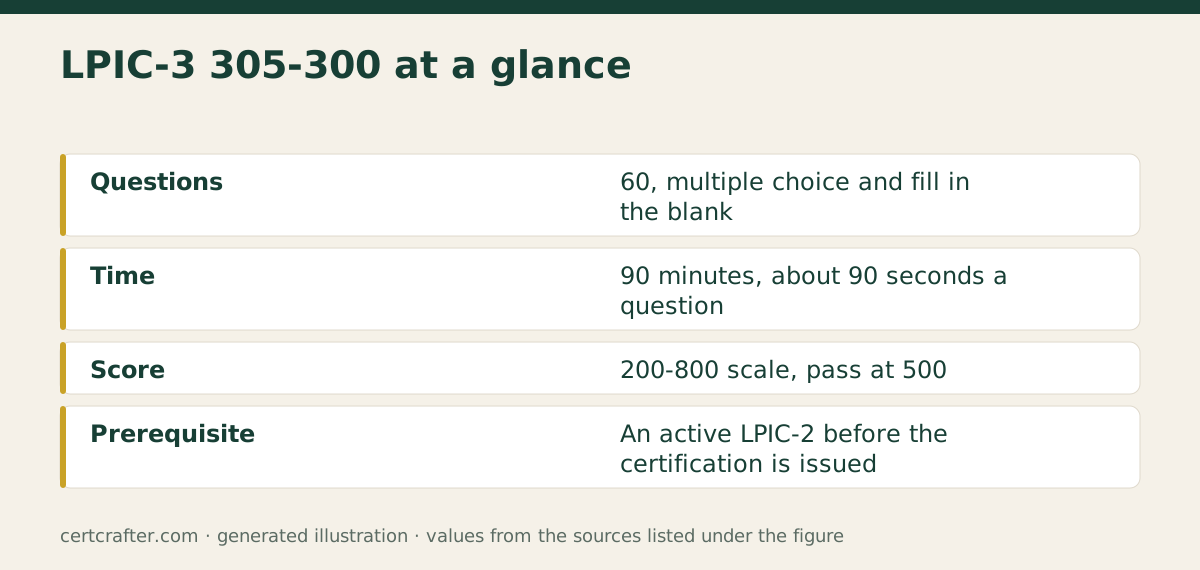
- Exam 305-300 is 60 questions in 90 minutes, scored on a 200-800 scale with a pass mark of 500.
- The paper mixes multiple choice with fill-in-the-blank items, so command syntax must be reproduced from memory, not merely recognised.
- The three topic areas are Full Virtualization, Container Virtualization, and VM Deployment and Provisioning.
- LPIC-3 is awarded only if you hold an active LPIC-2. The exam can be sat first, but the certification is not issued until LPIC-2 is current.
LPIC-3 305-300 is a short exam that punishes shallow preparation. Ninety minutes, sixty questions, and a meaningful proportion of them expecting you to type a command or option exactly rather than pick it from four choices.
How is the exam structured?
| Property | Value |
|---|---|
| Questions | 60 |
| Time | 90 minutes |
| Scoring | Scaled 200-800 |
| Pass mark | 500 |
| Format | Multiple choice and fill-in-the-blank |
| Validity | 5 years |
Ninety seconds per question is the headline number, but it is misleading as an average. Multiple-choice items on concepts go quickly. Fill-in-the-blank items asking for a specific virsh subcommand or a libvirt XML element do not.
Budget your time on the assumption that a third of the paper will take twice as long as the average.
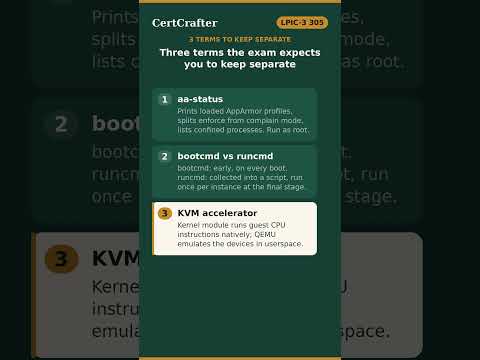 LPIC-3 305 — Three virtualization terms the exam expects you to keep separate. Watch on YouTube · CertCrafter
 The fill-in-the-blank problem
This is the single biggest difference between LPIC exams and most vendor certifications, and it changes how you must study.
Recognition is not enough. If you have only ever read about virsh you will recognise virsh list --all when you see it. Under exam conditions, asked to type the command that lists all domains including inactive ones, recognition does nothing for you.
The countermeasure is simple and unpopular: use the tools. Build a small lab, a spare machine, a nested virtualisation setup, or even a modest cloud instance, and actually run the commands. Muscle memory formed by typing a command twenty times is what fill-in-the-blank items are testing.
Reading a book about virtualisation will not pass this exam.
What is in scope?
Three topic areas:
Full Virtualization
The largest area. Xen and KVM as hypervisors, QEMU, and libvirt as the management layer above them. Expect questions on:
- Hypervisor architecture and the difference between type 1 and type 2
- KVM setup and the role of QEMU
virshoperation: domains, networks, storage poolslibvirtXML domain definitions and what the elements mean- Virtual networking modes: bridged, NAT, isolated
- Storage backends and disk image formats
Container Virtualization
Concepts first, then implementations. The underlying kernel mechanisms, namespaces and cgroups, are examinable in their own right, not merely as background.
- Namespaces, cgroups and what each one isolates
- LXC and LXD operation
- Docker: images, containers, volumes, networks, registries
- Container security boundaries and their limits
A common failure is arriving with practical Docker experience but no grounding in the kernel primitives beneath it. The exam asks about both.
VM Deployment and Provisioning
The smallest area, and the one candidates most often under-prepare.
cloud-initand its configuration- Vagrant workflow and Vagrantfiles
- Packer for image building
- General provisioning patterns
If you have never used cloud-init directly, spend a weekend on it. It appears more often than its share of the objectives suggests.
The LPIC-2 prerequisite
This catches people out, so it is worth stating plainly.
You may sit 305-300 whenever you like. LPIC-3 is only awarded while you hold an active LPIC-2. If your LPIC-2 lapsed three years ago, passing 305-300 will not produce a certification until you renew it.
Check the status of your LPIC-2 before booking, not after passing.
A four-week plan for an experienced Linux admin
Assuming you already administer Linux systems day to day:
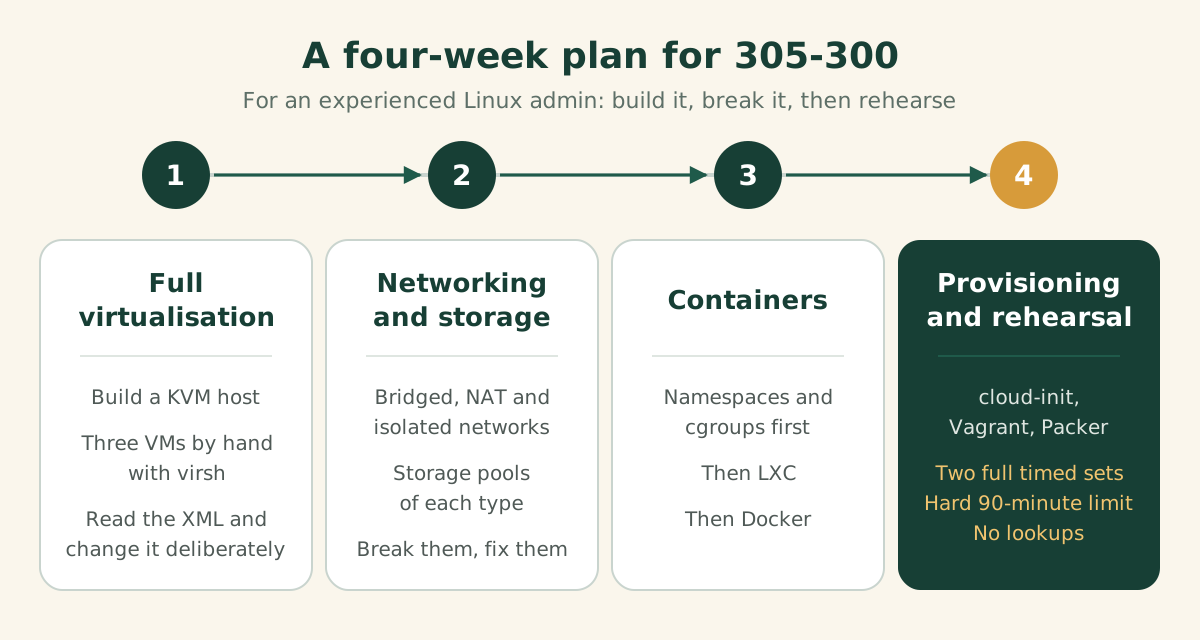
Week 1. Full virtualisation. Build a KVM host. Create three VMs by hand with virsh, not a GUI. Read the generated XML and change things in it deliberately.
Week 2. Networking and storage. Configure bridged, NAT and isolated networks. Create storage pools of each type. Break them and fix them.
Week 3. Containers. Start with namespaces and cgroups directly , unshare, nsenter, the cgroup filesystem, before touching Docker. Then LXC, then Docker. The order matters; it makes Docker’s behaviour obvious rather than magical.
Week 4. Provisioning and rehearsal. cloud-init, Vagrant, Packer. Then two full timed practice sets, with a hard 90-minute limit and no lookups.
Sitting the paper
Three tactics that consistently help:
- Answer the multiple-choice items first. They are faster, and banking them protects against running out of time on syntax questions.
- Type exactly what is asked. If the question says “the command including options”, a bare command name may be marked wrong. Read the instruction, not just the question.
- Leave nothing blank. There is no negative marking, so an educated guess strictly dominates an empty field.
The exam is fair and well constructed. It simply expects you to have used the technology rather than read about it, and it has an unusually direct way of finding out which one you did.
Frequently asked questions
How long is the LPIC-3 305-300 exam?
90 minutes for 60 questions, which is an average of 90 seconds each. The fill-in-the-blank items take longer than the multiple-choice ones, so pace accordingly.
What is the pass mark for LPIC-3 305-300?
500 on a scale of 200 to 800. Because it is scaled, the number of correct answers required varies slightly between exam forms and is not published.
Do I need LPIC-2 before taking 305-300?
You can sit the exam at any time, but LPIC-3 certification is only awarded while you hold an active LPIC-2. If your LPIC-2 has expired, the 305-300 pass will not convert into a certification until you renew it.
How long is LPIC-3 valid?
Five years. After that you either retake the current exam or achieve a higher-level certification to reset the clock.
Does the exam cover Docker and Kubernetes?
The container topic covers container concepts, LXC and Docker. Kubernetes is not a primary focus of 305-300, the emphasis is on the underlying container and virtualisation mechanisms rather than orchestration platforms.
References
- LPIC-3 Virtualization and Containerization exam 305 objectives — Linux Professional Institute
- LPIC-3 Virtualization and Containerization overview — Linux Professional Institute
CertCrafter is independent and is not affiliated with or endorsed by the certification bodies named above.
- #LPIC-3
- #Linux
- #virtualisation
- #containers
- #exam structure
Practise what this article covers
Get new articles by email
New exam guides, changes to exam dates and fees, and new practice-test certifications. One short email a day at most, only when there is something new.
Was this helpful?
Related articles
AI-200 Replaces AZ-204: What Changed in 2026
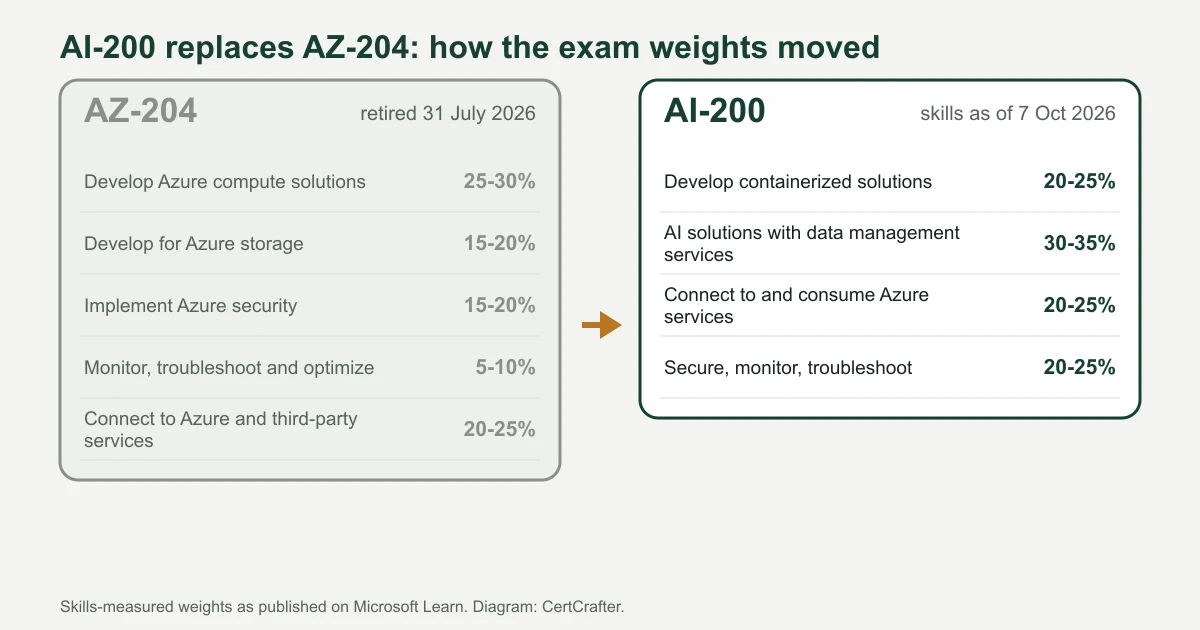
AZ-204 retired in July 2026 and AI-200 now tests Azure back ends for AI apps. Compare the domains, what was dropped, and get a 6-week plan to prepare well.

The API 510 exam structure, explained properly
170 questions, two sessions, a scaled pass mark and a reference set that changes. What the API 510 exam actually asks of you.
What blueprint-aligned practice tests actually mean
Most practice tests are written to a topic list, not an exam blueprint. Here is the difference, and how to tell which one you bought.
Comments
Comments are read by a person before they appear. How we moderate.